Anatomical Terminology: Standard Directions, Planes, and Axes
In the fields of medicine and biology, precision is paramount. To describe the location of organs, tissues, and structures without ambiguity, professionals use standard anatomical terms of location. These terms, primarily derived from Latin and Greek roots, provide a universal language that ensures a clinician in one part of the world understands exactly what another means when describing a patient's anatomy.
These descriptors are based on the standard anatomical position, a consistent reference point that defines what is at the front, back, top, and bottom of the body. By establishing this baseline, anatomists can use specific planes and axes to map the body in three-dimensional space.
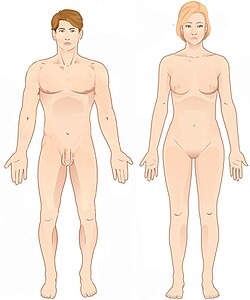
Key Facts
- Standard Anatomical Position: The universal reference point used to define directional terms.
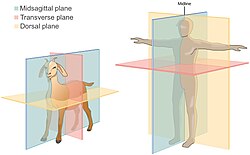
- Anatomical Planes: Imaginary flat surfaces (frontal, sagittal, transverse) used to section the body.
- Neuraxis Influence: Directional terms may change depending on whether an animal is a biped (like humans) or a quadruped (like dogs).
- Non-Bilaterians: Organisms without a symmetrical left/right side use terms like proximal and distal relative to their center.
- Combined Terms: Prefixes (e.g., sub-, inter-) and suffixes (e.g., -al) are used to refine specific locations.
The Framework: Planes and Axes
To navigate the body, anatomists use three primary planes—imaginary slices that divide the organism into sections.
Anatomical Planes
These planes allow for the precise description of motion and location. While the source mentions three main orientations, they generally divide the body into front/back, left/right, and top/bottom sections.
Anatomical Axes
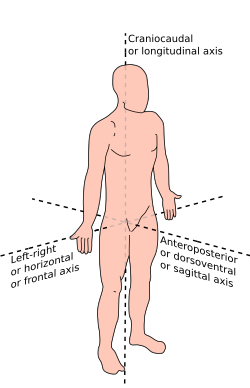
Axes are the imaginary lines around which the body rotates or along which it is measured:
- Left-Right Axis: Also known as the horizontal or frontal axis.
- Craniocaudal Axis: Also referred to as the rostrocaudal, longitudinal, or cephalocaudal axis.
- Anteroposterior Axis: Also known as the dorsoventral or sagittal axis.
It is important to note that organisms with spherical or asymmetrical body plans may utilize different axes entirely.
Core Directional Terms
Directional terms are used in pairs to describe the relationship between two structures.
Vertical Orientation: Superior and Inferior
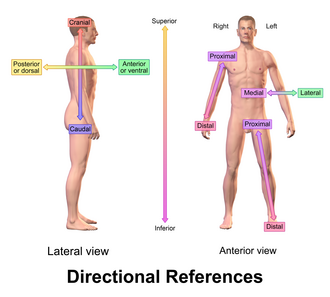
In human anatomy, superior (or cranial) describes a structure nearer to the head, while inferior (or caudal) describes something nearer to the feet. For example, the superior mediastinum is located above the inferior mediastinum. In veterinary anatomy, these terms are generally reserved for the eyes, lips, and inner ear; instead, dorsal and ventral are used for the rest of the body.
Front and Back: Anterior, Posterior, Dorsal, and Ventral
Anterior refers to the front, and posterior refers to the back. In veterinary medicine, embryology, and neuroanatomy, ventral (from the Latin venter for belly) refers to the front or lower side, while dorsal refers to the back.
Midline Relationships: Medial and Lateral
Medial describes a position closer to the body's midline, whereas lateral describes a position further away from the midline. Related terms include:
- Contralateral: On the opposite side of the body (e.g., the left brain controls the contralateral right arm).
- Unilateral: Affecting only one side of the body.
- Varus and Valgus: Terms describing the bowing of a joint; varus deviates toward the midline, while valgus deviates away from it.
Proximity to the Center: Proximal and Distal
Proximal describes a part closer to the main mass of the body (the chest or heart), while distal describes a part further away. For instance, the upper arm is proximal to the hand.
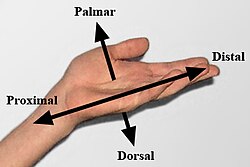
Specialized and Combined Terminology
Neuroanatomy and Head Terms
Specific terms are used for the head and nervous system. Cranial or cephalic refers to the head, while caudal refers to the tail end. In the human skull, because of the curved neuraxis (the axis of the nervous system), the term rostrocaudal is used to describe the C-shaped region connecting the rostral (beak-like/front) and caudal regions.
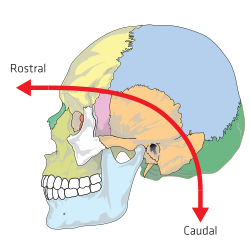
Depth and Centrality
- Central vs. Peripheral: Central refers to the core (e.g., central nervous system), while peripheral refers to the surface or outer regions.
- Superficial vs. Deep: These describe how close a structure is to the skin's surface.
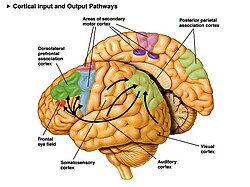
Modifiers and Prefixes
Anatomical terms are often modified to provide more detail:
- Sub-: Beneath (e.g., subcutaneous: beneath the skin).
- Infra-: Below (e.g., infraorbital: below the orbit).
- Inter-: Between (e.g., intercostal: between the ribs).
- Supra-: Above (e.g., supraorbital: above the eyes).
- Ab-: Away from (e.g., abduction).
- Ad-: Toward (e.g., adduction).
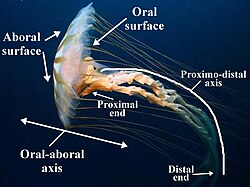
Comparative Anatomy: Other Organisms
Anatomical language adapts based on the organism's body plan. For non-bilaterian organisms (those without a symmetrical left/right side), terms like anterior and posterior are not applicable. Instead, they may use oral (near the mouth) and aboral (away from the mouth).

Organisms with elongated shapes, such as diatoms or paramecia, focus on the long axis, while radially symmetrical organisms, like jellyfish or sea stars, utilize radial and medio-peripheral axes.
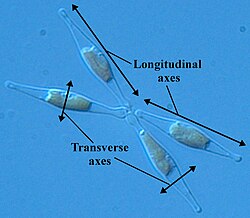


Because of these structural differences, the terms used for a human may differ significantly from those used for a dog, horse, or invertebrate.
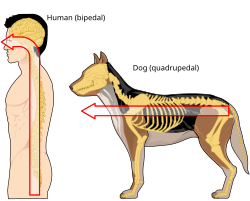
Summary of Anatomical Terms
| Term | Meaning | Opposite Term | Example |
|---|---|---|---|
| Superior (Cranial) | Toward the head | Inferior (Caudal) | Superior colliculus |
| Anterior (Ventral) | Toward the front | Posterior (Dorsal) | Ventral surface of the tongue |
| Medial | Toward the midline | Lateral | Medial malleolus |
| Proximal | Nearer to the body center | Distal | Upper arm (relative to hand) |
| Superficial | Near the surface | Deep | Peripheral nerve |
Frequently Asked Questions
What is the difference between anterior and ventral?
In human anatomy, anterior and ventral both generally refer to the front of the body. However, ventral is more commonly used in embryology, neuroanatomy, and veterinary medicine to describe the belly side of an organism.
How do proximal and distal differ from superior and inferior?
Superior and inferior describe a general vertical position (up or down) relative to the head and feet. Proximal and distal describe the distance of a structure from the main mass of the body or a point of attachment, typically used for limbs.
What does the term 'contralateral' mean?
Contralateral refers to a structure located on the opposite side of the body from another structure. A primary example is the brain, where the left hemisphere controls the contralateral right side of the body.
How is anatomical terminology different for invertebrates?
Invertebrates that lack bilateral symmetry (non-bilaterians) cannot use terms like left, right, anterior, or posterior. Instead, they use terms like oral (near the mouth), aboral (away from the mouth), or proximal and distal relative to their center.
What are 'varus' and 'valgus' in medical terms?
These terms describe the angulation of a bone or joint. Varus refers to a distal portion that deviates toward the midline (bow-legged), while valgus refers to a distal portion that deviates away from the midline (knock-kneed).