Anaconda: The Giant Semiaquatic Boas of South America
Anacondas, also known as water boas, are a group of large, semiaquatic snakes belonging to the genus Eunectes. Found throughout the tropical regions of South America, these formidable reptiles are best known for their immense size and adaptation to aquatic environments. While the term is often used generally, it specifically refers to a small group of species, including the world-renowned green anaconda.
The name Eunectes is derived from the Ancient Greek word eunēktēs, meaning "good swimmer." Interestingly, the common name "anaconda" does not originate from South America. It was derived from a snake in Ceylon (modern-day Sri Lanka) described by John Ray in 1693. Over time, the name was misapplied to South American boas, partly due to 18th-century fiction. In Brazil, these snakes are more commonly referred to as sucuri, sucuriju, or sucuriuba.
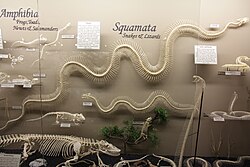
Key Facts
- Largest by Weight: The green anaconda (E. murinus) is the heaviest snake in the world.
- Habitat: Tropical South America, ranging from Ecuador and Venezuela to northern Argentina.
- Diet: Carnivorous, preying on fish, capybaras, caiman, and various birds.
- Reproduction: Known for "breeding balls" where multiple males compete for one female.
- Extreme Dimorphism: Females are significantly larger than males to increase offspring viability.
Species and Classification
The taxonomy of anacondas has been a subject of scientific debate. While historically several species were recognized, recent phylogenetic analyses by researchers like Dr. Jesús A. Rivas have suggested a revision, merging some species and identifying new ones, such as Eunectes akayima. However, some scientists continue to question these new classifications.
Current and Extinct Species
The genus includes the well-known green and yellow anacondas, as well as extinct ancestors from the Miocene epoch, such as E. stirtoni found in Colombia.
| Scientific Name | Common Name | Geographic Range |
|---|---|---|
| E. murinus | Green Anaconda | Peru, Bolivia, French Guiana, Suriname, Brazil |
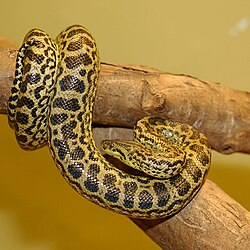
| E. notaeus | Yellow Anaconda | Eastern Bolivia, Central-Western Brazil, Paraguay, NE Argentina |
| E. beniensis | Bolivian Anaconda | Beni and Pando Departments, Bolivia |
| E. deschauenseei | Dark-spotted Anaconda | Northern Brazil and coastal French Guiana |
| E. stirtoni (Extinct) | N/A | Colombia (Miocene fossils) |
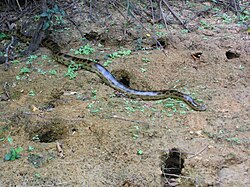
Biology and Behavior
Anacondas are apex predators in their ecosystems. Their diet is diverse, consisting of fish, turtles, deer, and wading birds. They are particularly adapted for hunting in water, where their weight is supported, allowing them to ambush larger prey like caiman and capybaras.
Sexual Dimorphism and Mating
One of the most striking features of the genus is sexual size dimorphism—the physical difference between males and females. In green anacondas, females average roughly 32 kg (70 lb), while males average only about 7 kg (15 lb). This disparity benefits the female by allowing for higher fecundity (the ability to produce more offspring) and larger young.
For males, there is an evolutionary "optimum size." While larger males are better at sperm competition and endurance, if they become too large, they may be mistaken for females by other males, interfering with their ability to mate.
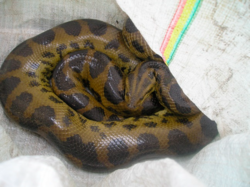
Breeding Balls and Cannibalism
During the mating season, typically the dry season, females release pheromones to attract males. This leads to the formation of breeding balls, where up to 13 males coil around a single female. The males use pelvic spurs to encourage the female to mate, and success depends on persistence and endurance rather than physical combat.
In some cases, sexual cannibalism occurs, specifically confirmed in E. murinus. Females may consume their mates after copulation, providing a high-protein meal that offers additional resources for the developing offspring.
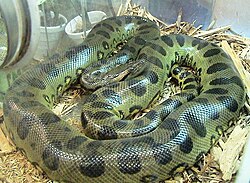
Asexual Reproduction
While rare, the green anaconda is capable of facultative parthenogenesis—a form of asexual reproduction where an embryo develops without fertilization. This has been observed in females living in isolation for over eight years, resulting in offspring genetically identical to the mother.
Relationship with Humans
Anacondas are frequently depicted as monsters in pulp magazines, movies, and comics, often portrayed as giants that hunt humans. In reality, while encounters can be dangerous, they do not regularly hunt people. Much of the scientific understanding of wild anacondas comes from the research of Dr. Jesús A. Rivas in the Venezuelan Llanos.
Frequently Asked Questions
Which is the largest snake in the world?
The green anaconda (Eunectes murinus) is the largest snake in the world by weight, although the reticulated python is longer.
Why are female anacondas so much larger than males?
Larger females can produce more and larger offspring, which increases their reproductive success. Males remain smaller to avoid being mistaken for females by other competing males during breeding.
What is a "breeding ball"?
A breeding ball is a mating behavior where multiple males coil around a single female, competing through endurance and positioning to successfully mate.
Do anacondas eat humans?
No, anacondas do not regularly hunt humans, despite their frequent portrayal as human-eating monsters in popular fiction and movies.
Can anacondas reproduce without a mate?
Yes, the green anaconda has been observed undergoing facultative parthenogenesis, allowing females in isolation to produce genetically identical offspring.