Amsterdam Airport Schiphol
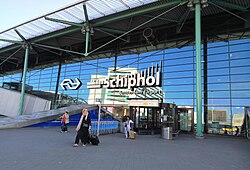
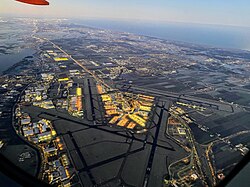
Amsterdam Airport Schiphol (IATA: AMS, ICAO: EHAM) is one of the world's most prominent public airports, serving as the primary gateway to the Greater Amsterdam region and the Netherlands. Operated by the Royal Schiphol Group, it is a critical piece of global infrastructure located in Haarlemmermeer. Since its opening on September 16, 1916, Schiphol has evolved from a modest airfield into a massive aviation complex spanning 2,787 hectares.
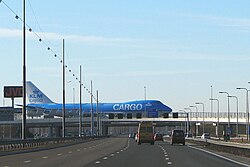
The airport is most notably the primary hub for KLM, including KLM Cargo and KLM Cityhopper, as well as Martinair. It also serves as an operating base for several other airlines, including Corendon Dutch Airlines, easyJet, Transavia, TUI fly Netherlands, and Vueling.
Key Facts
- Elevation: Situated at -11 ft (-3.4 m) below average mean sea level (AMSL).
- Passenger Volume: Handled 68,767,548 passengers in 2025.
- Economic Impact: Valued at $27.3 billion as of 2016.
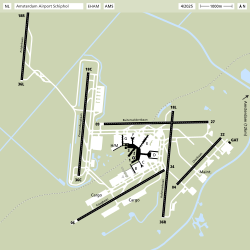
- Runway Capacity: Features six asphalt runways to manage high traffic volumes.
- Cargo Power: Processed 1,428,860 tonnes of freight in 2025.
Infrastructure and Facilities
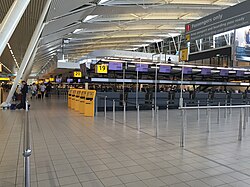
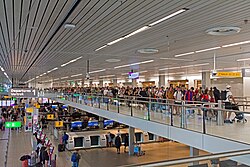
Schiphol is designed for high-capacity throughput, utilizing a sophisticated terminal system. The airport features multiple departure halls (1, 2, and 3) and specialized facilities to accommodate the Airbus A380, one of the world's largest passenger aircraft. For non-commercial flights, a dedicated General Aviation Terminal is available.
Runway System
The airport's operational efficiency is driven by its six asphalt runways, each serving specific traffic needs. The longest is the Polderbaan, stretching 3,800 meters.
| Runway Name | Direction/Code | Length (m) | Width (m) | Surface |
|---|---|---|---|---|
| Polderbaan | 18R/36L | 3,800 | 60 | Asphalt |
| Kaagbaan | 06/24 | 3,500 | 45 | Asphalt |
| Buitenveldertbaan | 09/27 | 3,453 | 45 | Asphalt |
| Aalsmeerbaan | 18L/36R | 3,400 | 45 | Asphalt |
| Zwanenburgbaan | 18C/36C | 3,300 | 45 | Asphalt |
| Oostbaan | 04/22 | 2,014 | 45 | Asphalt |
Ground Transportation
Schiphol is a multimodal hub, offering seamless integration between air and ground travel. Passengers can access the city and beyond via an extensive train and bus network. Notably, KLM operates specialized bus services connecting the airport to Maastricht railway station via Eindhoven and Maastricht airports.

Historical Evolution
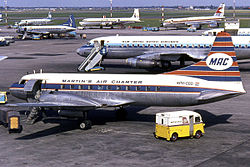
The airport's history is marked by steady growth and adaptation. In its early years, the site was used for basic aviation needs, including the use of vehicles to power winches for towing gliders in the 1930s.

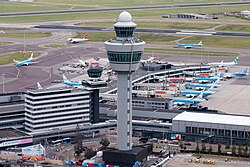
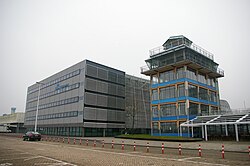
By the mid-20th century, the airport had established a formal control tower and expanded its apron to accommodate the jet age. The 1990s saw significant infrastructure developments, including the construction of a railway station and tunnel to improve accessibility.

Despite its success, the airport has faced challenges, including aviation accidents such as the crash of El Al Flight 1862 in 1992 and Turkish Airlines Flight 1951 in 2009.

Global Connectivity and Statistics

Schiphol connects the Netherlands to hundreds of destinations worldwide. Its top passenger routes in 2025 included Barcelona, London-Heathrow, and Dublin. In terms of cargo, Shanghai-Pudong and Doha were among the top freight partners.
Passenger traffic has shown resilience over the decades. While 2020 saw a sharp decline to approximately 20.8 million passengers due to global travel restrictions, the airport recovered significantly, reaching over 68 million passengers by 2025.
Frequently Asked Questions

Who owns and operates Amsterdam Airport Schiphol?
The airport is owned and operated by the Royal Schiphol Group.
Which airlines use Schiphol as their primary hub?
KLM, KLM Cargo, KLM Cityhopper, and Martinair use Schiphol as their hub.
What is the longest runway at Schiphol?
The longest runway is the Polderbaan (18R/36L), which measures 3,800 meters (12,467 ft) in length.
How can passengers access the airport via public transit?
The airport is accessible via a comprehensive network of trains and buses, including specialized KLM bus services to Maastricht.
What was the passenger traffic in 2025?
In 2025, Amsterdam Airport Schiphol handled 68,767,548 passengers.