Altaic Languages: The History and Controversy of a Proposed Language Family
For centuries, linguists have debated whether a vast group of languages across Northern, Eastern, and Central Asia share a single common ancestor. This proposed group, known as the Altaic language family, has been a centerpiece of linguistic discussion since the 18th century. While once widely accepted, the theory has faced intense scrutiny, leading to a fundamental shift in how scholars view the relationship between these diverse tongues.
The term "Altaic" refers to a collection of languages that some researchers believe descend from a single proto-language (a reconstructed ancestral language). However, modern consensus has largely moved away from the idea of a shared genetic origin, favoring instead the concept of a sprachbund—a linguistic area where languages become similar due to prolonged contact and borrowing rather than common descent.

Key Facts
- Proposed Subdivisions: Turkic, Mongolic, and Tungusic.
- Extended Groups: Some theories include Koreanic and Japonic languages.
- Current Scientific Status: Most comparative linguists reject the genetic family hypothesis in favor of the sprachbund (language contact) model.
- Geographic Reach: Northern, Eastern, and Central Asia, as well as parts of Eastern and Southeastern Europe and the Caucasus.
- Core Controversy: Whether similarities are due to shared ancestry (genetic) or long-term interaction (convergence).
The Structure of the Altaic Hypothesis
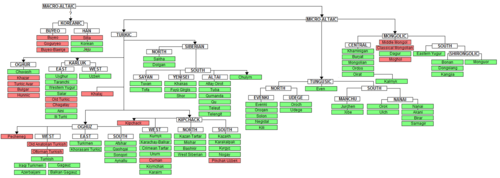
The traditional Altaic hypothesis focuses on three primary branches, often referred to as "Micro-Altaic":
- Turkic languages
- Mongolic languages
- Tungusic languages
In some broader versions of the theory, scholars have attempted to include Koreanic and Japonic languages. However, recent research, such as that by Juha Janhunen in 2023, suggests that Japonic and Koreanic are entirely unrelated to the core Turkic-Mongolic-Tungusic group.
The Transeurasian Alternative
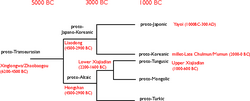
To resolve the polarization between supporters and critics, some researchers, such as Martine Robbeets, have proposed the term Transeurasian. This terminology aims to avoid the confusion surrounding the "Altaic" label and provides a new framework for studying the potential connections between these language groups.
Arguments for and Against the Altaic Connection
The debate between "Pro-Altaists" and "Anti-Altaists" centers on how to interpret shared linguistic features. Supporters point to shared lexicon (vocabulary) and grammatical structures as evidence of a common past.
In 1991, researcher Sergei Starostin claimed that members of the group shared approximately 15–20% of apparent cognates (words with a common etymological origin) within a specific word list. These included basic terms for body parts like "eye" and "ear," as well as natural elements like "water" and "sun." Supporters have even suggested the Proto-Altaic language could date back to 5000 or 6000 BC.
Conversely, critics like Gerard Clauson and Gerhard Doerfer argued that these similarities are not evidence of ancestry. They contended that the shared features—such as agglutinative morphology (the use of suffixes to build words) and SOV (subject–object–verb) word order—are common typological traits that can appear in unrelated languages. Most importantly, critics argue that the shared vocabulary consists of borrowings resulting from centuries of intense contact between neighboring peoples.
![This map shows the most likely location of the Urheimats of the proposed Altaic languages.[a]](/images/ac/e0/ace0217d6d2c5aa672cd2c14d5a3bb5d06102c9444caf124af0c761ccd793ff6.jpg)
The Sprachbund Hypothesis and Origins
The prevailing modern view is that the similarities between Turkic, Mongolic, and Tungusic languages are the result of convergence. This means that instead of diverging from a single source, these languages have moved closer together over time due to social and cultural interaction.
Some researchers have even attempted to link linguistic patterns to genetic history. For example, the dispersal of ancient Altaic communities might be reflected in the early Holocene dissemination of the haplogroup C2 (M217) paternal lineage. While this provides an interesting correlation, it remains a subject of ongoing study.
![Hypothesized homeland according to Blench (2009)[75]](/images/2c/ab/2cabc02dd6a289263377b81d28d1cc36480d7722c168af5ae4cdc8e78a51a607.webp)
Summary of Linguistic Classifications
| Classification Type | Included Language Groups | Scientific Standing |
|---|---|---|
| Micro-Altaic | Turkic, Mongolic, Tungusic | Widely viewed as a sprachbund (contact zone) |
| Macro-Altaic / Transeurasian | Turkic, Mongolic, Tungusic, Koreanic, Japonic | Highly controversial; many reject the connection |
| Japano-Koreanic | Japonic, Koreanic | Studied as a separate potential grouping |
Frequently Asked Questions
What is a sprachbund?
A sprachbund is a group of languages that have become similar to one another because of long-term geographical proximity and contact, rather than because they descend from a common ancestor.
Why do many linguists reject the Altaic theory?
Most modern linguists reject the theory because they believe the shared words and grammatical structures are the result of borrowing between neighboring cultures rather than a shared genetic origin. They have found that hypothesized sound shifts required for a genetic connection are often missing.
Are Japanese and Korean considered Altaic languages?
While some older theories included them, many modern linguists, including Juha Janhunen, argue that Japonic and Koreanic are unrelated to the core Turkic, Mongolic, and Tungusic groups.
What are the main characteristics of Altaic-type languages?
Languages often associated with this group frequently feature agglutinative morphology (adding suffixes to a root) and follow a subject–object–verb (SOV) word order.
What is the difference between "Altaic" and "Transeurasian"?
"Transeurasian" is a newer term proposed by researchers like Martine Robbeets to avoid the historical baggage and polarization associated with the term "Altaic," while attempting to describe a broader linguistic connection.