Alexander Russell: The Scottish Physician and Naturalist of Aleppo
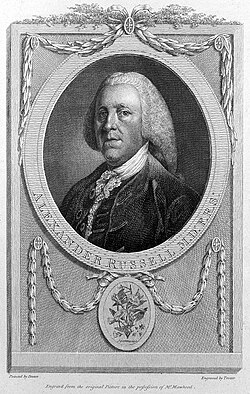
Alexander Russell (c. 1715 – 25 November 1768) was a distinguished Scottish physician and naturalist whose career spanned the intellectual hubs of Edinburgh, London, and the Levant. Best known for his extensive documentation of the Middle East, Russell combined medical practice with a keen interest in the natural world, leaving behind a legacy of scientific observation and clinical reporting.
Early Life and Education
Born in Edinburgh around 1715, Alexander Russell was the son of John Russell, a lawyer, and the half-brother of Patrick Russell. He pursued his higher education at the University of Edinburgh, where he earned his MD (Doctor of Medicine). Following his graduation, he moved to London around 1734 to begin his professional journey.
Medical Practice in Aleppo
In 1740, Russell's career took a significant turn when he was appointed as the physician to the English factory—a trading post and residential community of English merchants—in Aleppo. During his 14-year tenure in the city, he rose to become the chief medical practitioner, a position he secured by gaining the trust and confidence of the local pasha.
His time in Aleppo was not spent solely on clinical practice; he meticulously recorded the environment and health crises of the region. Most notably, he kept a detailed diary documenting the progress of the plague between 1742 and 1744.
Return to England and Professional Recognition
Russell returned to England in 1754. Two years later, in 1756, he published his seminal work, The Natural History of Aleppo, which integrated his medical observations with natural history. This contribution to science led to his election as a Fellow of the Royal Society in the same year.
In 1759, Russell was elected to a vacancy at St Thomas' Hospital in London. He dedicated the remainder of his life to this role, serving the hospital until his death on November 25, 1768.
Key Facts
- Nationality: Scottish.
- Primary Education: University of Edinburgh (MD).
- Major Work: The Natural History of Aleppo (1756).
- Key Appointment: Physician to the English factory in Aleppo (1740–1754).
- Professional Honor: Elected Fellow of the Royal Society in 1756.
- Final Post: Physician at St Thomas' Hospital, London.
Scientific Contributions and Publications
Russell was a prolific writer whose work ranged from comprehensive regional histories to specific clinical case studies. His publications covered a diverse array of medical and biological topics, including the study of Vorticella Ovifera (a type of ciliated protozoan) and the properties of the Scammony plant.
| Work Title | Year | Focus/Subject |
|---|---|---|
| The Natural History of Aleppo | 1756 | Regional history, nature, and plague records |
| Of a remarkable Marine Production | 1762 | Marine biology (Vorticella Ovifera) |
| Letter describing the Scammony Plant | 1755 | Botany |
| Cases of Lues Venerea cured by Corrosive Sublimate | Various | Clinical treatment of syphilis |
| Case of almost universal Emphysema | Various | Pulmonary pathology |
Clinical Research
Beyond his books, Russell contributed numerous papers to medical journals. His research included accounts of paralytic cases, the discharge of hydatids (fluid-filled cysts) with urine, and experiments using the decoction of Mezereon to treat venereal nodes.
Frequently Asked Questions
What was Alexander Russell's most famous publication?
His most famous work is The Natural History of Aleppo, published in 1756. It is highly valued for its historical and scientific detail and was later revised and enlarged by his brother, Patrick Russell, in 1794.
Where did Alexander Russell practice medicine?
Russell practiced in Aleppo, where he served the English factory and the local pasha, and later in London at St Thomas' Hospital.
What role did he play during the plague in Aleppo?
While serving as a physician in Aleppo, he maintained a detailed diary recording the progress and impact of the plague from 1742 to 1744.
When was Alexander Russell elected to the Royal Society?
He was elected as a Fellow of the Royal Society in 1756, the same year he published his work on Aleppo.
What medical conditions did Russell research in his later papers?
Russell wrote on a variety of conditions, including emphysema, paralytic cases, syphilis (Lues Venerea), and the presence of hydatids in urine.