Aleppo Room: A Masterpiece of Syrian Ottoman Art and Intercultural Harmony
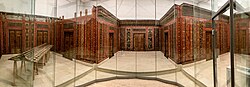
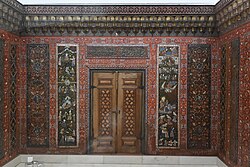
The Aleppo Room is a breathtaking example of 17th-century Syrian craftsmanship, consisting of the ornate wooden wall paneling from a reception room, or qa’a, in a residential building in Aleppo, Syria. Today, these panels are housed in the Museum of Islamic Art within the Pergamon Museum on Berlin's Museum Island, serving as a profound testament to the multicultural fabric of the Ottoman Empire.
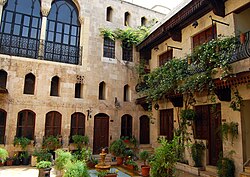
Originally part of the Beit Wakil (Wakil House) located in the historic Al-Jdayde quarter, the room was designed for a wealthy Christian broker, Isa ibn Butrus. In an era of diverse coexistence, this room served as a space where visitors of various ethnic and religious backgrounds were welcomed, a spirit reflected in the room's unique blend of artistic traditions.
Key Facts
- Artist: Halab Shah ibn Isa.
- Date: Created between 1600–1603 AD (Hegira 1009 or 1012).
- Origin: Beit Wakil, Al-Jdayde District, Aleppo, Syria.
- Current Location: Museum of Islamic Art, Pergamon Museum, Berlin.
- Dimensions: 11 meters long, 7.5 meters wide, and 2.95 meters high.
- Significance: The oldest surviving Syrian art of its category, merging Christian and Islamic iconography.
The Journey from Aleppo to Berlin
The panels transitioned from a private residence to a public museum in the early 20th century. In 1912, the Wakil family sold the paneling to Mrs. Mary Koch, who subsequently donated them to the Pergamon Museum. The museum acquired them for one thousand Ottoman liras.
The presentation of the room in Berlin has evolved over decades. Initially displayed partially at the Bode Museum (then the Kaiser Friedrich Museum) due to space constraints, the collection moved to the Pergamon Museum in 1932. By 1938, the panels were arranged in a rectangular form, though they were treated more as individual art objects than as an architectural interior.
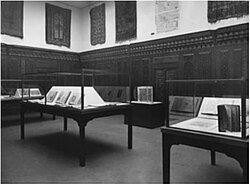
During World War II, the panels were dismantled and stored in boxes for protection. In recent years, the room has taken on a new symbolic meaning; the director of the Museum of Islamic Art, Stefan Weber, notes that it has become a symbolic home for Syrians in Germany, representing an environment where people of different faiths can find common ground.
Artistic Themes and Iconography
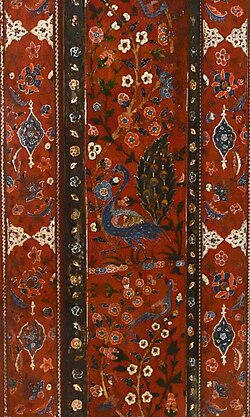
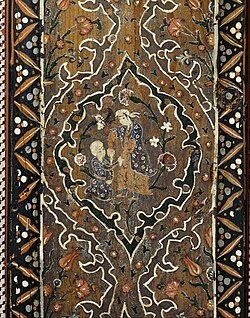
The Aleppo Room is renowned for its daring fusion of religious and courtly imagery. While Islamic decoration typically focuses on plant motifs, these panels include detailed depictions of people and animals.
Christian Symbolism
The right-side panels feature prominent biblical scenes, including the Last Supper—depicted with Jesus and his disciples sitting on the floor in an Oriental style—the sacrifice of Isaac, and Salome's dance before King Herod. Other figures include the Virgin Mary and Child, and Saint George slaying the dragon.
Courtly and Secular Themes
The left-side panels focus on courtly life, depicting a ruler on a throne and hunting parties featuring princes with falcons. The room also references literary classics, such as the love story of Leila and Majnun from Nizami's Haft Paykar. Inscriptions in Arabic, such as "Healing of the Heart" (shifa al-qalb), further enrich the narrative.
Construction and Technical Mastery
The room's construction demonstrates an exceptional level of carpentry and material knowledge. The T-shaped structure is composed of 10 cedar frames with 46 vertical and 10 horizontal in-fills.
Woodwork and Architecture
The frames use mitered mortise and tenon joints, while the doors—made of walnut with boxwood geometrical in-fills—utilize a plug system typical of Oriental woodwork. The upper section features a muqarnas cornice, a traditional architectural element characterized by stalactite-like honeycombing. Additionally, the room includes mashrabiyya (traditional carved wooden lattice screens).
Painting and Lacquer Techniques
The artists employed three distinct techniques to achieve the room's opulent finish:
- Lacquer Technique: Used on frames and panels with varying grounds to support colors like red, blue, and gold.
- Tempera and Pastiglia: The cornice and horizontal in-fills used a gypsum-based tempera. The al-‘adjami (pastiglia) technique involved using gypsum, white lead, and cinnabar to create raised letters, which were then gilded and varnished.
- Transparent Coatings: The doors were finished with shellac and oil-copal lacquer, with iron fittings decorated in tin leaf and gold lacquer to enhance the room's splendor.
Summary of the Aleppo Room
| Feature | Details |
|---|---|
| Material | Cedar (panels), Walnut and Boxwood (doors) |
| Key Techniques | Lacquer, Tempera, Pastiglia (al-‘adjami), Muqarnas carving |
| Primary Subjects | Biblical scenes, Ottoman court life, Persian literature |
| Dimensions | 11m (L) x 7.5m (W) x 2.95m (H) |
| Provenance | Beit Wakil, Aleppo → Pergamon Museum, Berlin |
Frequently Asked Questions
Who created the Aleppo Room?
The paneling was carved and painted by the artist Halab Shah ibn Isa around 1600–1603 AD.
Why is the iconography of the room unique?
It is unique because it deliberately merges Christian and Islamic iconography, featuring biblical figures who appear in both the Bible and the Quran, reflecting the multicultural identity of its owner, Isa ibn Butrus.
What is the 'al-‘adjami' technique mentioned in the construction?
Al-‘adjami is a pastiglia technique using a mixture of gypsum, white lead, and cinnabar in a proteinaceous binding medium to create raised decorative elements, which are then gilded.
Where can the Aleppo Room be seen today?
It is currently on display in the Museum of Islamic Art, which is part of the Pergamon Museum on Museum Island in Berlin, Germany.
What are mashrabiyya?
Mashrabiyya are traditional Arabic carved wooden lattice screens used for privacy and ventilation, several of which are part of the Aleppo Room's original components.