Aleppo Earthquake of 1138: One of History's Deadliest Seismic Events
On October 11, 1138, a catastrophic earthquake struck northern Syria, leaving a mark on history as one of the deadliest seismic events ever recorded. Centered near the city of Aleppo, the disaster caused widespread devastation across the region, claiming an estimated 230,000 lives. While modern historians suggest this death toll may be a conflation of several earthquakes occurring between 1137 and 1139, the scale of the destruction remains a testament to the volatile geology of the Near East.
Key Facts
- Date: October 11, 1138 (preceded by a foreshock on October 10).
- Estimated Magnitude: Estimates vary from Me 6.0 to Mw 7.2 or Me 7.5.
- Reported Casualties: 230,000 dead (though likely combined with other nearby events).
- Epicenter: 36°13′N 37°10′E.
- Primary Geological Cause: Movement along the Dead Sea Transform system.
Geological Setting of the Near East
The region surrounding Aleppo is situated atop a triple junction—a rare geological point where three tectonic plates meet: the Arabian, African, and Eurasian plates. This configuration makes the Near East one of the most tectonically active areas on Earth.
The Arabian plate is currently subducting (sliding beneath) the Eurasian plate, a process that created the Anatolian plateau and the Caucasus Mountains. To the west, the region is defined by transform boundaries—where plates slide horizontally past one another—most notably the Dead Sea Transform system. This fault system separates the Arabian plate from the African plate and has been responsible for numerous historic disasters, including the destruction of Jericho around 1500 BCE and the 1927 Jericho earthquake.
![[7] The Near East houses a triple junction between the Arabian, Eurasian, and African plates. This is responsible for most of the seismic, volcanic and orogenic activity in the region.](/images/83/e6/83e6fdfd5c42757aea4a0c6e7d6ca111db3b60a8a817c1c491ef5e77a33dd0ed.png)
The 1138 Seismic Sequence
The earthquake of 1138 was not an isolated event but the start of a violent seismic period. It triggered the first of two intense sequences: the first lasting from October 1138 to June 1139, and a second, more severe series from September 1156 to May 1159. The first sequence primarily impacted Aleppo and the western region of Edessa (modern-day Şanlıurfa, Turkey), while the second devastated northwestern Syria, northern Lebanon, and Antioch (modern Antakya, Turkey).
Magnitude and Rupture
Determining the exact magnitude of a medieval earthquake is challenging. Some researchers, such as Guidoboni and Comastri (2005), estimated a magnitude of Me 6.0, though others argue this is too low given the destruction. Italy's National Institute of Geophysics and Volcanology suggested a higher Me 7.5. More recent research by Carena et al. (2023) postulates a Mw 7.2 earthquake resulting from a 50 km rupture along the northern segment of the St. Simeon Fault.
Impact and Destruction
Contemporary accounts from the chronicler Ibn al-Qalanisi indicate that the main shock was preceded by a foreshock on October 10. While some residents of Aleppo fled to the countryside after the initial tremors, many stayed behind, leading to thousands of deaths when the main shock struck the following day.
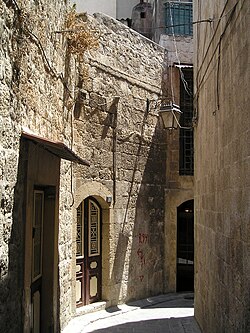
The destruction was comprehensive. In Aleppo, the walls of the citadel and the surrounding city walls collapsed, and numerous homes were leveled. The damage was so severe that cracks in the foundations allowed opposing military factions—Crusaders and Muslim forces—to breach the city's defenses. Beyond Aleppo, the town of Zardana was obliterated, and the fort of Athareb was destroyed, killing 600 guards.
The village of Azrab reportedly suffered the worst fate, where the ground split and swallowed the settlement, likely due to a massive earthquake-induced landslide. Some reports also suggest the event was accompanied by a tsunami.
Economic and Political Aftermath
The earthquake occurred during a period of intense conflict between the Crusader states, such as the Principality of Antioch, and the Muslim states of Aleppo and Mosul. The seismic disaster exacerbated the region's instability.
Economically, the disaster was crippling. Approximately 60% of Aleppo's urban fabric was destroyed. Due to a lack of revenue, reconstruction was minimal, and the city's administration struggled to attract residents back. More significantly, the disruption of land trade routes through Aleppo, combined with the sack of Constantinople during the Fourth Crusade, accelerated a global shift toward maritime trade. This shift contributed to the rise of Italian merchant city-states, including Venice, Genoa, and Pisa.
| Category | Details |
|---|---|
| Date | October 11, 1138 |
| Location | Northern Syria (Aleppo region) |
| Estimated Magnitude | 6.0 to 7.5 (Me/Mw) |
| Reported Deaths | 230,000 |
| Key Fault | St. Simeon Fault / Dead Sea Transform |
| Major Impact | Destruction of Aleppo's citadel and shift to maritime trade |
Frequently Asked Questions
Was the death toll of 230,000 accurate?
Modern historians believe this figure is likely an overestimation caused by the conflation of the 1138 event with other earthquakes that occurred in November 1137 (Jazira plain) and September 1139 (Ganja).
What caused the earthquake geologically?
The earthquake was caused by tectonic activity along the Dead Sea Transform system, a plate boundary where the Arabian plate slides past the African plate.
How did the earthquake affect global trade?
By disrupting key land trade routes between Africa, Asia, and Europe, the disaster helped precipitate a shift toward maritime trade, benefiting Italian city-states like Venice and Genoa.
Did the earthquake cause any landslides?
Yes, reports indicate that the village of Azrab was essentially swallowed by the ground, which is now interpreted as a result of a landslide triggered by the seismic shocks.
Were there other earthquakes around this time?
Yes, the 1138 event was part of two intense sequences. The first lasted until June 1139, and a second, more devastating series occurred between September 1156 and May 1159.