Albert Einstein Memorial: A Monument to Science and Space-Time
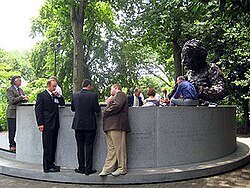
Located in the heart of Washington, D.C., the Albert Einstein Memorial stands as a profound tribute to one of the most influential physicists in history. Situated in a serene grove of elm and holly trees at the southwest corner of the National Academy of Sciences grounds, this monumental bronze sculpture captures the essence of a man who fundamentally altered our understanding of the universe.
Unveiled on April 22, 1979, to commemorate the centennial of Einstein's birth, the memorial was described by physicist John Archibald Wheeler as a tribute to the man who united space and time into space-time—the four-dimensional continuum combining three spatial dimensions and one time dimension. Today, it remains a popular destination for visitors exploring the National Mall.
Key Facts
- Sculptor: Robert Berks, based on a 1953 life bust of Einstein.
- Location: National Academy of Sciences, 2101 Constitution Avenue N.W., Washington, D.C.
- Materials: Bronze figure on a Mount Airy white granite bench.
- Dimensions: The statue is 12 feet (3.7 m) tall and weighs approximately 4 tons.
- Foundation: Supported by three caissons totaling 135 tons, sunk 23 to 25 feet into bedrock.
- Replicas: Located at the Georgia Institute of Technology and the Israel Academy of Sciences and Humanities.
Artistic Design and Construction
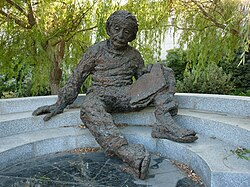
The memorial depicts Albert Einstein in a state of casual repose, seated on a three-step bench of white granite from Mount Airy, North Carolina. The bronze figure was cast at the Modern Art Foundry in Astoria, Queens, New York. The surrounding landscape was meticulously designed by landscape architect James A. Van Sweden to complement the sculpture's presence.
The sculptor, Robert Berks—renowned for his portraits of figures such as John F. Kennedy and Mary McLeod Bethune—drew inspiration from a bust he created of Einstein at his Princeton home in 1953. This personal connection ensures the statue captures a lifelike representation of the scientist.
The Celestial Platform
One of the most striking features of the memorial is the circular dais upon which the bench sits. Measuring 28 feet (8.5 m) in diameter and crafted from emerald-pearl granite from Larvik, Norway, the dais serves as a massive astronomical map.
Embedded in the granite are over 2,700 metal studs that mark the positions of celestial objects as they appeared at noon on the day of the memorial's dedication, April 22, 1979. These positions were accurately determined by astronomers at the U.S. Naval Observatory. The map includes:
- The sun, moon, and planets.
- 4 asteroids and 5 galaxies.
- 10 quasars (extremely remote celestial objects emitting massive amounts of energy).
- Numerous stars, with different stud sizes denoting apparent magnitude (the brightness of a star as seen from Earth).
- Special markers for binary stars, pulsars, and globular or open clusters.
The design creates a unique sensory experience: a visitor standing at the center of the dais will find that Einstein appears to make direct eye contact, and the acoustics of the area notably amplify spoken words.
Scientific and Philosophical Tributes
The memorial integrates Einstein's intellectual legacy directly into its physical form. In the statue's left hand, he holds manuscript papers engraved with three equations that summarize his most significant scientific breakthroughs.
Behind the statue, three quotations are inscribed along the back of the bench, chosen to highlight his commitment to scientific integrity, social justice, and a sense of wonder:
- "As long as I have any choice in the matter, I shall live only in a country where civil liberty, tolerance, and equality of all citizens before the law prevail."
- "Joy and amazement at the beauty and grandeur of this world of which man can just form a faint notion ..."
- "The right to search for truth implies also a duty; one must not conceal any part of what one has recognized to be true."
Summary of Memorial Specifications
| Feature | Specification |
|---|---|
| Statue Height | 12 feet (3.7 m) |
| Statue Weight | Approximately 4 tons |
| Dais Diameter | 28 feet (8.5 m) |
| Dais Material | Emerald-pearl granite (Norway) |
| Celestial Markers | 2,700+ metal studs |
| Foundation Depth | 23 to 25 feet (7.0 to 7.6 m) |
Cultural Impact and Curiosities
Beyond its scientific significance, the memorial has entered popular culture in unexpected ways. It appeared in the opening title sequence of the 20th season of Sesame Street. It has also been the subject of artistic interventions, such as in July 2012, when the artist Olek "yarn bombed" the sculpture, covering it in a colorful crocheted wrap of teal, purple, and pink.
In a more ephemeral tribute, a full-scale replica of the memorial made entirely of dark and white chocolate was once displayed at the Marriott Wardman Park Hotel in Washington, D.C.
Frequently Asked Questions
Where is the Albert Einstein Memorial located?
It is located in Washington, D.C., at the southwest corner of the National Academy of Sciences grounds at 2101 Constitution Avenue N.W., near the Vietnam Veterans Memorial.
What do the metal studs on the ground represent?
The studs represent the positions of the sun, moon, planets, stars, galaxies, and other astronomical objects as they appeared at noon on April 22, 1979.
Who designed the statue and the landscaping?
The bronze statue was created by sculptor Robert Berks, and the surrounding landscaping was designed by James A. Van Sweden.
Are there other versions of this statue?
Yes, there are two replicas: one at the Georgia Institute of Technology in Atlanta and another at the Israel Academy of Sciences and Humanities.
What is the significance of the equations in the statue's hand?
The equations engraved on the papers summarize three of Albert Einstein's most important scientific advances.