Aircraft Electronic Countermeasures: Technology and Evolution
Electronic Countermeasures (ECM)—the use of electromagnetic energy to deceive or neutralize enemy radar and communications—are utilized by nearly all modern military land, sea, and air units. However, aircraft serve as the primary instruments in the ECM battle. Due to their altitude and mobility, airborne platforms can monitor and influence a significantly larger area of terrain than ground-based or naval units.
When deployed effectively, ECM prevents aircraft from being tracked by search radars and protects them from being targeted by surface-to-air or air-to-air missiles. This invisible shield is critical for survival in contested airspace.
Key Facts
- Primary Purpose: To prevent radar tracking and neutralize missile targeting.
- Deployment Methods: ECM can be embedded directly into the airframe or carried as attachable underwing pods.
- Platform Differences: Dedicated ECM aircraft possess significantly more power and range than fighter jets carrying standalone pods.
- Modern Trends: Shift toward AESA (Active Electronically Scanned Array) antennas and expendable active decoys.
ECM Implementation and Hardware
The physical implementation of ECM varies based on the aircraft's role. Some platforms feature embedded systems integrated into the airframe, while others use attachable underwing pods. Fighter aircraft utilizing conventional electronically scanned antennas typically mount dedicated jamming pods to expand their capabilities.
In the air forces of the United States, Germany, and Italy, there is a strategic reliance on dedicated electronic warfare aircraft to carry high-power equipment. While many multi-role fighters can carry ECM pods, these are generally less powerful and have a shorter effective range than the specialized systems found on dedicated ECM platforms.
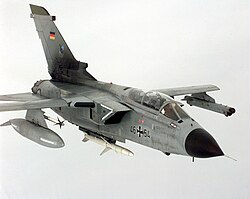
Dedicated ECM Aircraft Platforms
Throughout aviation history, several specialized aircraft have been developed to dominate the electromagnetic spectrum. These include:
- United States: EA-3 Skywarrior, EB-66 Destroyer, EC-130H Compass Call, EA-37B Compass Call, EF-111A Raven, and the EA-18G Growler. The EA-6B Prowler was notably equipped with the ALQ-92 communications jammer, the ALQ-100 multi-band track breaking system, and five ALQ-99 tactical jammer pods.
- Germany: Tornado ECR.
- Russia: Su-24MP, Yak-28PP, and Mi-8PP.
- China: J-16D.
The Future of Airborne Jamming
The landscape of electronic warfare is evolving toward higher precision and greater efficiency. A primary example is the Next Generation Jammer, designed to replace the AN/ALQ-99 on the E/A-18G. Planned for adoption around 2020, this system utilizes a small AESA antenna divided into quadrants to provide all-around coverage while maintaining highly directional jamming capabilities.
Simultaneously, DARPA is pursuing the Precision Electronic Warfare (PREW) project. This initiative aims to create a low-cost system that synchronizes multiple simple airborne jamming pods. By coordinating these pods with high precision, the system can replicate the directionality of an electronically scanned antenna, which prevents the collateral jamming of non-targeted receivers.
Expendable Decoys and DRFM
Innovation is also occurring in the realm of expendables. Leonardo (formerly Selex ES/Finmeccanica) has developed BriteCloud, an expendable active decoy. This system uses Digital Radio Frequency Memory (DRFM)—a technology that captures an incoming radar signal and re-transmits a modified version to deceive the enemy—to jam RF-based threats.
BriteCloud is self-contained in a small canister similar to a flare cartridge. A 55 mm version has already undergone flight trials with the Gripen aircraft, and a 218 mm variant is currently in an advanced stage of development.
ECM System Comparison
| System Type | Typical Platform | Power/Range | Key Characteristic |
|---|---|---|---|
| Embedded/Pod-based | Multi-role Fighters | Lower | Versatile, short-range protection |
| Dedicated EW Aircraft | EA-18G, Tornado ECR | Higher | Long-range, high-power jamming |
| Expendable Decoys | Gripen (BriteCloud) | Localized | DRFM-based active deception |
| Next-Gen (AESA) | Future E/A-18G | High/Precise | Quadrant coverage, directional jamming |
Frequently Asked Questions
Why are aircraft preferred over land or sea units for ECM?
Aircraft are the primary weapons in ECM because their altitude allows them to "see" and influence a much larger patch of earth than units based on land or sea.
What is the difference between a jamming pod and a dedicated ECM aircraft?
While many fighters can carry jamming pods, these pods are generally less powerful and have a shorter range than the specialized equipment carried by dedicated electronic warfare aircraft.
What is DRFM technology?
Digital Radio Frequency Memory (DRFM) is a technology used in systems like BriteCloud to jam RF-based threats by capturing and manipulating radar signals to deceive the receiver.
What is the goal of DARPA's PREW project?
The Precision Electronic Warfare (PREW) project aims to synchronize several simple, low-cost jamming pods to mimic the directionality of an electronically scanned antenna, thereby avoiding the jamming of non-targeted receivers.
What is the Next Generation Jammer?
The Next Generation Jammer is a replacement for the AN/ALQ-99 on the E/A-18G. It uses a quadrant-divided AESA antenna to provide both all-around coverage and highly directional jamming.