Air Force Cross
The Air Force Cross (AFC) is a prestigious military decoration awarded to personnel of the British Armed Forces for exemplary gallantry while flying. Unlike many other aviation awards, the AFC is specifically granted for acts of bravery that occur while not in active operations against an enemy, making it a unique recognition of skill and courage in non-combat flight environments.
Established shortly after the creation of the Royal Air Force, the AFC has evolved over a century to become an inclusive award that recognizes bravery across all ranks and branches of the military.
Key Facts
- Established: 3 June 1918.
- Purpose: Awarded for exemplary gallantry while flying, but not in active operations against the enemy.
- Eligibility: Open to all ranks of the British Armed Forces; formerly open to Commonwealth and allied forces.
- Physical Description: A silver cross representing aircraft propeller blades.
- Post-nominal: Recipients are entitled to use the letters "AFC".
- Total Awards: 5,553 (including further award bars).
History and Evolution
The Air Force Cross was created on 3 June 1918. Initially, the award was reserved for Royal Air Force (RAF) commissioned officers and Warrant Officers. Over time, eligibility expanded to include aviation officers from the Royal Navy and the Army.
In its early years, the criteria for the AFC were broader, encompassing "valour, courage or devotion to duty whilst flying." This allowed the medal to be awarded for meritorious service over a long period. However, in 1993, the criteria were narrowed to focus strictly on exemplary gallantry while flying.
The award's accessibility has also changed. Between 1919 and 1932, civilians were eligible for the AFC. In 1941, eligibility extended to the Fleet Air Arm, and in 1942, it opened to Army officers. Posthumous awards became permissible in 1979. A significant shift occurred in 1993 when the distinction between ranks was removed; the Air Force Medal (previously for other ranks) was discontinued, and all ranks became eligible for the AFC.
While Commonwealth nations like Canada, Australia, and New Zealand once recommended the AFC, most established their own independent honours systems by the 1990s.
Design and Appearance
Designed by Edward Carter Preston, the medal is a silver cross measuring 60 millimetres in height and 54 millimetres in width. The arms of the cross are shaped to represent aircraft propeller blades, with wings positioned between the arms.
The Obverse and Reverse
The obverse (front) of the medal depicts Hermes, the messenger god, riding on the wings of a hawk and holding a laurel wreath. The upper arm features the royal crown, while the remaining three arms display the royal cypher of the reigning monarch.
The reverse is largely plain, featuring a central roundel with the monarch's cypher and the date "1918". While originally unnamed, the year of issue began being engraved on the lower limb in 1939, and since 1984, the recipient's name has been engraved on the medal.
Ribbon and Bars
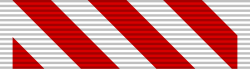
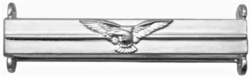
The 32 mm ribbon consists of white with red broad diagonal stripes at a 45-degree angle (a design adopted in July 1919). When a recipient is awarded a second or subsequent AFC, a bar is added to the ribbon. This silver bar features the Royal Air Force eagle in the center.
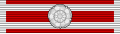
When the ribbon is worn alone, a silver rosette is used to denote each additional bar awarded.

Award Statistics and Recipients
From 1918 to 2017, approximately 5,360 Air Force Crosses and 193 bars were awarded. The distribution of these awards reflects the intensity of aviation activity during the World Wars and the subsequent Cold War era.
The award has also been extended to international allies, with 87 honorary awards given to foreign forces, including members of the US Air Force in the post-war period.

| Period | Crosses | 1st Bar | 2nd Bar |
|---|---|---|---|
| World War I (1918–19) | 679 | 2 | 0 |
| Inter-War (1920–39) | 159 | 10 | 3 |
| World War II (1940–45) | 2,001 | 26 | 1 |
| Post-War (1946–79) | 2,242 | 135 | 8 |
| Total (1918–79) | 5,081 | 173 | 12 |
Notable Recipients
- George Bulman: Awarded the AFC three times as a test pilot.
- Geoffrey Dhenin: Awarded the AFC twice for his role in British nuclear weapons tests in Australia.
- Andrew Humphrey: Marshal of the Royal Air Force, awarded the AFC three times.
- Willie Read: Awarded the AFC three times.
- H. P. Ruffell Smith: Awarded the AFC three times.
- Peter Thorne: Awarded the AFC three times between 1947 and 1956.
Frequently Asked Questions
What is the difference between the Air Force Cross and the Distinguished Flying Cross?
The Air Force Cross is awarded for gallantry while flying but not in active operations against the enemy. The Distinguished Flying Cross (DFC) is awarded for bravery while flying in active operations against the enemy.
Who is eligible to receive the Air Force Cross today?
Since 1993, all ranks of all arms of the British Armed Forces are eligible for the award, regardless of their rank or specific branch of service.
What does the silver rosette on the ribbon signify?
A silver rosette is worn on the ribbon when the medal is not being worn in full, denoting that the recipient has been awarded a bar (a subsequent AFC).
Can civilians be awarded the Air Force Cross?
Civilians were eligible for the AFC between 1919 and 1932, but the award is now primarily a military decoration for the Armed Forces.
What is the significance of the figure on the medal?
The obverse of the medal depicts Hermes, the Greek messenger god, riding on the wings of a hawk and holding a laurel wreath, symbolizing speed and victory.