Aeronautics: The Science and History of Flight
Aeronautics is the comprehensive science and art dedicated to the study, design, and manufacturing of machines capable of flight. It encompasses the techniques required to operate aircraft and rockets within the Earth's atmosphere. While the term once referred strictly to the operation of aircraft, it has evolved to include the technology, business, and engineering aspects of flight. Although often used interchangeably with aviation, aeronautics is a broader term that includes ballistic vehicles and lighter-than-air craft, such as airships.
At the heart of this field is aerodynamics, a branch of dynamics that examines how air moves and interacts with objects in motion. This interaction is what allows a heavy machine to overcome gravity and navigate the skies.
Key Facts
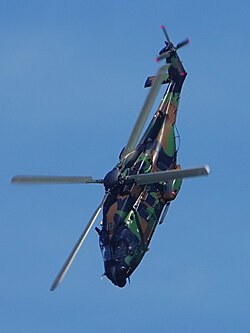
- Aeronautics covers both heavier-than-air and lighter-than-air flight, as well as rocketry.
- Sir George Cayley is recognized as the founder of modern aeronautics for identifying the four forces of flight.
- Aerodynamics is categorized by flow speeds: incompressible (subsonic), transonic (around Mach 1), and compressible (supersonic).
- Otto Lilienthal was the first to achieve documented, repeated, and successful glider flights.
- Rocketry relies on action and reaction, using internal propellants to generate thrust.
The Evolution of Flight: From Dreams to Science
Early Concepts and Observations
The human desire to fly began with rudimentary attempts, often involving the construction of wings and jumping from heights, which frequently resulted in injury or death. More methodical investigators, including scientists of the Islamic Golden Age like Abbas ibn Firnas, studied bird flight to find rational solutions. In ancient China, man-carrying kites, rotary-wing toys, and small hot air lanterns were used extensively, as documented by Marco Polo in 1282.
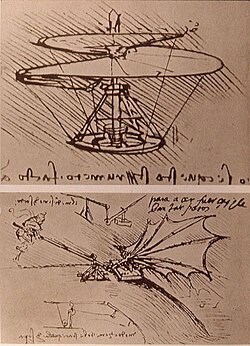
In Europe, Roger Bacon early on described the principles of the flapping-wing ornithopter (a machine that flies by flapping wings) and lighter-than-air balloons. Later, during the Renaissance, Leonardo da Vinci produced rational designs for helicopters and ornithopters. While some of his designs had flaws, da Vinci correctly understood that air offers resistance to an object equal to the resistance the object offers the air—a precursor to Newton's Third Law of Motion.
The Era of Lighter-Than-Air Flight
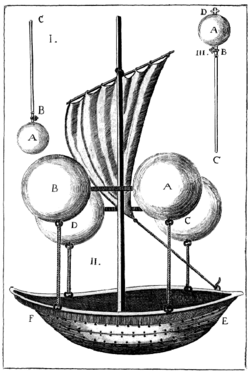
The scientific approach to flight progressed in the 17th century. Galileo demonstrated that air has weight, and by 1670, Francesco Lana de Terzi proposed using vacuum-sealed metal spheres to create lift. Although these spheres would have collapsed under atmospheric pressure, de Terzi introduced the concepts of using ballast to ascend and venting gas to descend, methods still used today.
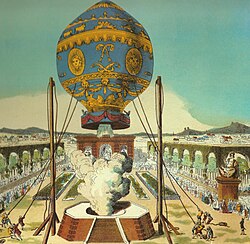
The late 18th century saw the rise of practical balloons. The Montgolfier brothers developed hot air balloons (Montgolfières) using "electric smoke," while Jacques Charles and the Robert brothers created the first gas-tight hydrogen balloons (Charlières) using rubberized silk. By 1784, the balloon La Caroline completed a flight of over 100 kilometers between Paris and Beuvry.
The Foundation of Modern Aeronautics
Sir George Cayley (1773–1857) transformed flight from an experimental hobby into a science. In his treatise "On Aerial Navigation," Cayley identified the four vector forces that govern flight: thrust, lift, drag, and weight. He moved away from flapping wings to develop the fixed-wing aeroplane, introducing the stabilizing tail and the cambered aerofoil (a curved wing surface) to increase lift.
The Rise of Heavier-Than-Air Flight
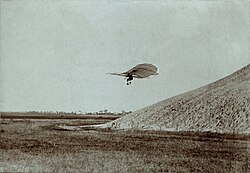
In the 19th century, the Aeronautical Society of Great Britain helped promote heavier-than-air research. This culminated in the work of German engineer Otto Lilienthal, the "flying man." Lilienthal was the first to achieve successful, repeated glider flights, proving that human flight was practical. His "Lilienthal Normalsegelapparat" is regarded as the first airplane produced in series.
Branches of Aeronautical Study
Modern aeronautics is divided into three primary disciplines:
- Aviation: The practical art and operation of flying aircraft, including balloons and airships.
- Aeronautical Engineering: The design, construction, and control of aircraft and their power systems.
- Aeronautical Science: The theoretical study of flight, with a heavy emphasis on aerodynamics.
When combined with astronautics (the study of flight beyond the atmosphere), these fields form aerospace engineering.
Understanding Aerodynamics
Aerodynamics focuses on how air interacts with moving objects. It is generally categorized by the speed of the airflow relative to the speed of sound (Mach 1):
- Incompressible Flow: Occurs at subsonic speeds where air moves around objects without being compressed.
- Transonic Flow: Occurs around Mach 1, where airflow can be subsonic in some areas and supersonic in others.
- Compressible Flow: Occurs at supersonic speeds, characterized by the appearance of shock waves.
The Principles of Rocketry
Rocketry involves vehicles that obtain thrust from a rocket engine, which carries its own propellant. Operating on the principle of action and reaction, rockets expel exhaust at extremely high speeds to push the vehicle forward. While inefficient for low-speed travel, they are essential for high-acceleration tasks, such as launching satellites and interplanetary exploration.
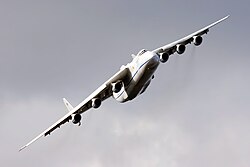
Summary of Flight Technologies
| Type | Lifting Mechanism | Key Examples | Primary Characteristic |
|---|---|---|---|
| Lighter-than-Air | Buoyancy (Hot air/Hydrogen) | Montgolfière, Charlière | Low energy, slow speed |
| Heavier-than-Air | Aerodynamic Lift (Wings) | Gliders, Aeroplanes | High speed, controllable |
| Rocketry | Reaction Thrust | Spacecraft, Missiles | Capable of vacuum operation |
Frequently Asked Questions
What is the difference between aeronautics and aviation?
Aeronautics is the broader science and engineering study of flight, including lighter-than-air craft and ballistic vehicles. Aviation is more specifically the art or practice of operating aircraft.
Who is considered the father of modern aeronautics?
Sir George Cayley is widely acknowledged as the founder of modern aeronautics because he was the first to scientifically identify the four forces of flight: lift, weight, drag, and thrust.
What are the three types of aerodynamic flow?
The three types are incompressible flow (subsonic), transonic flow (around the speed of sound), and compressible flow (supersonic).
How do rockets differ from airplanes in terms of propulsion?
Airplanes rely on the surrounding atmosphere for lift and often for engine combustion. Rockets carry all their necessary propellants internally, allowing them to operate in the vacuum of space through action and reaction.
What was Otto Lilienthal's contribution to flight?
Otto Lilienthal was the first person to make well-documented, repeated, and successful flights using gliders, proving that heavier-than-air flight was a practical reality.