Admiral Sir Nigel Essenhigh: A Legacy of Royal Navy Leadership
Admiral Sir Nigel Essenhigh GCB DL is a distinguished former officer of the Royal Navy whose career spanned nearly four decades of service. From his early days as a navigating officer to reaching the pinnacle of naval command as the First Sea Lord—the professional head of the Royal Navy—Essenhigh played a pivotal role in shaping the UK's maritime strategy and procurement during a period of significant global transition.
Key Facts
- Highest Rank: Admiral
- Top Command: First Sea Lord and Chief of the Naval Staff (2001–2002)
- Combat Experience: Commanded HMS Exeter during the Gulf War
- Major Procurement: Secured the contract for up to 150 Joint Strike Fighter aircraft
- Honours: Knight Grand Cross of the Order of the Bath (GCB)
- Post-Navy Career: Executive roles at Northrop Grumman and Babcock International
Early Career and Specialization
Born on 8 November 1944 in Newcastle upon Tyne and educated at St. Cuthbert's School, Nigel Essenhigh joined the Royal Navy in 1963. He quickly progressed through the junior officer ranks, becoming a sub-lieutenant in 1965 and a lieutenant in 1967. By 1972, he qualified as a principal warfare officer, a role specializing in the tactical employment of ships and weapons, with a specific focus on navigation.
His early operational experience included serving as a navigating officer on the frigate HMS Juno and the destroyer HMS Antrim. After a stint with the staff of the Flag Officer Sea Training, he was promoted to lieutenant commander in 1975 and served aboard the destroyer HMS Glasgow in 1978.
Command of the Type 42 Destroyers
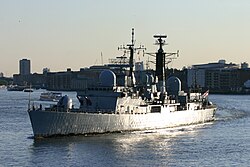
Upon his promotion to commander in 1980, Essenhigh transitioned into strategic planning at the Ministry of Defence, contributing to the 1981 Defence Review. However, his career is perhaps most noted for his command of the Type 42 destroyer, a class of guided-missile destroyers designed for area air defence.
In 1982, he took command of HMS Nottingham, operating across the Atlantic, Mediterranean, and West Indies.
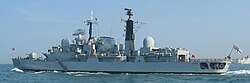
Following a period of study at the Royal College of Defence Studies and a role as Assistant Director (Weapons and Ships) in the Naval Plans Department, Essenhigh assumed command of HMS Exeter in April 1989. Under his leadership, the vessel saw active operational service during the Gulf War.
Rise to the Highest Naval Office
The 1990s saw Essenhigh ascend through the senior officer ranks. After completing the Higher Command and Staff Course at Camberley in 1992, he became the Director of Naval Plans and Programmes. He later served as the Hydrographer of the Navy and the Assistant Chief of Defence Staff (Programmes).
By September 1998, promoted to full admiral, he held several high-profile roles simultaneously: Commander-in-Chief Fleet, NATO Commander-in-Chief Eastern Atlantic, and NATO Commander Allied Naval Forces North West Europe.
His career culminated in his appointment as First Sea Lord and Chief of the Naval Staff in January 2001. During this tenure, he made a landmark decision for the future of British air power by entering a contract to acquire up to 150 Joint Strike Fighter aircraft to equip the UK's two new aircraft carriers.
| Period/Year | Role/Achievement | Key Detail |
|---|---|---|
| 1963 | Joined Royal Navy | Started service in Newcastle upon Tyne |
| 1982 | Commanding Officer | HMS Nottingham (Type 42 Destroyer) |
| 1989 | Commanding Officer | HMS Exeter (Gulf War service) |
| 1998 | Admiral | Commander-in-Chief Fleet & NATO Commands |
| 2001–2002 | First Sea Lord | Chief of the Naval Staff |
Retirement and Public Advocacy
After retiring on 3 December 2002, Admiral Essenhigh transitioned into the private sector. He served as an advisor to Northrop Grumman and, from 2010 to 2011, acted as the chief executive of its Information Systems Europe business, focusing on command, control, intelligence, and counter-IED (Improvised Explosive Device) products. He also served as a non-executive director of Babcock International.
In his later years, Essenhigh has remained active in public life as a Deputy Lieutenant of Devon. He also became a vocal critic of UK defence spending. In 2015, alongside other former military leaders, he described the UK Armed Forces as "feeble," arguing that the government was repeating the mistakes of the 1930s by appeasing enemies. This sparked a public debate with then-Secretary of State for Defence Michael Fallon, who defended the military's capabilities.
The Essenhigh naval tradition continues through his son, Rear Admiral Angus Essenhigh, who served as the fourth captain of the aircraft carrier HMS Queen Elizabeth and was appointed national hydrographer in 2023.
Frequently Asked Questions
What was Admiral Essenhigh's most significant procurement decision?
As First Sea Lord, he entered into the contract to acquire up to 150 Joint Strike Fighter aircraft for the United Kingdom's two new aircraft carriers.
Which ships did Admiral Essenhigh command?
He commanded two Type 42 destroyers: HMS Nottingham in the early 1980s and HMS Exeter during the Gulf War.
What roles did he hold within NATO?
He served as the NATO Commander-in-Chief Eastern Atlantic and the NATO Commander Allied Naval Forces North West Europe.
What did Admiral Essenhigh claim about the UK Armed Forces in 2015?
He characterized the UK Armed Forces as "feeble" and argued that the government was making the same mistakes as in the 1930s by appeasing enemies through military weakness.
What did he do after retiring from the Royal Navy?
He worked as an advisor and chief executive for Northrop Grumman's Information Systems Europe, served as a non-executive director for Babcock International, and became a Deputy Lieutenant of Devon.