Admiral Sir Jock Slater: A Distinguished Career in the Royal Navy
Admiral Sir John Cunningham Kirkwood Slater, widely known as Jock Slater, stands as one of the most prominent figures in late 20th-century British maritime history. From his early days as a cadet to his eventual appointment as the professional head of the Royal Navy, Slater's career spanned four decades of evolving naval strategy and global conflict.
Key Facts
- Highest Rank: Admiral
- Top Position: First Sea Lord and Chief of the Naval Staff (1995–1998)
- Notable Commands: HMS Illustrious, HMS Kent, and HMS Jupiter
- Key Contribution: Played a pivotal role in the 1998 Strategic Defence Review
- Major Honors: Knight Grand Cross of the Order of the Bath (GCB)
Early Life and Education
Born on March 27, 1938, Jock Slater was the son of James Kirkwood Slater and Margaret Claire Byrom Bramwell. He came from a lineage with deep ties to naval excellence; he is the great-nephew of Admiral of the Fleet The Viscount Cunningham of Hyndhope, who served as First Sea Lord during the Second World War.
Slater's academic journey began at the Edinburgh Academy, followed by Sedbergh School, before he entered the Royal Naval College, Dartmouth, to begin his professional training.
Rise Through the Ranks
Slater joined the Royal Navy as a cadet in 1956 and was confirmed as a sub-lieutenant on January 1, 1959. His early service provided a broad foundation in naval operations, serving aboard the destroyer HMS Troubridge, the minesweeper HMS Yaxham, the Royal Yacht HMY Britannia, and the destroyer HMS Cassandra.
By 1965, he earned his first command of the minesweeper HMS Soberton, where he focused on fishery protection duties. This period marked the beginning of his specialization in navigation, leading to a posting at HMS Dryad, a shore establishment dedicated to naval training.
Command and Specialization
Throughout the late 1960s and 1970s, Slater's trajectory was marked by steady promotion and increasing responsibility. He served as an Equerry to the Queen starting in October 1968 and was later appointed a Lieutenant of the Royal Victorian Order in 1971.
His command experience expanded rapidly: he led the frigate HMS Jupiter in 1972 and the destroyer HMS Kent in 1976. After attending the Royal College of Defence Studies in 1978, he transitioned into strategic roles at the Ministry of Defence.
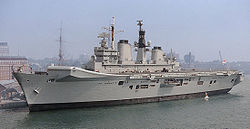
In May 1981, Slater achieved a significant milestone by becoming the first commanding officer of the aircraft carrier HMS Illustrious.
Senior Leadership and Strategic Influence
Slater's ascent to the highest echelons of command began in 1985 when he was promoted to Rear Admiral as Assistant Chief of the Defence Staff (Policy and Nuclear). By 1987, as Vice Admiral, he took on the role of Flag Officer Scotland and Northern Ireland, alongside various NATO commands in the Eastern Atlantic and the English Channel.
In January 1991, he reached the rank of full Admiral upon his appointment as Commander-in-Chief Fleet. He later served as Vice-Chief of the Defence Staff in 1993 before reaching the pinnacle of his career in July 1995.
First Sea Lord and the Strategic Defence Review
As First Sea Lord and Chief of the Naval Staff from 1995 to 1998, Slater was responsible for the overall leadership of the Royal Navy. His tenure was most notably defined by his key role in the 1998 Strategic Defence Review, a comprehensive evaluation of the UK's military capabilities conducted by the Labour Government.
| Period/Year | Rank/Role | Key Command/Achievement |
|---|---|---|
| 1956 | Cadet | Joined Royal Navy |
| 1965 | Commander | HMS Soberton (Minesweeper) |
| 1981 | Captain | HMS Illustrious (Aircraft Carrier) |
| 1991 | Admiral | Commander-in-Chief Fleet |
| 1995–1998 | First Sea Lord | Chief of the Naval Staff |
Life After Service
Following his retirement in December 1998, Sir Jock Slater remained active in both the corporate and charitable sectors. He served as a Non-Executive Director for Lockheed Martin UK and VT Group. His commitment to maritime and historical preservation is evident in his roles as Chairman of the Trustees of the Imperial War Museum and Chairman of the executive committee of the Royal National Lifeboat Institution (RNLI).
Additionally, he has served as a Deputy Lieutenant of Hampshire and a Prime Warden of the Shipwrights' Company, while maintaining a personal interest in outdoor activities.
Frequently Asked Questions
What was Sir Jock Slater's highest rank in the Royal Navy?
Sir Jock Slater achieved the rank of full Admiral.
Which aircraft carrier did Sir Jock Slater first command?
He was the first commanding officer of the aircraft carrier HMS Illustrious, taking command in May 1981.
What was his role in the 1998 Strategic Defence Review?
As First Sea Lord and Chief of the Naval Staff, he played a key role in the review carried out by the Labour Government to assess and reshape the UK's defence strategy.
What are some of the honors awarded to Admiral Slater?
He was appointed a Knight Grand Cross of the Order of the Bath (GCB), a Lieutenant of the Royal Victorian Order (LVO), and received the Legion of Merit from the United States.
Who was Sir Jock Slater's notable relative?
He is the great-nephew of Admiral of the Fleet The Viscount Cunningham of Hyndhope, who served as First Sea Lord during the Second World War.