Admiral of the Royal Navy
In the hierarchy of the United Kingdom's maritime forces, the Admiral is a senior flag officer rank within the Royal Navy. Designated as a four-star rank with the NATO rank code OF-9, it represents one of the highest levels of leadership at sea. While the rank of Admiral of the Fleet technically sits above it, the rank of Admiral is currently the highest position to which a serving officer can be promoted during peacetime.
Admirals are part of a broader group known as flag officers, which also includes rear admirals and vice admirals. This terminology stems from the historical right of these officers to fly a personal command flag from their ship's mast to signal their presence and authority to the rest of the fleet.
Key Facts
- NATO Code: OF-9 (Four-star rank).
- Equivalent Ranks: General (British Army and Royal Marines) and Air Chief Marshal (Royal Air Force).
- Highest Active Rank: Admiral is the highest attainable rank for serving officers; Admiral of the Fleet is largely in abeyance.
- Insignia: Identified by a broad band with three narrower bands of sleeve lace and four stars on the shoulder board.
- Personal Flag: A St George's cross (red cross on a white field).
The Evolution of Naval Command
The First Admirals
The term "admiral" did not appear in Europe until the mid-13th century and reached England toward the end of that century. Early English naval efforts relied heavily on levies of private vessels rather than a permanent standing navy. While some historians trace the concept of admirals back to Alfred the Great, official records typically begin with King Henry III's appointment of Sir Richard de Lucy in 1223 or 1224.
A significant milestone occurred on March 8, 1287, when Sir William de Leybourne was commissioned as the Admiral of the Seas of England. This was part of King Edward I's strategy to create a permanent official staff. Over time, these roles were split into regional commands—Admiral of the North, South, and West—before being reunited between 1408 and 1414 as the High Admiral of England, Ireland, and Aquitaine, the precursor to the modern Lord High Admiral.
Squadrons and the System of Colours
During the Elizabethan era, the Royal Navy expanded to a size that required organization into squadrons. These were distinguished by colors: the admiral of the squadron flew a red ensign, vice admirals flew white, and rear admirals flew blue. Eventually, these evolved into formal ranks, such as Admiral of the White.
The structure of command was positional. The admiral typically occupied the lead or middle of the fleet. If the admiral was in the middle, the vice admiral commanded the leading portion (the van), while the rear admiral commanded the rear of the fleet.
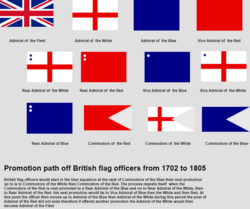
Promotion and the "Yellow Admiral"
For much of the 18th and 19th centuries, promotion was based strictly on seniority among post-captains. Because rank was held for life, an officer could only move up when someone above them died or resigned. This led to extreme cases, such as Provo Wallis, whose service spanned 96 years.
To address the issue of aging officers, the Admiralty introduced "yellow admirals" in 1747. Formally known as Rear-Admirals without distinction of squadron, these were captains promoted to flag rank on the condition that they immediately retire on half-pay, serving as an early form of superannuation.
Modern Rank and Insignia
The system of colored squadrons was abolished in 1864. Today, the Red Ensign is used by the Merchant Navy, the White Ensign by the Royal Navy, and the Blue Ensign by naval reserves and auxiliaries.
Modern admirals are identified by specific uniform markings. The sleeve lace consists of one broad gold band topped by three narrower bands. In 2001, the shoulder board was updated to feature four stars to align with international NATO OF-9 standards.
| Rank | NATO Code | Personal Flag | Sleeve Lace/Stars |
|---|---|---|---|
| Admiral of the Fleet | OF-10 | Union Flag | Five Stars |
| Admiral | OF-9 | St George's Cross | Four Stars |
| Vice Admiral | OF-8 | St George's Cross + 1 Red Disc | Three Stars |
| Rear Admiral | OF-7 | St George's Cross + 2 Red Discs | Two Stars |
Frequently Asked Questions
What is the difference between an Admiral and an Admiral of the Fleet?
An Admiral (OF-9) is the highest rank a serving officer can typically achieve. An Admiral of the Fleet (OF-10) is a higher rank that is currently in abeyance during peacetime, except for honorary appointments for members of the Royal Family or retired officers.
What does the term "flag officer" mean?
A flag officer is any officer holding the rank of rear admiral, vice admiral, or admiral. They are called this because they are entitled to fly a personal command flag from their ship to indicate their rank and authority.
What was a "yellow admiral"?
A yellow admiral was a captain promoted to the rank of rear admiral without being assigned to a specific color squadron. This was a mechanism used by the Admiralty to allow older officers to retire with the prestige of flag rank and half-pay without giving them an active command.
How did the colored squadrons work before 1864?
The fleet was divided into Red, White, and Blue squadrons. Officers were promoted through these squadrons (e.g., Rear Admiral of the Blue, then Rear Admiral of the White). This system determined the career path and the specific flags flown by the officers until the system was simplified in 1864.