Acorn Worms: The Evolutionary Link Between Invertebrates and Vertebrates
Acorn worms, scientifically known as Enteropneusta, are a fascinating class of marine invertebrates belonging to the phylum Hemichordata. Often overlooked due to their subterranean lifestyle, these creatures provide critical insights into the evolution of complex life. Their closest non-hemichordate relatives are the echinoderms (such as starfish and sea urchins), and they are frequently studied as a potential evolutionary link between classical invertebrates and vertebrates.
With 111 known species worldwide, acorn worms exhibit a surprising range of sizes. While the species Meioglossus psammophilus is a mere 0.6 millimeters long, the giant Balanoglossus gigas can reach lengths of 2.5 meters. Many people recognize them by their distinct iodoform-like smell, caused by secretions containing iodine.
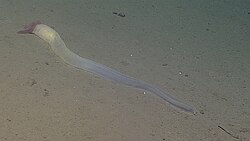
Key Facts
- Phylum: Hemichordata; Class: Enteropneusta.
- Temporal Range: From the Miaolingian period (505 million years ago) to the present.
- Body Plan: Divided into three parts: a proboscis, a collar, and a trunk.
- Diet: Primarily deposit feeders or suspension feeders.
- Habitat: U-shaped burrows in seabed sediment, from shorelines to depths of 10,000 feet.
- Unique Trait: Possess a stomochord, a structure once mistaken for a vertebrate notochord.
Anatomy and Physical Structure
The body of an acorn worm is characterized by three distinct regions. The proboscis is acorn-shaped and used for burrowing; the collar is a short, fleshy section containing the mouth; and the trunk is the long, worm-like remainder of the body.
Their skin is covered in cilia (tiny hair-like projections) and mucus-secreting glands. Some species produce bromide compounds that act as a chemical defense against predators and bacteria. Movement is slow, relying on a combination of ciliary action and peristalsis—the rhythmic contraction of muscles—within the proboscis.
![Structure of anterior end – a, Arrow from proboscis-cavity (pc) passing to left of pericardium (per) and out through proboscis pore-canal. b1, arrow from central canal of neurochord (cnc) passed out through anterior neuropore. b2, ditto; through posterior neuropore. c, arrow intended to pass from 1st gill-pouch through collar pore-canal into collar-coelom (cc). cts, posterior limit of collar. dv, dorsal vessel passing into central sinus (bs). ev, efferent vessel passing into ventral vessel (vv). epr, epiphysial tubes. st, stomochord. vs, ventral septum of proboscis. sk, body of nuchal skeleton. m, mouth. th, throat. tb, tongue-bars. tc, trunk coelom.[15]](/images/eb/94/eb940d8bf6adfc66859ee6a1d3f691ecc15b67da424a2e8a85574535d07cb592.png)
Skeletal and Nervous Systems
Unlike vertebrates, acorn worms lack a bony skeleton, possessing instead a Y-shaped nuchal skeleton located on the ventral side of the proboscis and collar. Their nervous system consists of a plexus of nerves under the skin, with dorsal and ventral nerve cords. The dorsal cord in the proboscis is often hollow and is considered homologous to the vertebrate brain, primarily coordinating the muscular movements required for crawling and burrowing.
Biological Systems
Digestive and Respiratory Processes
Acorn worms employ two primary feeding strategies. Deposit feeders swallow sand or mud to extract organic detritus, while suspension feeders use cilia on their gill bars to draw organic particles from the water. A ciliated groove in front of the mouth helps direct food and may serve as a sensory organ for tasting.
The digestive tract consists of a tubular mouth cavity, a pharynx with gill slits, an oesophagus, and an intestine. Notably, they have no stomach. In some families, the oesophagus has dorsal openings that allow the animal to squeeze out excess water to concentrate its food. Respiration is similar to that of fish; oxygenated water is drawn through the mouth and exits via the gill slits on the trunk.
![Structure of branchial region – bc, coelom. tb, tongue-bars. ds, mesentery. pr, ridge. vv, vessel. gp, gill-pore. dn, dorsal nerve. dv, vessel. œ, oesophagus. vs, mesentery. vn, ventral nerve.[15]](/images/d2/36/d236e78dea04dd26566e5a555c53963fcc93e23692dbb3f9c3f8036c4a21a85e.png)
Circulatory and Excretory Functions
The circulatory system is open, meaning blood flows through tissue sinuses rather than enclosed vessels. A dorsal vessel delivers blood to a muscular sac in the proboscis that functions as a heart. This heart is a closed vesicle that pulsates to push colorless, acellular blood through the body.
Because acorn worms lack a dedicated excretory system, the glomerulus—a complex of sinuses and peritoneal folds in the proboscis—is believed to handle waste removal.
Evolutionary Significance
Acorn worms are of immense interest to biologists because they share several traits with chordates. These include a heart that doubles as a kidney, gill-like breathing structures, and in some cases, a post-anal tail. Their three-part body plan is mirrored in the development of the vertebrate frontal neural tube, which eventually divides into three main brain regions.
Research into gene expression suggests that the signaling centers shaping the brains of vertebrates are present in acorn worm embryos, though in these invertebrates, they control the development of body regions rather than the neural system.
Lifestyle and Reproduction
Most acorn worms live in U-shaped burrows. They remain mostly hidden, with only the proboscis protruding from the burrow opening. While most are sediment-dwellers, the Torquaratoridae family lives in the deep sea, where they crawl on the ocean floor or drift through the water column to find new foraging sites.
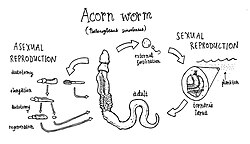
Acorn worms are dioecious (separate sexes), though some can reproduce asexually through fragmentation. Females release eggs in a gelatinous mucus mass, which are fertilized externally by males. Depending on the species, they may hatch as miniature adults or pass through a free-swimming tornaria larva stage. The tornaria larva is strikingly similar to the bipinnaria larvae of starfish, highlighting the close phylogenetic link between hemichordates and echinoderms.
| Feature | Description |
|---|---|
| Body Regions | Proboscis, Collar, Trunk |
| Feeding Types | Deposit feeding and Suspension feeding |
| Circulation | Open system with a pulsating heart-sac |
| Respiration | Gill slits on the trunk |
| Larval Stage | Tornaria (in some species) |
| Size Range | 0.6 mm to 2.5 m |
Frequently Asked Questions
Why are acorn worms called "hemichordates"?
They are called hemichordates because they possess a structure called the stomochord, which was originally mistaken for a notochord (the flexible rod supporting the body in chordates).
How do acorn worms breathe?
They breathe by drawing oxygenated water into their mouths, which then flows out through a series of gill slits located along the trunk, similar to the respiratory process in primitive fish.
What is the difference between deposit and suspension feeding?
Deposit feeders swallow sediment (sand or mud) to extract organic matter, whereas suspension feeders filter organic particles and microbes directly from the surrounding water using cilia.
Do acorn worms have a brain?
They do not have a brain in the vertebrate sense, but they have a hollow dorsal nerve cord in the proboscis that is considered homologous to the vertebrate brain and coordinates their movement.
How do acorn worms reproduce?
Most reproduce sexually with separate males and females; eggs are fertilized externally in the water. Some species can also reproduce asexually through fragmentation.