Acanthodii: The Evolution and Biology of Spiny Sharks
The Acanthodii, commonly known as "spiny sharks," were a class of extinct gnathostomes (jawed fishes) that navigated the Earth's waters from the Early Silurian through the Permian period. While their streamlined bodies and predatory appearance mirror modern sharks, they represent a distinct and complex chapter in vertebrate evolution.
Rather than being a single unified group, modern science views acanthodians as a paraphyletic grade—a collection of various fish lineages that are basal to the Chondrichthyes (the group containing living sharks, rays, and chimaeras). They possess a fascinating mosaic of biological features, blending characteristics found in both cartilaginous fish and osteichthyans (bony fish).
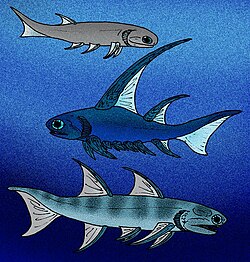
Key Facts
- Temporal Range: Early Silurian to the Permian period.
- Defining Feature: Stout, immovable bony spines supporting most fins.
- Skeleton: Primarily cartilaginous, though they possessed bony scales and fin bases.
- Habitat: Originally marine, later becoming predominant in freshwater environments during the Devonian.
- Relationship: Considered "stem-sharks" and closely related to the ancestors of modern cartilaginous fish.
Physical Characteristics and Anatomy
The moniker "spiny shark" is derived from their superficial resemblance to sharks, including a streamlined body, paired fins, and a strongly upturned tail. However, the most distinguishing feature was the presence of large, bony spines reinforcing the anterior margins of their fins. Because these spines and their scales were more durable than the cartilaginous skeleton, they are often the only remains found in sedimentary rock.
Their skin was covered in tiny, rhomboid platelets similar to the scales of holosteians (such as gars and bowfins). These scales are highly diagnostic; each order of acanthodian has a unique ornamentation pattern, making these fossils invaluable for geologists determining the relative age of rock strata. A typical scale consists of a bulbous base, a neck, and a diamond-shaped crown.
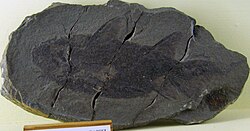
Skeletal Structure and Jaws
While their internal skeletons were made of cartilage, acanthodians developed bonelike material in their skin. Some scales enlarged to form a protective bony covering over the head and lower shoulder girdle. Some species even evolved a bony flap over the gill openings, similar to the operculum found in bony fish. Their jaws are believed to have evolved from the first gill arch of ancestral jawless fishes.
Taxonomy and Diversity
Acanthodians are traditionally divided into four primary orders, each with distinct ecological roles and physical traits:
- Acanthodiformes: Specialized filter feeders with toothless jaws, long gill rakers, and a single dorsal fin. They were the most specialized and the last to survive, persisting into the Permian.
- Ischnacanthiformes: Formidable predators characterized by tooth plates fused directly to their jaws.
- Diplacanthiformes: A group previously nested within the Climatiiformes, distinguished by their specific skeletal arrangements.
- Climatiiformes: A paraphyletic assemblage (including climatiids and gyracanthids) featuring robust bony shoulder girdles and "prepelvic" spines located between the pectoral and pelvic fins.
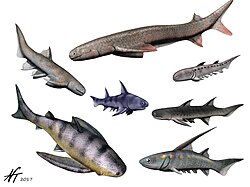
Evolutionary History and Phylogeny
The earliest unequivocal acanthodian fossils, such as Fanjingshania and Qianodus from China, date back approximately 439 million years to the Early Silurian. This places them roughly 50 million years before the appearance of true sharks.
Their diversity peaked during the Lochkovian stage of the Early Devonian. While they successfully colonized rivers, lakes, and Carboniferous coal swamps, they eventually faced stiff competition from the rising dominance of bony fishes. This pressure led to their gradual decline, with the final records—isolated scales and spines—appearing in the Middle-Late Permian of the Paraná Basin in Brazil, roughly 250 million years ago.
The Phylogenetic Debate
The exact placement of acanthodians on the tree of life has been a subject of intense study. Early theories linked them to bony fish. However, recent findings, including the discovery of the placoderm Entelognathus and studies of Doliodus, suggest that acanthodians are a paraphyletic group leading toward the Chondrichthyes. Doliodus, in particular, serves as a transitional fossil, displaying a mosaic of both shark and acanthodian features.
| Order | Primary Diet/Role | Key Anatomical Feature | Survival Period |
|---|---|---|---|
| Acanthodiformes | Filter Feeder | Toothless jaws, long gill rakers | Until Permian |
| Ischnacanthiformes | Predator | Fused tooth plates | Paleozoic |
| Climatiiformes | Generalist | Prepelvic spines, robust shoulder girdles | Paleozoic |
| Diplacanthiformes | Generalist | Distinctive fin spine arrangement | Paleozoic |
Frequently Asked Questions
Were acanthodians actually sharks?
No, they were not true sharks. While they are often called "spiny sharks" due to their body shape and relationship to cartilaginous fish, they are considered stem-sharks or a paraphyletic grade of fish that existed before and alongside true sharks.
Why are they called "spiny sharks"?
They earned this name because they possessed stout, largely immovable bony spines that supported all of their fins except for the tail.
Where did acanthodians live?
The earliest species were marine, but by the Devonian period, they had successfully colonized freshwater environments, including rivers, lakes, and later, the coal swamps of the Carboniferous.
What caused the extinction of the acanthodians?
While no single event is cited, they faced increasing competition from bony fishes (Osteichthyes), which began to dominate the global waters, leading to the acanthodians' eventual disappearance by the Permian.
How do scientists identify acanthodian fossils?
Because their cartilaginous skeletons rarely fossilize, scientists primarily rely on their distinctive, diamond-shaped bony scales and fin spines, which vary in ornamentation between different orders.