Abu Hanifa Mosque: A History of Architecture and Resilience in Baghdad
The Abu Hanifa Mosque stands as one of Baghdad's most significant religious and historical landmarks. Dedicated to the founder of the Hanafi madhab (a school of Islamic jurisprudence), the site has evolved over a millennium from a modest prayer space into a grand architectural complex. Its history is a reflection of the shifting political and sectarian tides of Iraq, surviving empires, wars, and extensive reconstructions.
Establishment and Early Growth
The origins of the site date back to 375 AH (985/986 CE) during the Buwayhid rule of the Abbasid Caliphate. Under the orders of Samsam al-Dawla, a medium-sized mosque was first constructed near the tomb of Abu Hanifa. Shortly after, in 379 AH, Abu Ja'far al-Zammam added a hall to the structure, expanding its capacity for worshippers.
The Seljuk Era and the First School
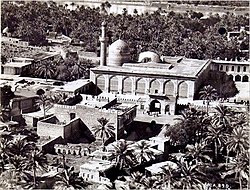
The mosque underwent a major transformation in 459 AH (1066 CE) under the direction of Abu Saad al-Khwarizmi (also known as al-Mustawfi), the Grand Vizier to the Seljuk Emperor Alp Arslan. Al-Khwarizmi commissioned a shrine for Abu Hanifa featuring a white dome and a high malban (a raised platform or structure), modeled after the shrines of the family of Ali ibn Abu Talib.
Beyond the mosque, Al-Khwarizmi established the Great Imam School to teach the Hanafi madhab. According to the historian Ibn Khallikan, the school opened on September 22, 1067, making it the first school in Baghdad. The construction was remarkably swift, taking only four and a half months from January 8 to May 15, 1067.
Conflict and Ottoman Restoration
The site suffered a devastating blow in 1508 when the Safavid dynasty invaded Baghdad. Due to sectarian conflicts, the mosque and school were destroyed. However, the tide turned in 1534 when the Ottomans recaptured the city. Sultan Suleiman the Magnificent ordered the complete reconstruction of the mosque, adding a minaret, a hall, a bathroom, and between 50 and 140 shops. To ensure its safety, a square fortress armed with 150 soldiers and a watchtower were built around the perimeter.
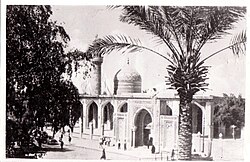
The mosque reached a peak of splendor under Sultan Murad IV after the Ottomans recaptured Baghdad in 1638. Murad IV, a follower of the Hanafi school, commissioned a luxurious dome and renewed the school. Under the administration of Shaykh al-Islām Yahya, the complex was adorned with gold and silver strips and green wool drapes. To protect the shrine, the sultan settled members of the al-Ubaid tribe in the surrounding neighborhood.
Later Ottoman and Mamluk Enhancements
Throughout the 17th and 19th centuries, various officials continued to refine the site. In 1669/1670 CE, Mohammed Bek Daftary reconstructed old sections, and in 1679/1680 CE, Omar Pasha created one of Baghdad's most beautiful gardens on the grounds. In 1757, during the Mamluk dynasty's rule in Iraq, Suleiman Abu Layla renewed the shrine's dome and minaret.
Significant royal patronage continued into the 19th century. Sultan Abdülmecid I ordered repairs in 1839/1840 CE, decorating the mosque with a tunic from Al-Masjid an-Nabawi. Later, in 1871/1872 CE, Pertevniyal Sultan (mother of Sultan Abdulaziz) funded a massive reconstruction costing 80,000 liras. Designed by engineer Asit Karz, this project added a big courtyard, a chapel, and a Quranic school over a five-year period.
Modern Era and 20th Century Upgrades
In 1910, Sultan Abdul Hamid II funded renovations costing 2,300 liras to add rooms for students and the poor. Further updates occurred in 1918, 1935, and 1948, the latter of which saw the addition of verses from Surah Al-Fath on the hallway walls.
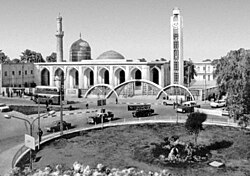
Following the 1958 Revolution, the government commissioned engineer Najmuddin Abdullah al-Jumaili for a comprehensive five-year upgrade starting in 1959. These modernizations included:
- Raising walls by one meter and installing anti-moisture barriers.
- Covering walls with Jordanian alabaster and adding Moroccan-style Andalusian ornaments.
- Installing a mosaic floor and modern lighting.
- Constructing a clock tower covered in blue and white mosaic in 1961.
- Adding a summer chapel, new bathrooms, and ablution areas.
The Iraq War and Recovery
The mosque was caught in the crossfire during the Battle of Baghdad on April 10, 2003. A four-hour conflict between U.S. and Iraqi forces resulted in damage to the halls, the clock tower, and parts of the domes. Local residents immediately stepped in to clear debris and protect antiquities. Through the efforts of the Sunni endowment and various families and companies, the mosque was fully restored by 2004. While Katyusha rockets landed in the courtyard in 2006, they caused no further damage to the structure.
Key Facts
- First School: The Great Imam School (est. 1067) is recognized as the first school in Baghdad.
- Royal Patronage: Major reconstructions were funded by the Seljuks, Ottomans, and the Mamluk dynasty.
- Architectural Highlights: Features include Jordanian alabaster, Moroccan Andalusian ornaments, and a blue-and-white mosaic clock tower.
- Resilience: The mosque survived total destruction by the Safavids in 1508 and battle damage in 2003.
| Period/Era | Key Figure | Major Contribution |
|---|---|---|
| Buwayhid (985 CE) | Samsam al-Dawla | Initial construction of the mosque |
| Seljuk (1066 CE) | Abu Saad al-Khwarizmi | Built the shrine, white dome, and Great Imam School |
| Ottoman (1534 CE) | Suleiman the Magnificent | Rebuilt mosque after Safavid destruction; added fortress |
| Ottoman (1638 CE) | Sultan Murad IV | Added luxurious dome and gold/silver decorations |
| Ottoman (1871 CE) | Pertevniyal Sultan | Comprehensive rebuild costing 80,000 liras |
| Modern (1959 CE) | Najmuddin al-Jumaili | Alabaster walls, mosaic floors, and clock tower |
Frequently Asked Questions
When was the Abu Hanifa Mosque first established?
The mosque was first built in 375 AH (985/986 CE) during the Buwayhid rule of the Abbasid Caliphate by order of Samsam al-Dawla.
What is the significance of the Great Imam School?
Established in 1067 by Abu Saad al-Khwarizmi, it is considered the first school in Baghdad and was dedicated to teaching the Hanafi madhab.
How did the mosque survive the Safavid invasion?
The mosque did not survive the 1508 Safavid invasion; it was destroyed and abolished. It was later rebuilt by Sultan Suleiman the Magnificent after the Ottomans recaptured Baghdad in 1534.
What modern architectural features were added in the 1960s?
Upgrades included Jordanian alabaster walls, Moroccan Andalusian ornaments, mosaic flooring, and a blue-and-white mosaic clock tower completed in 1961.
Was the mosque damaged during the 2003 Iraq War?
Yes, a four-hour battle on April 10, 2003, damaged the halls, clock tower, and parts of the domes, though it was fully restored by 2004.