Abrasive Coating: The Science and Engineering of Sandpaper
At its most basic level, sandpaper consists of a backing material coated with abrasive particles using a specialized adhesive. While it may seem like a simple tool, the performance of sandpaper is determined by a complex interplay of particle composition, size, and bonding methods. By adjusting these parameters, manufacturers can create abrasives tailored for everything from heavy material removal to mirror-like polishing.
Key Facts
- Aluminium oxide is the most common synthetic grit due to its strength and versatility.
- Friability allows abrasive grains to fracture, exposing new sharp edges during use.
- Closed coat sandpaper covers 90-95% of the surface, while open coat covers 50-70%.
- Stearated papers use zinc stearate to prevent clogging when sanding paint or finishes.
- Grit sizes range from coarse (approximately 2 mm) to ultrafine (less than 1 μm).
Grit Materials: Natural and Synthetic
Historically, flint was the primary abrasive material, but it is rarely used today because it is too soft for most modern sanding requirements. Today, the industry relies heavily on synthetic materials and a few specialized natural minerals.
Synthetic Abrasives
- Aluminium Oxide (ALO): A strong, cost-effective material suitable for both wood and metal.
- Alumina Zirconia: A premium ceramic alternative that offers superior longevity and sharpness.
- Silicon Carbide: Available in very fine sizes and frequently used for wet sanding.
Natural Abrasives
Certain natural materials remain essential for specific finishes. Emery is typically used for polishing metal, garnet is preferred for wood finishing, and crocus paper—composed of iron oxide particles—is used for the fine polishing of soft metals.
The Role of Friability
A critical property of high-quality abrasives is friability. This refers to the ability of a material to fracture at a controlled rate under the heat generated during sanding. As the material breaks, it exposes new, sharp edges. This self-sharpening mechanism allows friable grits to last significantly longer than non-friable grits, which simply dull over time and lose their effectiveness.
Understanding Grit Sizes and Standards
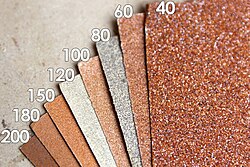
Grit size refers to the physical dimensions of the abrasive particles. Coarser grits (around 2 mm) are ideal for removing material from hard surfaces quickly, though they risk damaging fine details. Ultrafine grits (under 1 μm) are used for precision finishing.
Because different regions use different measurement systems, several standards exist to ensure consistency:
- ANSI/CAMI: The standard used in the United States.
- FEPA (P Grade): The European standard, which also serves as the basis for ISO 6344.
- JIS: The standard primarily used in Japan and other Asian countries.
- Micron Grading: Used for extra-fine grits (60-0.1μm) to specify exact particle size.
Some products use non-regulated descriptive terms like "coarse," "medium," or "fine," which can vary between different manufacturers.
Manufacturing and Size Filtration
To ensure a uniform finish, abrasive particles must be filtered by size after being crushed. The method used depends on the target grit size:
- Sieving: Coarse particles are passed through a series of increasingly finer test sieves.
- Air Classification: Medium particles are separated by weight using air flows.
- Water Classification: The finest particles are separated based on their sedimentation rate (how quickly they settle in a liquid tank).
Coating Types and Adhesives
The way grit is distributed across the backing determines the sandpaper's application. Closed coat sandpaper has 90% to 95% surface coverage, making it ideal for hand sanding and hard materials. Open coat sandpaper has 50% to 70% coverage; the gaps between particles make it more flexible and prevent clogging, making it better suited for softer materials, though it is less effective for perfectly even polishing.
Bonding and Application
Adhesives bond the grit to the backing. While hide glue is still used, it is not waterproof and often fails under the heat of machine sanding. Resin bonds are used for waterproof or wet/dry sandpapers.
Adhesives are typically applied in two stages: the make-coat (which binds the grit to the backing) and the size-coat (which fixes the grit in place from above). These are applied via gravity coating or electrostatic coating. In the latter, electric fields give the backing a negative charge and the grit a positive charge, resulting in a stronger bond than gravity-based methods.
Anti-Loading Technology
To prevent the sandpaper from "loading" (clogging with debris), some papers are stearated. This involves adding a dry lubricant, usually zinc stearate, to the abrasive. This "soap" layer is particularly useful when sanding paint or finishes, as it prevents clogging and extends the life of the paper.
Summary of Abrasive Materials
| Material | Type | Primary Use | Key Characteristic |
|---|---|---|---|
| Aluminium Oxide | Synthetic | Wood and Metal | Strong and inexpensive |
| Alumina Zirconia | Synthetic | Heavy Duty | Superior sharpness and longevity |
| Silicon Carbide | Synthetic | Wet Sanding | Available in very fine grits |
| Emery | Natural | Metal Polishing | Natural mineral |
| Garnet | Natural | Wood Finishing | Natural mineral |
| Iron Oxide | Natural | Soft Metal Polishing | Used in crocus paper |
Frequently Asked Questions
What is the difference between open coat and closed coat sandpaper?
Closed coat sandpaper covers 90-95% of the surface, providing a more consistent polish for hard materials. Open coat covers 50-70%, offering more flexibility and reducing clogging, which is ideal for softer materials.
What does "friability" mean in abrasives?
Friability is the property that allows abrasive grains to fracture under heat, breaking away to reveal new, sharp cutting edges, which prevents the sandpaper from becoming dull quickly.
Why is stearated sandpaper used for painting projects?
Stearated sandpaper contains zinc stearate, a dry lubricant that prevents paint and finish debris from clogging the grit, thereby increasing the sandpaper's useful life.
Which grit standard should I follow?
It depends on your region: ANSI/CAMI is used in the US, FEPA (P Grade) is used in Europe and is the basis for ISO 6344, and JIS is common in Japan and Asia.
How are the finest abrasive particles separated?
The finest particles are separated using water classification, a process based on sedimentation where particles are sorted by how quickly they settle to the bottom of a liquid tank.