Abrahamic Religions and the Controversy of Idolatry
The concept of idolatry—the worship of hollow forms or cult images—has been a central point of theological debate across the Abrahamic faiths. Derived from the Greek eidolon (meaning "appearance"), the term entered Middle English in the 13th century. While some practitioners view cult images as idols, others distinguish between the act of worship and the act of veneration.
This tension is captured in the Book of Isaiah, which highlights the paradox of worshipping "the work of their own hands," a sentiment echoed in both Isaiah 2.8 and 17.8.
Key Facts
- Judaism is strictly aniconic, forbidding any physical depiction of God.
- Christianity distinguishes between latria (adoration due to God) and veneration (respect shown to saints or icons).
- Islam emerged in opposition to the pagan idol worship centered at the Kaaba in Mecca.
- Iconoclasm refers to the deliberate destruction of religious images, a phenomenon seen during the Byzantine era and the Protestant Reformation.
Judaism: The Strict Prohibition of Images
In Judaism, idolatry is regarded as one of the gravest sins. The faith is aniconic, meaning that any physical representation of God or the use of cult images is strictly disallowed.
These prohibitions extend beyond the act of worship itself. Jewish law includes stipulations against eating food offered as libations to idols, moving openly in areas where idols are present, or interacting with idol worshippers during specific festivals. Over time, the definition of idolatry evolved. The Mishnah and Talmud define it as worshipping a graven image through actions typically reserved for the Jewish God in the Temple in Jerusalem, such as sacrificing animals, offering incense, prostrating, or sprinkling blood on altars. While kissing or "honoring" an idol was not classified as idolatry per se, it remained forbidden.
Christianity: Veneration versus Worship
Christianity presents a more complex relationship with imagery. Images that are venerated are known as icons. Catholic and Eastern Orthodox traditions make a sharp distinction between veneration (respectful honor) and adoration (latria), the latter being reserved for God alone.
The acceptance of these images was not immediate. Eastern Orthodoxy faced the Byzantine Iconoclasm in the 8th and 9th centuries, and monumental sculpture remained rare. In the West, the shift toward sculpted images was slow until the reign of Charlemagne. A pivotal moment occurred when Charlemagne placed a life-size crucifix in the Palatine Chapel in Aachen, paving the way for large statues and church reliefs.
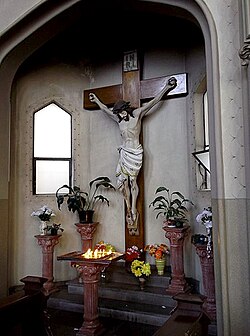
The Libri Carolini, an 8th-century work commissioned by Charlemagne, established the Catholic position on images, granting them a significant, though slightly less prominent, role than in Eastern Orthodoxy. Some early Christians believed idols were inhabited by demons; thus, destroying them was seen as a way to deprive these spirits of a material dwelling.
The Reformation and Iconoclasm
The 16th-century Reformation triggered widespread iconoclasm (the breaking of images) across England, Scotland, Ireland, Germany, Switzerland, France, and the Low Countries. This movement, known as the Beeldenstorm in the Low Countries, saw the near-total destruction of three-dimensional images of saints and the Virgin Mary, as well as the smashing of stained glass.
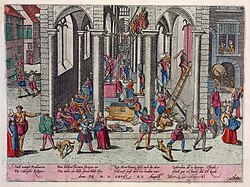
Further destruction occurred during the English Civil War, driven by Puritans. In response, Catholic centers like Rome and Antwerp launched a Counter-Reformation renewal of religious imagery. This era saw the flourishing of the veneration of the Virgin Mary and the construction of new shrines, such as those in Rome's Santa Maria Maggiore.
The Catechism of the Catholic Church clarifies that honoring an image is not idolatry because the honor passes to the "prototype"—the person portrayed in the image.
Islam: The Purification of the Kaaba
Before the rise of Islam, the city of Mecca was characterized by al-Jahiliyah (the pre-Islamic era). During this time, pagan merchants controlled the Kaaba, which served as a center where various Arabian tribes placed their idols. This arrangement generated significant wealth for Meccan merchants through tithes and fostered a stable environment for trade.
The teachings of Muhammad challenged this system, leading to volatile opposition and his eventual flight to Medina. Following a series of conflicts, Muhammad conquered Mecca in 630. Upon his return, he took three decisive actions: he destroyed the idols within the Kaaba to remove the signs of Jahiliyyah, ordered the construction of the first Masjid al-Haram (mosque) around the Kaaba, and pardoned his former enemies. This transition marked the end of idol worship in Mecca and facilitated the rise of Islam.
Summary of Perspectives on Imagery
| Religion | Stance on Images | Key Term/Concept | Historical Turning Point |
|---|---|---|---|
| Judaism | Strictly Forbidden | Aniconism | Mishnah/Talmud definitions |
| Christianity | Veneration Allowed | Icons / Latria | Reformation/Counter-Reformation |
| Islam | Strictly Forbidden | Al-Jahiliyah | Conquest of Mecca (630) |
Frequently Asked Questions
What is the difference between veneration and worship in Christianity?
Veneration is a respectful honor shown to a saint or a holy image (icon), whereas worship (or latria) is the absolute adoration reserved exclusively for God.
What does it mean for a religion to be aniconic?
Aniconism is the prohibition of physical representations of a deity or other sacred figures, as seen in the strict laws of Judaism.
What was the Beeldenstorm?
The Beeldenstorm was a period of violent iconoclastic riots in the Low Countries during the 16th-century Reformation, resulting in the widespread destruction of church decorations and paintings.
How did Muhammad change the Kaaba in Mecca?
After the conquest of Mecca in 630, Muhammad removed and destroyed the pagan idols housed in the Kaaba and established the Masjid al-Haram around it.
Why did some early Christians destroy idols?
Some believed that idols were not just statues but were inhabited by demons; destroying the physical object was believed to deprive the demon of its earthly dwelling.