A9 Dualling Project: Transforming the Route from Perth to Inverness
The A9 is one of Scotland's most critical transport arteries, connecting the cities of Perth and Inverness. To improve safety and efficiency, Transport Scotland is overseeing a massive upgrade to convert significant portions of the route into a dual carriageway (a road with two separate carriageways for traffic traveling in opposite directions). This ambitious project aims to modernize the driving experience and reduce the high rate of accidents associated with the existing single-carriageway sections.
While the project has faced significant delays and criticism, it remains a cornerstone of Scotland's infrastructure strategy, with a total estimated cost of £3.7 billion.
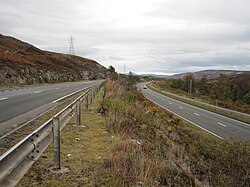
Key Facts
- Total Estimated Cost: £3.7 billion.
- Project Timeline: Started in 2015 with a target completion date of 2035.
- Current Progress: As of October 2025, 35% of the route between Perth and Inverness is dualled.
- Future Milestones: 48% completion by 2030, 85% by 2033, and 100% by 2035.
- Traffic Volume: Annual average daily traffic (AADT) ranges from 8,500 near Pitlochry to 37,000 near Inverness.
Speed Limits and Road Safety
Safety has been a primary driver for the A9 upgrades. To manage risks on single-carriageway sections, the government has implemented various speed controls. In October 2014, average speed cameras were introduced alongside a 50 mph speed limit trial for HGVs (Heavy Goods Vehicles, defined as vehicles over 7.5 tonnes gross vehicle weight).
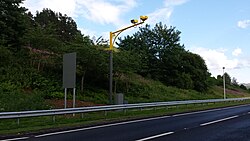
While a proposal to lower the national speed limit on single carriageways from 60 to 50 mph for all vehicles was rejected, there are ongoing discussions to align HGV speed limits with those in England and Wales. Currently, the speed limits for the A9 between Perth and Inverness are as follows:
| Vehicle Type | Single Carriageway (SC) | Dual Carriageway (DC) |
|---|---|---|
| Cars/Motorcycles | 60 | 70 |
| Cars towing trailers | 50 | 60 |
| HGVs | 50 | - |
| Buses/Coaches | 50 | - |
Construction Progress and Timeline
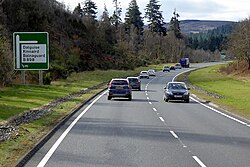
The dualling process is being executed in sections. Early successes include the Kincraig to Dalraddy and Luncarty to Pass of Birnam stretches, both of which are now complete.
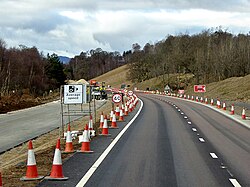
Recent activity has focused on the Tomatin to Moy and Tay Crossing to Ballinluig sections, both currently under construction. Looking ahead, the statutory process for the Pass of Birnam to Tay Crossing section began in May 2025, which will introduce a new roundabout and two grade-separated junctions to improve traffic flow.
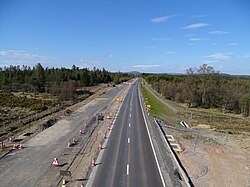
The project faces a logistical challenge to meet the 2035 deadline. Transport Scotland has indicated that up to 43 miles of concurrent roadworks may be necessary, though individual work zones will be capped at 15 miles to manage disruption.
Detailed Section Status
| Section | Length | Status | End of Work |
|---|---|---|---|
| Kincraig to Dalraddy | 4.7 mi | Complete | Sep 2017 |
| Luncarty to Pass of Birnam | 5.9 mi | Complete | Aug 2021 |
| Tomatin to Moy | 6 mi | Under construction | 2028 |
| Tay Crossing to Ballinluig | 5.1 mi | Under construction | 2028 |
| Pitlochry to Killiecrankie | 4 mi | In preparation | 2030 |
| Pass of Birnam to Tay Crossing | 5.2 mi | In preparation | 2032 |
| Dalraddy to Slochd | 15.6 mi | In preparation | 2033 |
| Dalwhinnie to Crubenmore | 6.9 mi | In preparation | 2033 |
| Crubenmore to Kincraig | 10.3 mi | In preparation | 2035 |
| Glen Garry to Dalwhinnie | 5.9 mi | In preparation | 2035 |
| Killiecrankie to Glen Garry | 13.8 mi | In preparation | 2035 |
Challenges and Criticism
The project has not been without controversy. The original completion target of 2025 was missed, leading to a revised deadline of 2035. This ten-year delay has sparked criticism from campaigners and political figures who argue that the slow pace of work endangers lives on the "deadliest" sections of the road.
In January 2025, the Scottish Government rejected calls to prioritize the most dangerous sections of the single carriageway, stating that such a shift would not necessarily shorten the overall project timeline. Additionally, some critics have questioned the environmental impact of the project in relation to Scotland's net-zero goals.
Frequently Asked Questions
When will the A9 dualling be fully completed?
The current target completion date for the entire project between Perth and Inverness is 2035.
How much of the A9 is currently a dual carriageway?
As of October 2025, approximately 35% of the route between Perth and Inverness has been upgraded to a dual carriageway.
What is the total cost of the upgrade?
The estimated cost for the dualling project is £3.7 billion.
Why was the completion date pushed back from 2025 to 2035?
The project has faced significant delays, leading the Scottish Government to revise the timeline to ensure all sections can be completed, though specific reasons for the initial delays have been a point of political debate.
What are the current speed limits for HGVs on the A9?
HGVs are currently subject to a 50 mph speed limit on single-carriageway sections of the A9.