63rd (Royal Naval) Division: From Naval Volunteers to Army Infantry
The 63rd (Royal Naval) Division was a unique infantry formation of the United Kingdom during the First World War. Born from the necessity of the early war effort, it began as a collection of Royal Navy and Royal Marine reservists and volunteers who were not required for sea service. This hybrid force, initially known as the Royal Naval Division (RND), bridged the gap between naval tradition and land warfare, fighting in some of the most grueling campaigns of the Great War.
For personnel from the Royal Navy, the division used the designation HMS Victory IV to maintain naval administrative structures while operating on land. Over the course of the war, the division evolved from a naval experiment into a seasoned army formation, eventually being transferred to the British Army in July 1916.

Key Facts
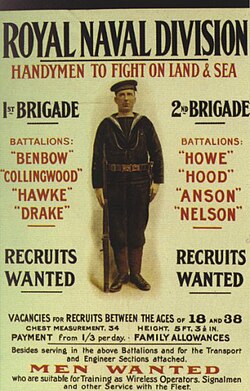
- Active Period: August 20, 1914, to April 1919.
- Original Composition: Royal Navy and Royal Marine reservists and volunteers.
- Major Transitions: Transferred from the Royal Navy to the British Army on July 19, 1916.
- Primary Theaters: Belgium (Antwerp), Gallipoli, and the Western Front (France and Flanders).
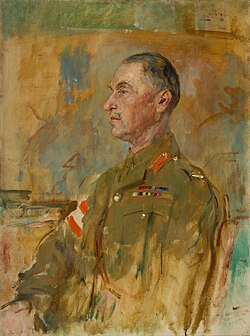
- Commanders: Notable leaders included Major-General Archibald Paris and Major-General Charles Lawrie.
Early Operations in Belgium
At the outbreak of war, the division was deployed to Flanders. Initial forces from the Chatham, Portsmouth, and Plymouth battalions landed at Ostend on August 27 and 28, 1914, to hold the town alongside Belgian troops. However, a rapid Allied retreat forced the War Office to shift supply lines to western France, leading to the re-embarkation of the Marines on September 31.
The division soon found itself embroiled in the Siege of Antwerp. Under the command of Major-General Archibald Paris and receiving orders from Winston Churchill, the force attempted to defend the city. The Royal Marine Brigade and naval brigades occupied shallow trenches that left them dangerously exposed to German artillery observers.
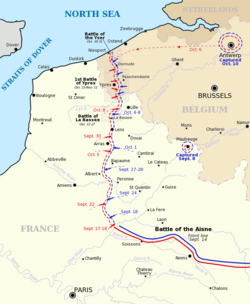
The withdrawal from Antwerp in October 1914 was chaotic. While most of the division retreated toward the Netherlands frontier and eventually returned to Deal, a communication failure left three battalions of the 1st Naval Brigade and the Portsmouth battalion of the Marine Brigade behind. During a disorganized retreat via railway, a train was derailed at Moerbeke, resulting in the capture of approximately 550 men.
The Gallipoli Campaign
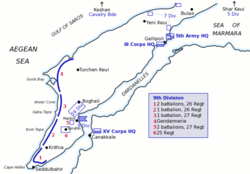
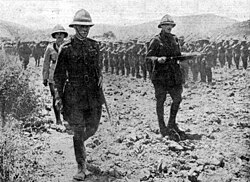
In 1915, the division was shipped to Egypt before participating in the Gallipoli campaign at Anzac Cove and Cape Helles. The campaign was marked by high casualties, including the death of poet Rupert Brooke, who died of an infected mosquito bite on April 23, 1915.
The RND was one of only two British divisions involved in the initial landings. The operation involved a complex naval bombardment and a daring reconnaissance mission by Lieutenant-Commander Bernard Freyberg, who swam ashore at night to discover that the Ottoman defenses were largely dummies.
Transition to the Western Front
By July 19, 1916, heavy losses among the original naval volunteers led to the division's transfer to the British Army. It was redesignated as the 63rd (Royal Naval) Division, taking the number of a previously disbanded Territorial Force division. From this point forward, they fought as army infantry on the Western Front.
Battle of the Ancre and Miraumont
In February 1917, the division attacked on the north bank of the Ancre to capture a section of the road toward Puisieux. Despite oppressive fog and mud, the division successfully utilized a creeping barrage—a tactic where artillery fire advances in timed increments just ahead of the infantry—to overcome German strong-points. The operation resulted in 549 casualties but captured 599 prisoners.
The Second Battle of Passchendaele
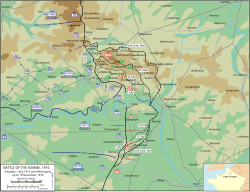
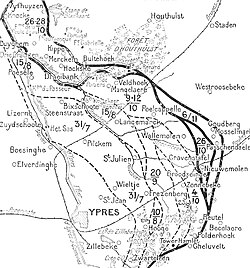
The division faced extreme conditions during the Second Battle of Passchendaele (October 26 – November 10, 1917). Operating near the Canadian Corps, the 188th Brigade initially captured Varlet Farm and Banff House. However, deep mud and intense machine-gun fire stalled further progress. Between October 26 and 31, the division suffered 3,126 casualties. They eventually secured ground up to the Paddebeek using night attacks, which proved more effective and less costly.
Divisional Summary and Structure
The division's organization shifted significantly after its transfer to the Army. The 1916 reorganization reduced the force to two naval infantry brigades and one army brigade. Due to heavy losses at Passchendaele and Welsh Ridge, some naval battalions, such as the Howe and Nelson battalions, were eventually disbanded.
| Category | Details |
|---|---|
| Branch | Royal Navy (1914–1916), British Army (1916–1919) |
| Type | Infantry Division |
| Key Engagements | Antwerp, Gallipoli, Ancre, Arras, Passchendaele, Cambrai |
| HQ Location | Westminster, London |
| Parent Corps | VIII Corps |
Frequently Asked Questions
Why was a naval division fighting on land?
The division was formed from Royal Navy and Royal Marine reservists and volunteers who were not needed for sea service at the start of World War I, allowing the UK to utilize their manpower for land operations.
When did the division become part of the British Army?
The division was officially transferred to the British Army on July 19, 1916, and redesignated as the 63rd (Royal Naval) Division.
What was the significance of HMS Victory IV?
HMS Victory IV was the administrative designation used for Royal Navy personnel within the division to maintain their naval status and records while serving as infantry.
Which major battles did the 63rd Division fight in?
The division fought in the Siege of Antwerp, the Gallipoli campaign, the Battle of the Ancre, the Battle of Arras, the Second Battle of Passchendaele, and the Battle of Cambrai.
How did the division's structure change over time?
Originally composed of naval and marine brigades, the 1916 reorganization introduced an army brigade (the 190th) and eventually led to the disbandment of some naval battalions due to high casualty rates.