52nd Sikhs (Frontier Force)
The 52nd Sikhs (Frontier Force) was a distinguished infantry regiment of the British Indian Army with a legacy spanning nearly two centuries. Known by nicknames such as the Dogra Paltan and Tunpur Bwanja, the unit evolved through various designations and organizational shifts, eventually becoming a cornerstone of the modern Pakistan Army.
Key Facts
- Active Period: 1846–1922 (as a distinct regiment); continues today as 4th Battalion The Frontier Force Regiment.
- Original Composition: Primarily Dogras, with Pathans and Gurkhas.
- Key Affiliation: Part of the Punjab Frontier Force, famously known as "The Piffers."
- Major Honors: Recipient of the Victoria Cross (Lt Col Arthur Edward Cumming) and the Nishan-i-Haider (Major Muhammad Akram).
- Uniform: Drab with scarlet facings.
Founding and Early Frontier Service
The regiment was raised on December 22, 1846, at Kangra by Major JWV Stephen. Originally titled the 2nd Regiment of Infantry The Frontier Brigade, its diverse makeup of Dogras, Pathans, and Gurkhas earned it the designation "Hill Corps." By 1851, the unit joined the Punjab Irregular Force, which later became the Punjab Frontier Force (the Piffers). This elite force, comprising cavalry, infantry, and artillery, was tasked with maintaining order on the volatile Punjab Frontier.
During its early years, the regiment saw extensive action in the Second Sikh War (1848–49) and the Great Indian Mutiny (1857–58), where it operated in the Murree Hills and Hazara. Its operational reach extended further during the Second Afghan War (1878–80), participating in the Battles of Kandahar and Ahmad Khel.
Global Deployments
The regiment's service was not limited to the Indian subcontinent. In 1902, the unit was deployed to British Somaliland to suppress a resistance movement led by Diiriye Guure of the Dervish State.
The 20th Century: World Wars and Transitions
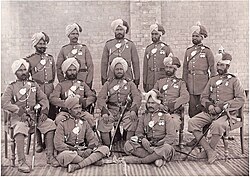
Following the 1903 reforms led by Lord Kitchener, the unit was officially designated as the 52nd Sikhs (Frontier Force). By the outbreak of the First World War in 1914, the regiment's composition included three companies of Dogras, two of Pathans, two of Sikhs, and one of Punjabi Muslims.
During the First World War, the regiment served in Mesopotamia as part of the 18th Indian Division, fighting in the Battle of Sharqat in 1917. Later, in 1919, they moved to Kurdistan to help suppress the Iraqi Revolt of 1920.
The Second World War and the Malayan Campaign
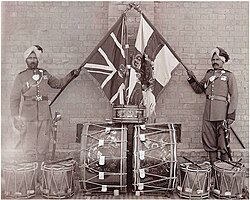
In 1922, the 52nd Sikhs were grouped with other units to form the 12th Frontier Force Regiment, becoming its 2nd Battalion (Sikhs). During the Second World War, the battalion fought in the Malayan Campaign. Their Commanding Officer, Lieutenant Colonel Arthur Edward Cumming, was awarded the Victoria Cross for outstanding valour. However, the battalion was captured by Japanese forces following the surrender of Singapore in February 1942, only to be re-raised in 1946.
Integration into the Pakistan Army
With the partition of India in 1947, the Frontier Force Regiment was allocated to the Pakistan Army. The unit saw immediate action in the 1948 Kashmir War. In 1956, following a merger with the Pathan Regiment and the Frontier Force Rifles, the unit was redesignated as the 4th Battalion The Frontier Force Regiment (4 FF).
The battalion continued to distinguish itself in subsequent conflicts, fighting in the Sialkot Sector during the Indo-Pakistan War of 1965 and demonstrating exceptional courage at the Battle of Hilli during the 1971 war. For his bravery in the latter conflict, Major Muhammad Akram was awarded the Nishan-i-Haider, Pakistan's highest military gallantry award.
Regimental Summary
| Period/Year | Designation | Key Engagement/Event |
|---|---|---|
| 1846 | 2nd Regiment of Infantry The Frontier Brigade | Formation at Kangra |
| 1848–1880 | 2nd (or Hill) Sikh Infantry | Second Sikh War, Indian Mutiny, Second Afghan War |
| 1903 | 52nd Sikhs (Frontier Force) | Kitchener Reforms |
| 1914–1920 | 52nd Sikhs (Frontier Force) | WWI (Mesopotamia), Iraqi Revolt |
| 1922–1947 | 2nd Battalion (Sikhs) 12th FFR | Malayan Campaign, Singapore Surrender |
| 1947–Present | 4th Battalion The Frontier Force Regiment | Kashmir War, 1965 War, 1971 War (Battle of Hilli) |
Frequently Asked Questions
What were the 52nd Sikhs commonly called?
The regiment was known by the nicknames Dogra Paltan and Tunpur Bwanja, and as part of the Punjab Frontier Force, they were referred to as "Piffers."
Who was the most decorated officer during WWII?
Lieutenant Colonel Arthur Edward Cumming, the Commanding Officer during the Malayan Campaign, was awarded the Victoria Cross for his outstanding valour.
Which modern army does the regiment belong to?
Following the 1947 partition, the regiment was allocated to the Pakistan Army, where it currently exists as the 4th Battalion The Frontier Force Regiment.
What was the significance of the Battle of Hilli?
During the Indo-Pakistan War of 1971, the battalion fought with great courage at the Battle of Hilli, resulting in Major Muhammad Akram receiving the Nishan-i-Haider, Pakistan's highest gallantry award.
What was the original ethnic composition of the unit?
When raised in 1846, the regiment was composed mostly of Dogras, along with Pathans and Gurkhas.