24-Isopropyl Cholestane and the Evolution of Precambrian Sponges
The transition from single-celled organisms to complex, multicellular life is one of the most significant chapters in Earth's history. Central to this mystery is the Cambrian explosion, a period of rapid diversification that occurred approximately 541 million years ago. However, chemical clues found in ancient rocks suggest that the foundations for this explosion were laid much earlier. One such clue is 24-isopropyl cholestane, a molecular fossil that may push the origin of animals back millions of years.
Key Facts
- 24-isopropyl cholestane is a C30 sterane (C30H54) produced by certain sponges, protists, and marine algae.
- High concentrations of this molecule in Neoproterozoic rocks suggest sponges existed before the Cambrian explosion.
- The ratio of 24-isopropyl cholestane to 24-n-propyl cholestane is used to distinguish between sponge and algal sources.
- Evidence for early sponges is found in the Hufq supergroup in Oman and bioclastic packstones in South Australia.
- The presence of this biomarker in rhizarian protists complicates its use as a definitive sponge proxy.
The Chemistry of Molecular Fossils
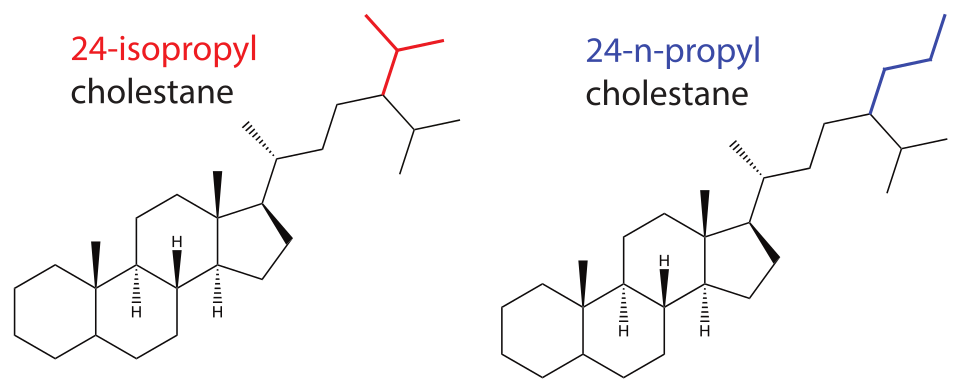
In the study of ancient life, scientists often rely on biomarkers—organic molecules that remain stable over geologic time and can be traced back to specific biological sources. 24-isopropyl cholestane is a geologically stable form of 24-isopropyl cholesterol. It features a cholestane skeleton with an isopropyl moiety at the C 24 position, with a molecular mass of 414.76 g/mol.
A closely related molecule is 24-n-propyl cholestane, which also possesses a cholestane skeleton but has an n-propyl moiety at C 24. While both are found in marine environments, their relative proportions provide critical data for paleontologists.
The Argument for Precambrian Sponges
24-isopropyl cholestane is produced in large quantities by Demospongiae, a class of sponges within the phylum Porifera. When researchers identified high abundances of this molecule in Precambrian rocks from the Hufq supergroup in Oman, it suggested that sponges were present long before the rapid radiation of life in the Cambrian period.
Using Sterane Ratios as a Proxy
Because marine pelagophyte algae also produce 24-isopropyl cholestane (though they primarily produce 24-n-propyl cholestane), scientists use the ratio between the two to determine the source. In most rocks, this ratio is low (0.2–0.3). However, in the Omani samples, the ratio ranges from 0.52 to 16.1, with an average of 1.51. This significant elevation strongly suggests the presence of sponge organic matter.
Supporting Physical Evidence
Beyond chemistry, researchers have examined bioclastic packstones from South Australia. By creating 3D models of asymmetric structures with interconnected channels roughly 1 mm in diameter, they found networks that appear inconsistent with algae or fungi. While controversial, these structures are tentatively interpreted as primitive sponges.
Implications for Earth's History
The timing of these findings is crucial. Various estimates place the age of these biomarker-bearing rocks between 650 Ma and 540 Ma (millions of years ago), all of which pre-date the Cambrian explosion at ~541 Ma.
If sponges existed this early, it alters our understanding of the coupling between biology and the Neoproterozoic climate. This period was marked by "Snowball Earth" episodes, the deposition of Banded Iron Formations, and a gradual rise in atmospheric oxygen. The presence of sponges raises questions about the minimum dissolved oxygen (O2) levels in ancient oceans and the transition from a euxinic (sulfidic and anoxic) Canfield ocean to the oxygenated deep-ocean we see today.
| Molecule | Chemical Formula | Primary Biological Sources | Geologic Significance |
|---|---|---|---|
| 24-isopropyl cholestane | C30H54 | Demospongiae, Rhizaria, Algae | Potential proxy for early animal life |
| 24-n-propyl cholestane | C30H54 | Marine pelagophyte algae | Baseline for algal organic input |
Scientific Caveats and Controversies
Despite the compelling evidence, the link between 24-isopropyl cholestane and sponges is not undisputed. Several factors complicate this interpretation:
- Specificity: The discovery of 24-isopropyl cholestane in rhizarian protists (single-celled organisms) means the molecule cannot be used alone to prove the existence of sponges.
- Algal Evolution: It is possible that extinct ancestors of modern algae produced higher ratios of these steranes, or that algae changed their production patterns over 600 million years.
- Diagenesis: Some argue that the molecule could be formed through sedimentary diagenesis—the chemical alteration of other organic molecules after they are buried in sediment.
- Symbiosis: Bacteria living symbiotically with sponges might be the actual producers of the biomarker.
- The Fossil Gap: There is a notable absence of widespread sponge fossils accompanying these biomarkers, and the sterane ratio returns to background levels during the Paleozoic, which is unexpected given the proliferation of sponges.
Frequently Asked Questions
What is 24-isopropyl cholestane?
It is a C30 sterane, a stable organic molecule produced by certain sponges, marine algae, and protists, used by scientists as a molecular fossil to study ancient life.
Why is this molecule important for understanding the Cambrian explosion?
Its presence in rocks dating back to the Neoproterozoic suggests that multicellular animals, specifically sponges, may have evolved millions of years before the rapid diversification of the Cambrian explosion.
How do scientists tell if the molecule came from a sponge or algae?
They analyze the ratio of 24-isopropyl cholestane to 24-n-propyl cholestane. A high ratio (typically above 0.3) is generally interpreted as an indicator of sponge organic matter.
Does the presence of sponges prove the oceans were highly oxygenated?
Not necessarily. Research suggests that sponges can survive with very little oxygen, meaning their presence in the Precambrian may not provide strict constraints on the oxygen levels of the Proterozoic oceans.
What is the main argument against the sponge hypothesis?
The primary argument is a lack of specificity; because rhizarian protists also produce 24-isopropyl cholestane, the biomarker is not uniquely linked to sponges.