1st South Midland Mounted Brigade: From the English Midlands to the Middle East
The 1st South Midland Mounted Brigade was a distinguished yeomanry formation of the British Army, serving through some of the most challenging theaters of the First World War. Formed as part of the Territorial Force—a volunteer reserve force—in 1908, the brigade evolved through several redesignations, eventually becoming the 5th Mounted Brigade and later the 13th Cavalry Brigade.
From its origins in the English Midlands to the deserts of Palestine, the brigade's history is a testament to the versatility of the Yeomanry, transitioning from traditional mounted roles to dismounted infantry combat and back again.
Key Facts
- Active Period: 1908 – April 1920.
- Primary Roles: Yeomanry and Cavalry.
- Major Campaigns: Gallipoli, Egypt, and Palestine.
- Key Evolution: Transitioned from 1st South Midland Mounted Brigade → 5th Mounted Brigade → 13th Cavalry Brigade.
- Notable Action: Participated in the charge at Huj, the final British cavalry charge against enemy guns.
Formation and Early Service
Established under the Territorial and Reserve Forces Act 1907, the brigade was officially formed in 1908. Its composition reflected its regional roots, drawing units primarily from Gloucestershire, Warwickshire, and Worcestershire. The original structure included three yeomanry regiments, a horse artillery battery and ammunition column, a transport and supply column, and a field ambulance.
Upon the outbreak of the First World War on August 4, 1914, the brigade was embodied and initially deployed to East Anglia. After a brief period with the 1st Mounted Division, it joined the 2nd Mounted Division in September 1914, spending the following months on coastal defence duties in Norfolk.
The Gallipoli Campaign
In April 1915, the brigade moved to Egypt, arriving in Alexandria on April 24. By August, the unit faced a significant tactical shift: it was dismounted, meaning the soldiers fought as infantry. To maintain their mounts, each regiment left behind a squadron headquarters and two troops (approximately 100 men) in Egypt to care for the horses.
The brigade landed at "A" Beach, Suvla Bay, on the night of August 17, 1915. They were soon thrust into heavy combat, advancing toward Chocolate Hill and participating in the attack on Hill 112. The attrition of the Battle of Scimitar Hill necessitated a reorganization on September 4, 1915, where the brigade was absorbed into the 1st Composite Mounted Brigade as a battalion-sized unit known as the 1st South Midland Regiment.
Service in Egypt and Palestine
Returning to Egypt in December 1915, the unit was reformed and remounted. On April 20, 1916, the 1st South Midland Mounted Brigade was officially redesignated as the 5th Mounted Brigade. By January 1917, it joined the Imperial Mounted Division, which later became the Australian Mounted Division in June 1917.
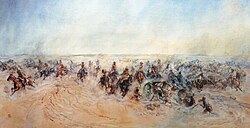
During this period, the brigade played a pivotal role in the Sinai and Palestine Campaign, including the First, Second, and Third Battles of Gaza. They were instrumental in the Capture of Beersheba and the Battle of Mughar Ridge, as well as defending against Turkish counter-attacks during the defense of Jerusalem. One of the most storied moments in the brigade's history occurred at Huj, where three of its squadrons participated in the last British cavalry charge against enemy artillery.
Transition to the 13th Cavalry Brigade
In April 1918, the Egyptian Expeditionary Force (EEF) underwent a major reorganization following the arrival of Indian Army units. The 5th Mounted Brigade merged with elements of the 3rd (Ambala) Cavalry Brigade. This merger saw the Royal Gloucestershire Hussars remain, while the Warwickshire Yeomanry and Queen's Own Worcestershire Hussars were reassigned. In their place, the 9th Hodson's Horse and 18th King George's Own Lancers joined the formation.
On July 22, 1918, the unit was renumbered as the 13th Cavalry Brigade, part of the 5th Cavalry Division. The brigade concluded the war with successful operations in the Affair of Abu Tellul, the Battle of Megiddo, the Capture of Damascus, and the Occupation of Aleppo.
Following the Armistice of Mudros, the brigade remained in Palestine for occupation duties until it was finally disbanded in April 1920.
Brigade Summary
| Designation | Period | Key Division | Notable Commander |
|---|---|---|---|
| 1st South Midland Mounted Brigade | 1908 – 1916 | 2nd Mounted Division | Brigadier-General E.A. Wiggin |
| 5th Mounted Brigade | 1916 – 1918 | Imperial / Australian Mounted Division | Brigadier-General P.D. FitzGerald |
| 13th Cavalry Brigade | 1918 – 1920 | 5th Cavalry Division | Brigadier-General P.J.V. Kelly |
Frequently Asked Questions
What was the original purpose of the 1st South Midland Mounted Brigade?
It was formed in 1908 as part of the Territorial Force, serving as a yeomanry brigade composed of volunteer cavalry units from the southern English Midlands.
Why did the brigade fight dismounted at Gallipoli?
Due to the terrain and the nature of the Gallipoli Campaign, the brigade was required to fight as infantry. They left a small contingent of men in Egypt to care for their horses during this period.
What was the significance of the charge at Huj?
The charge at Huj is historically significant as it was the final British cavalry charge conducted against enemy guns during the First World War.
How did the brigade change when it became the 13th Cavalry Brigade?
The brigade merged with elements of the 3rd (Ambala) Cavalry Brigade, incorporating Indian Army units such as 9th Hodson's Horse and 18th King George's Own Lancers, while some original British yeomanry units were reassigned.
When was the brigade finally disbanded?
After serving as part of the occupation forces in Palestine following the Armistice, the brigade was disbanded in April 1920.