1991–92 European Cup: Barcelona's Historic First Triumph
The 1991–92 European Cup stands as a pivotal moment in football history. As the 37th season of the prestigious tournament, it served as the bridge between the traditional knockout format and the modern era. This edition was the final one held before the competition was officially rebranded as the UEFA Champions League.
This season introduced a groundbreaking change: the first-ever group stage. Rather than a straight knockout path to the final, the eight winning clubs from the second round were divided into two groups of four. These teams played each other home and away, with only the group winners advancing to the championship match.
Key Facts
- Champions: Barcelona (their 1st title).
- Runners-up: Sampdoria.
- Winning Goal: Scored by Ronald Koeman via a free kick in the 112th minute.
- Venue: The final was hosted at Wembley Stadium in London.
- Top Scorers: Sergei Yuran (Benfica) and Jean-Pierre Papin (Marseille) with 7 goals each.
- Total Attendance: 1,725,387 spectators across 73 matches.
The Road to Wembley
The tournament began with 32 teams entering the first round. Among the participants was Arsenal, marking the return of English clubs to the European Cup after a five-year ban resulting from the 1985 Heysel Stadium disaster. While Arsenal reached the second round, other giants like Marseille and Benfica also made deep runs.
The group stage saw Barcelona dominate Group B, securing their place in the final. In Group A, Sampdoria emerged victorious to set up a clash between the Spanish and Italian sides.
Geopolitical Shifts and Tournament Impact
The 1991–92 season was heavily influenced by the political climate of the era. Red Star Belgrade, the defending champions, were severely hampered by the Yugoslav Wars, which prevented them from playing at their home ground. They were eventually eliminated in the group stage. This marked the final time clubs from that nation participated in the primary European competition before the independence of Slovenia and Croatia.
Additionally, this season saw the final appearance of an East German team, Hansa Rostock, following the reunification of Germany.
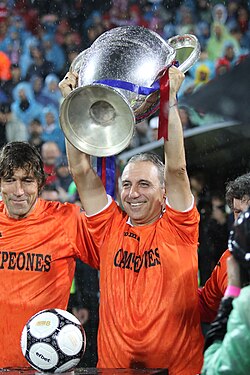
The Final Match
On May 20, 1992, Barcelona faced Sampdoria at Wembley Stadium. The match was a tense affair that remained deadlocked through regulation time. It took extra time to find a winner, when Ronald Koeman struck a decisive free kick in the 112th minute to secure a 1–0 victory.
This victory was historic, marking the first time a Spanish team had won the tournament since 1966 and the first of five European Cup trophies for Barcelona.
Tournament Summary
| Category | Detail |
|---|---|
| Dates | 17 September 1991 – 20 May 1992 |
| Total Teams | 32 |
| Total Matches | 73 |
| Total Goals | 192 (Avg 2.63 per match) |
| Average Attendance | 23,635 per match |
| Top Scorers | Sergei Yuran & Jean-Pierre Papin (7 goals) |
Frequently Asked Questions
Who won the 1991–92 European Cup?
Barcelona won the tournament, claiming their first-ever title after defeating Sampdoria 1–0 in the final.
How did the tournament format change in 1991–92?
This was the first season to introduce a group stage. The eight winners of the second round were split into two groups, and the winner of each group progressed directly to the final.
Who scored the winning goal in the final?
Ronald Koeman scored the winning goal with a free kick in the 112th minute of extra time.
Why was this season significant for English football?
It marked the return of English clubs to the European Cup after a five-year ban following the Heysel Stadium disaster, with Arsenal representing England.
Which players were the top scorers of the competition?
Sergei Yuran of Benfica and Jean-Pierre Papin of Marseille shared the top scorer spot, each netting 7 goals.