1966 Argentine Coup d'État and the Argentine Revolution
On June 28, 1966, Argentina experienced a pivotal political shift when a military coup d'état overthrew the constitutional government of Arturo Umberto Illia. This event marked the beginning of a period known as the Argentine Revolution (Revolución Argentina), a civil-military dictatorship that ruled the nation until May 25, 1973. Unlike previous military interventions in Argentina, which typically presented themselves as provisional governments, this regime sought to establish a permanent dictatorial system.
This era is frequently studied by political scientists as a prime example of a bureaucratic-authoritarian state—a term coined by Guillermo O'Donnell to describe regimes that prioritize technical expertise and military control over liberal democracy to suppress both communism and democratic instability.
Key Facts
- Date of Coup: June 28, 1966.
- Overthrown Leader: President Arturo Umberto Illia.
- Successive Dictators: Juan Carlos Onganía, Roberto Marcelo Levingston, and Alejandro Lanusse.
- Political Model: Bureaucratic-authoritarian state characterized by technocracy and corporatism.
- Major Unrest: The Cordobazo (1969) and the Night of the Long Batons (1966).
- End Date: May 25, 1973.
The Onganía Regime: Technocracy and Corporatism
General Juan Carlos Onganía assumed the role of de facto president with the support of various industrial capitalists, multinational companies, and certain sectors of the labor movement, including General Confederation of Labour (CGT) leader Augusto Vandor. The regime aimed to replace the existing political structure with a new social and political order.
Technocratic Governance
The Onganía administration emphasized technocracy—the governance of a society by technical experts. The state apparatus was restructured to prioritize technical specialization over political affiliation. This was evident in the cabinet appointments; for example, the Secretary of Housing was led by architects and construction entrepreneurs. Research indicates that approximately 76% of the Onganía regime's officials came from private business backgrounds, integrating industry leaders directly into decision-making processes.
Corporatist Ideology
The regime also implemented a corporatist model, particularly in Córdoba under Carlos Caballero. This system granted representation to specific private and religious organizations in exchange for state control. This often resulted in state functions being transferred to private hands, with Catholic fundamentalists and business groups gaining significant influence over government areas, such as the Ministry of Social Welfare.
Economic Policies and Social Unrest
Under Minister of Economy Adalbert Krieger Vasena (1966–1969), the government pursued liberal economic policies. These included a 40% devaluation of the currency, a wage freeze, and the suspension of collective labor conventions. While these measures favored foreign capital, they severely weakened the agricultural sector and the working class.
The regime also aggressively targeted "immoralism," banning miniskirts and long hair for men, and suppressing avant-garde art. This moral campaign, combined with economic hardship, alienated the middle class and students.
The Night of the Long Batons
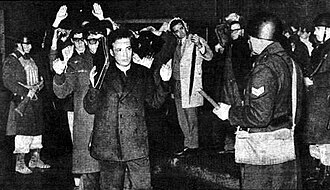
In July 1966, the regime ended university autonomy—a right established in 1918. During the "Night of the Long Batons," police invaded the University of Buenos Aires, assaulting students and faculty. This brutality led to the exile of 301 professors, including prominent scholars like Manuel Sadosky and Tulio Halperín Donghi.
The Cordobazo and Rising Resistance
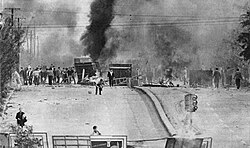
By 1969, opposition peaked with the Cordobazo, a massive uprising in Córdoba led by the CGT de los Argentinos and Agustín Tosco. This sparked similar movements in Rosario (the Rosariazo) and Santa Fe. Simultaneously, left-wing urban guerrilla groups emerged, including the Fuerzas Armadas de Liberación (FAL) and the People's Revolutionary Army (ERP).
Transition of Power: Levingston and Lanusse
The intensity of the protests forced General Onganía to resign in 1970. He was succeeded by General Roberto M. Levingston, who attempted to deepen the goals of the Argentine Revolution through a nationalist-developmentist lens. However, Levingston was soon ousted in an internal coup by General Alejandro Agustín Lanusse in 1971.
Lanusse's tenure was marked by infrastructure projects but failed to address social demands. The period saw an escalation in armed conflict involving groups like the Montoneros and the ERP. A dark chapter of this era was the 1972 Trelew massacre, where 16 prisoners were killed after an attempted escape.
Eventually, Lanusse lifted the ban on the Justicialist Party to facilitate a transition. Because Juan Perón remained in exile, he appointed Héctor José Cámpora as his candidate under the slogan "Cámpora in Government, Perón in power," leading to the end of the military regime in 1973.
Summary of the Argentine Revolution
| Phase/Leader | Period | Key Characteristics | Major Events |
|---|---|---|---|
| Juan Carlos Onganía | 1966–1970 | Technocracy, Corporatism, Moralism | Night of the Long Batons, Cordobazo |
| Roberto Levingston | 1970–1971 | Nationalist-Developmentism | La Hora del Pueblo statement |
| Alejandro Lanusse | 1971–1973 | Infrastructure focus, Transition planning | Trelew massacre, 1973 Elections |
Frequently Asked Questions
What was the primary goal of the Argentine Revolution?
Unlike previous coups, the Argentine Revolution aimed to establish a permanent new political and social order. It sought to replace liberal democracy with a bureaucratic-authoritarian state that gave the Armed Forces a leading role in politics and economics for decades.
What was the "Night of the Long Batons"?
It was a violent police attack in July 1966 against the University of Buenos Aires. The regime violated university autonomy, beating and arresting professors and students, which resulted in a massive "brain drain" as hundreds of intellectuals fled the country.
What was the Cordobazo?
The Cordobazo was a major civil uprising in May 1969 in the city of Córdoba. Led by workers and students, it signaled a breakdown in the regime's control and catalyzed nationwide protests against the Onganía dictatorship.
How did the regime use technocracy?
The regime appointed individuals based on technical specialization rather than political affiliation. This meant that government ministries were often staffed by private sector executives and business owners from the relevant industry to modernize the state without political interference.
Who eventually succeeded the military dictatorship?
The dictatorship ended in 1973 following the election of Héctor José Cámpora, who ran as the representative of Juan Perón under the Justicialist Liberation Front (FreJuLi).