1950 FIFA World Cup: The Dramatic Return of Global Football
The 1950 FIFA World Cup marked a pivotal moment in sporting history. After a twelve-year hiatus caused by the devastation of World War II—which forced the cancellation of the 1942 and 1946 tournaments—the world's premier football competition finally returned. Hosted by Brazil from June 24 to July 16, 1950, this edition was the first to take place during the Cold War and introduced the trophy as the Jules Rimet Cup, honoring the 25th anniversary of Jules Rimet's presidency of FIFA.
The tournament is most remembered for its unconventional format and a shocking conclusion that remains one of the most famous upsets in sports history. Unlike modern tournaments, the 1950 edition was not decided by a single final match, but rather by a final group stage.
Key Facts
- Host Nation: Brazil
- Champion: Uruguay (their 2nd title)
- Top Scorer: Ademir (Brazil) with 9 goals
- Total Attendance: 1,045,246 spectators
- Unique Format: No single-match final; decided by a four-team final group.
- Historic Upset: Uruguay defeated Brazil in the deciding match, an event known as the Maracanaço.
The Road to Brazil: Host Selection and Qualification
The tournament nearly failed to materialize due to a lack of international interest. However, Brazil stepped forward at the 1946 FIFA Congress, offering to host the event on the condition that it be held in 1950 instead of 1949. This bid was quickly accepted, mirroring a previous attempt Brazil had made for the cancelled 1942 event.
Qualification was complicated by the geopolitical climate of the era. Former Axis powers, specifically Germany and Japan, were unable to participate as they were still under occupation. The German Football Association and Japan Football Association were not readmitted to FIFA until September 1950. Meanwhile, the French-occupied Saarland was admitted just two weeks before the tournament began.
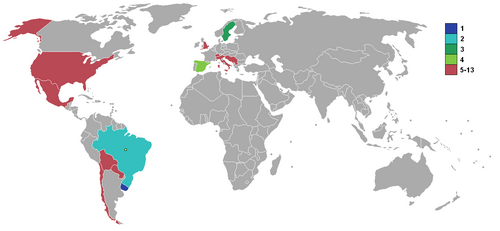
Ultimately, 13 teams from three confederations competed. While many South American nations like Uruguay, Mexico, and Chile returned after a long absence, England made its debut appearance in the competition.
Tournament Format and Venues
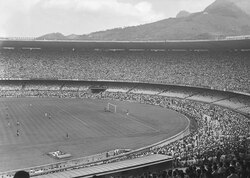
The competition began with four groups. The winners of these groups advanced to a final round-robin stage to determine the champion. The matches were spread across six host cities, with the centerpiece being the newly constructed Estádio do Maracanã in Rio de Janeiro.
The Maracanã's massive capacity of 200,000 people drove attendance to record levels. The average attendance of nearly 61,000 per game remained an unbeaten record until 1994. Even excluding the Maracanã, the tournament saw impressive crowds in São Paulo, though other venues experienced significantly lower turnouts.
Venue Summary
| Stadium | City | Capacity |
|---|---|---|
| Estádio do Maracanã | Rio de Janeiro | 200,000 |
| Estádio do Pacaembu | São Paulo | 60,000 |
| Estádio Independência | Belo Horizonte | 30,000 |
| Estádio dos Eucaliptos | Porto Alegre | 20,000 |
| Estádio Vila Capanema | Curitiba | 10,000 |
| Estádio Ilha do Retiro | Recife | 10,000 |
The Final Round and the Maracanaço
Brazil entered the final round as overwhelming favorites. They had dominated their early matches, including a 7–1 victory over Sweden and a 6–1 rout of Spain, scoring 23 goals while conceding only four. However, they faced a disciplined Uruguay side that was well-accustomed to the pressure of large South American stadiums.
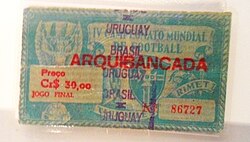
The tournament reached its climax on July 16, 1950. In the deciding match of the final group, Uruguay faced Brazil at the Maracanã. In a stunning turn of events, Uruguay won 2–1, securing the championship and leaving the host nation in shock. This result is historically referred to as the Maracanaço, one of the greatest upsets in football history.
Final Standings
- Champions: Uruguay
- Runners-up: Brazil
- Third Place: Sweden
- Fourth Place: Spain
Frequently Asked Questions
Why was there a 12-year gap between World Cups?
The gap was caused by World War II, which led to the cancellation of the scheduled 1942 and 1946 tournaments.
What is the "Maracanaço"?
The Maracanaço refers to the shocking 2–1 victory of Uruguay over the host nation Brazil in the deciding match of the 1950 World Cup, held at the Maracanã Stadium.
Who was the top scorer of the 1950 tournament?
Ademir from Brazil was the top scorer, netting a total of 9 goals.
Was there a final match in 1950?
No. The 1950 World Cup is the only tournament in history that was not decided by a single-match final; instead, it used a four-team final group stage.
Which teams were unable to participate due to political reasons?
Germany and Japan were unable to participate as they were still occupied and partitioned following World War II, and had not yet been readmitted to FIFA.