1824 United States Elections: The End of the Era of Good Feelings
The elections for the 19th United States Congress, held across 1824 and 1825, represent a pivotal turning point in American political history. This period marked the collapse of the Era of Good Feelings—a time of perceived national unity—and the dissolution of the First Party System. As the Federalist Party faded into irrelevance, the dominant Democratic-Republican Party fractured, giving way to intense regional interests and renewed partisanship.
The bitterness resulting from these contests did not merely change the administration; it laid the groundwork for the Second Party System, fundamentally altering how candidates were nominated and how the American public engaged with federal politics.
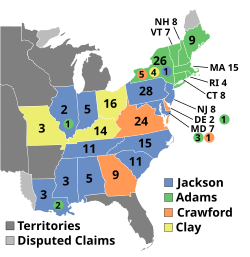
The Presidential Contest of 1824
The 1824 presidential election was uniquely chaotic. For the first time in years, the congressional nominating caucus—the traditional method for selecting a party's candidate—broke down. With no strong opposition from the Federalists, the field opened to four major candidates, all of whom belonged to the Democratic-Republican Party.
The Four Contenders
- Andrew Jackson: A Senator from Tennessee who captured the plurality of both the popular and electoral votes.
- John Quincy Adams: The Secretary of State who eventually secured the presidency.
- William H. Crawford: The Secretary of the Treasury.
- Henry Clay: The Speaker of the House.
Because no single candidate achieved a majority of the electoral vote, the decision was deferred to the House of Representatives under the terms of the Twelfth Amendment (the amendment governing the election of the President and Vice President). The House chose from the top three candidates: Jackson, Adams, and Crawford.
Despite Andrew Jackson's lead in electoral and popular votes, the House elected John Quincy Adams as president. This remains the only instance in U.S. history where the candidate with the most electoral votes did not win the presidency, and the first time the popular vote winner was denied the office.
Congressional Shifts and the 19th Congress
While the presidential race was defined by a deadlock, the elections for the 19th Congress saw a shift in partisan control, though the Democratic-Republicans remained the dominant force.
The House of Representatives
In the House, all 213 voting members were contested. The result was a gain for the Anti-Jacksonian faction (+22 seats). While Democratic-Republicans maintained a majority, supporters of Adams narrowly outnumbered those of Jackson. John W. Taylor, a future member of the National Republicans, was elected Speaker of the House.
The Senate
Sixteen of the 48 Senate seats were contested. The Senate saw a significant gain for the Jacksonian faction (+25 net seat change). Similar to the House, Democratic-Republicans held a dominant majority, though in this chamber, Jackson's supporters narrowly outnumbered those of Adams.
Key Facts
- Presidential Winner: John Quincy Adams (elected by the House).
- Popular/Electoral Plurality: Andrew Jackson.
- Vice Presidential Winner: John C. Calhoun (won by electoral majority).
- Historical Milestone: Ended the "Virginia dynasty" of presidents.
- Constitutional Precedent: Only time the House elected the president under the Twelfth Amendment.
- Party Status: The Federalist Party ceased to function as a national entity.
Election Results Summary
| Candidate | Party | Electoral Votes |
|---|---|---|
| Andrew Jackson | Democratic-Republican | 99 |
| John Quincy Adams | Democratic-Republican | 84 |
| William H. Crawford | Democratic-Republican | 41 |
| Henry Clay | Democratic-Republican | 37 |
Frequently Asked Questions
Why didn't Andrew Jackson become president despite having the most votes?
Because no candidate received an absolute majority of the electoral votes, the Twelfth Amendment required the House of Representatives to select the president from the top three candidates. The House ultimately chose John Quincy Adams over Andrew Jackson.
What was the "Virginia dynasty"?
The Virginia dynasty refers to the period where the presidency was held by a series of leaders from Virginia. John Quincy Adams's victory effectively ended this trend.
How did the Federalist Party fare in 1824?
The Federalist Party had fallen into irrelevance following a performance in 1812 and ceased to function as a national party by the 1824 election.
Who won the vice presidency in 1824?
John C. Calhoun won the vice presidency, securing a majority of the electoral votes.
What was the impact of the 1824 election on the U.S. party system?
The election marked the end of the First Party System and the Era of Good Feelings. The resulting bitterness and factionalism between Jackson and Adams supporters led to the gradual emergence of the Second Party System.