Zone of Control in Board Wargaming
In the complex world of board wargames, managing the movement of armies is as critical as the combat itself. One of the most fundamental mechanics used to simulate the friction of war is the Zone of Control (ZOC). A Zone of Control is the area directly adjacent to specific combat forces that influences how enemy units move and act within that space.
On maps utilizing hexagonal tiles, a unit's ZOC typically consists of the six hexagons immediately surrounding the hexagon the unit occupies.
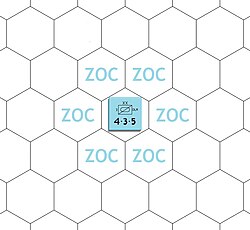
Key Facts
- Definition: ZOC is the area adjacent to a combat unit that restricts enemy movement.
- Hexagonal Layout: In hex-based games, a ZOC usually covers the six surrounding tiles.
- Purpose: It prevents fast units from bypassing enemies without a reaction, simulating military caution.
- Variations: Rules range from completely stopping movement (rigid) to merely slowing it down (fluid).
- Digital Adoption: The concept is also used in computer strategy games, such as the Civilization series.
Types of Zone of Control
Because different wargames aim to simulate different levels of realism or pacing, the effects of a ZOC can vary. These are generally categorized by how they restrict movement:
Rigid Zone of Control
In a rigid system, any combat unit that enters an enemy's ZOC must immediately stop its movement.
Semi-Rigid Zone of Control
Semi-rigid rules do not necessarily stop a unit upon entry, but they prohibit a unit from moving directly from one ZOC space to another.
Fluid or Elastic Zone of Control
Rather than stopping a unit entirely, fluid or elastic ZOCs increase the movement cost, effectively slowing the unit down as it passes the enemy.
Locking Zone of Control
Locking rules are the most restrictive, as they prohibit a unit from leaving a ZOC once it has entered.
Advanced ZOC Mechanics and Limitations
Beyond simple movement restrictions, ZOCs can interact with the environment and other units in several ways. Certain terrain features—such as mountains, cities, or rivers—may cancel the effects of a ZOC. In some instances, the presence of other enemy units or overlapping enemy ZOCs can also nullify the effect.
Some games introduce more nuanced rules where ZOCs affect friendly units, simulating traffic congestion on access routes and roads. Additionally, ZOCs may be used to interdict supply lines or block units from retreating after combat. Some rule sets even mandate that any unit entering a ZOC must be attacked.
| ZOC Type | Effect on Movement |
|---|---|
| Rigid | Unit must stop upon entering the zone. |
| Semi-Rigid | Cannot move directly from one ZOC space to another. |
| Fluid/Elastic | Increases movement cost (slows the unit). |
| Locking | Prohibits the unit from leaving the zone. |
The Theory and Practice of ZOC
Theoretically, the ZOC represents the military necessity of caution. It simulates the real-world need for soldiers to dismount from transports, move off-road, or utilize cover when operating in the presence of an enemy force.
Practically, ZOCs solve a specific problem inherent to turn-based gaming. Because players alternate turns, one player's units remain inactive while the other moves. Without ZOCs, a player could use high-speed units to easily bypass and surround an opponent's forces without giving them a chance to react. The ZOC ensures that the inactive player still exerts influence over the battlefield.
Frequently Asked Questions
What is a Zone of Control in a wargame?
It is the area immediately adjacent to a combat unit that restricts or modifies the movement and actions of enemy units.
How does a ZOC work on a hexagonal map?
On a hex map, the ZOC typically consists of the six hexagons that touch the hexagon occupied by the combat unit.
What is the difference between rigid and fluid ZOCs?
A rigid ZOC forces a unit to stop moving immediately upon entry, whereas a fluid (or elastic) ZOC simply increases the movement cost to slow the unit down.
Can terrain affect a Zone of Control?
Yes, certain features like rivers, mountains, and cities can cancel the effects of a ZOC depending on the specific game rules.
Are ZOCs only found in board games?
No, the concept is also implemented in digital strategy games, including the Civilization series.