Zenith Electronics: A History of American Radio and Television Innovation
From its humble beginnings as a small producer of amateur radio equipment to becoming a titan of the American living room, Zenith Electronics represents a significant chapter in the evolution of home entertainment. Founded on a commitment to quality, the company pioneered technologies that defined how the world listened to music and watched television for decades.
The Early Years: From Ham Radio to Household Name
The company began in 1918 in Chicago, Illinois, as Chicago Radio Labs, co-founded by Ralph Matthews and Karl Hassel. The name "Zenith" was derived from "ZN'th," a contraction of the founders' ham radio call sign, 9ZN. The word also refers to the highest point reached by a celestial object, symbolizing the company's aspirations for success and notability.
In 1921, Eugene F. McDonald joined the venture, and by 1923, the Zenith Radio Company was officially incorporated. The company quickly gained a reputation for high-quality engineering and a series of rapid-fire innovations during the 1920s.
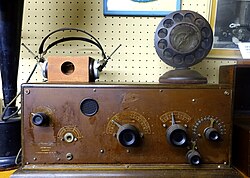
Early Milestones in Radio
- 1924: Introduction of the first portable radio.
- 1926: Launch of the first mass-produced AC (alternating current) radio.
- 1927: Introduction of push-button tuning.
- 1930s: Expansion into automobile radios with the Model 460, which sold for US$59.95 and notably required no separate battery or generator.
The Television Era and Technical Breakthroughs
Zenith transitioned into the visual medium in 1939 with its first television set, though commercial sets did not reach the general public until 1948. The company became a leader in the industry, credited with inventing the wireless remote control and FM multiplex stereo.
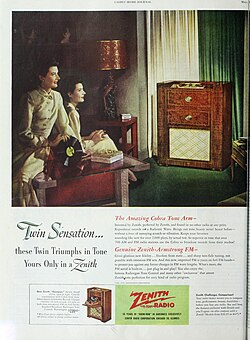
The company's commitment to quality was encapsulated in its long-standing slogan, "the quality goes in before the name goes on" (a phrase previously used by the Geo. P. Bent Piano Company as early as 1906). Zenith also ventured into broadcasting, establishing one of the nation's first FM stations in 1940 (WWZR, later WEFM), which began broadcasting in stereo in June 1961.
Advancements in Display and Sound
Zenith pushed the boundaries of hardware by developing flat-face and high-contrast picture tubes. They also pioneered the multichannel television sound (MTS) stereo system for analog broadcasts in the U.S. and Canada. Later, in 1993, Zenith introduced the Grand Alliance model, contributing to the digital HDTV system implementation and the ATSC (Advanced Television Systems Committee) standard.
Industrial Scale and Corporate Structure
By 1960, Zenith and RCA dominated the U.S. television market, each holding over 20% of the share. At its peak in 1962, the Zenith Radio Corporation employed 11,000 people, with a massive presence in Chicago across several specialized plants:
| Plant Location | Primary Focus | Approx. Employees |
|---|---|---|
| 6001 West Dickens Ave. | Radios, TVs, and Hi-Fi phonographs | 2,500 |
| 1500 North Kostner Ave. | Govt electronics, transistors, hearing aids | 2,100 |
| 5801 West Dickens Ave. | Electronics and servicing | 300 |
| 3501 West Potomac Ave. | Warehousing | 60 |
| 6501 West Grand Ave. | Government Hi-Fi equipment | 500-600 |
The company also operated subsidiaries including the Rauland Corporation, which produced specialized picture tubes (including color CRTs and military night vision tubes), and Central Electronics, Incorporated, which focused on amateur radio equipment.
Market Struggles and the Shift to Computing
The 1970s and 80s brought intense competition from Japanese manufacturers. In 1970, Zenith joined National Union Electric (NUE), Sears, and Motorola in a massive antitrust and anti-dumping lawsuit seeking $900 million in damages. However, after years of litigation, the U.S. Supreme Court ruled against Zenith's antitrust claims in 1986, and the anti-dumping appeals ended in 1987.
To diversify, Zenith purchased the Heath Company in 1979 for $64.5 million, creating Zenith Data Systems (ZDS). By 1984, the company renamed itself Zenith Electronics Corporation to reflect its focus on computers and CATV (Community Antenna Television), having exited the radio business in 1982.
The Transition to LG Electronics
While ZDS was initially profitable, Zenith's consumer television business began losing money by 1987. To fund HDTV research and reduce debt, Zenith sold ZDS to Groupe Bull in 1989 for $635 million. Facing a hostile takeover threat and an aging analog product line, Zenith sold a 5% stake to the Korean company GoldStar (now LG Electronics) in 1990.
LG increased its stake to 55% in 1995, gaining controlling interest. Following a Chapter 11 bankruptcy filing in 1999, LG acquired the remaining 45% of the company by converting $200 million of debt into common stock. The Network Systems division, known for cable and satellite set-top boxes, was sold to Motorola in 2000.
Key Facts
- Founded: 1918 as Chicago Radio Labs; incorporated as Zenith Radio Company in 1923.
- Key Inventions: Wireless remote control, FM multiplex stereo, and contributions to the ATSC digital HDTV standard.
- Market Peak: One of the two largest U.S. TV manufacturers by 1960.
- Diversification: Entered the computer market via Zenith Data Systems (ZDS) in 1979.
- Final Acquisition: Fully acquired by LG Electronics following a 1999 bankruptcy.
Frequently Asked Questions
Where did the name "Zenith" come from?
The name was a contraction of "ZN'th," based on the founders' ham radio call sign, 9ZN. It also refers to the highest point reached by a celestial object, symbolizing success.
What were some of Zenith's most famous early inventions?
Zenith is credited with inventing the wireless remote control and FM multiplex stereo, and it introduced the first portable radio in 1924.
Why did Zenith enter the computer market?
Zenith purchased the Heath Company in 1979 to form Zenith Data Systems (ZDS) to prepare for increasing competition from electronics and computer manufacturers in the home.
How did LG Electronics become the owner of Zenith?
LG (formerly GoldStar) began with a 5% stake in 1990, increased it to 55% in 1995, and finally acquired the remaining 45% in 1999 after Zenith filed for Chapter 11 bankruptcy.
What happened to the Zenith headquarters in Chicago?
The headquarters building was occupied by Aon and was eventually demolished in 2018 to allow for the expansion of Abt Electronics.