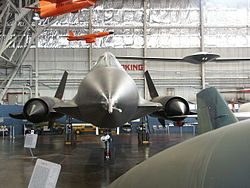
YF-12: The Mach 3+ Interceptor That Paved the Way for Supersonic Flight
In the high-stakes era of the Cold War, the race for speed and altitude pushed aerospace engineering to its absolute limits. Among the most remarkable achievements of this period was the Lockheed YF-12, a Mach 3+ capable interceptor prototype designed to defend American airspace at unprecedented speeds. Developed by Lockheed's legendary "Skunk Works" division, this aircraft was not merely a fast jet; it was a technological leap that bridged the gap between reconnaissance and combat capability.
The YF-12 was born from a need to replace the F-106 Delta Dart. While it shared much of its DNA with the secret CIA A-12 reconnaissance aircraft, the YF-12 was purpose-built for interception. It featured a two-seat configuration to accommodate both a pilot and a fire control officer, ensuring that the complex radar and missile systems could be managed effectively during high-speed engagements.
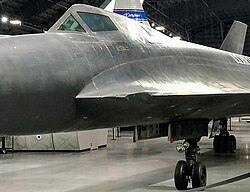
Key Facts
- Manufacturer: Lockheed Corporation
- Type: High-altitude interceptor prototype
- Top Speed: Mach 3.35 (over 2,000 mph)
- Primary Armament: Hughes AIM-47 Falcon air-to-air missiles
- Key Technology: Hughes AN/ASG-18 fire-control radar
- Status: Canceled as a production interceptor, but used for NASA research
Design and Development
The development of the YF-12 was deeply intertwined with the cancellation of the North American XF-108 Rapier program. Following that cancellation, Lockheed proposed the AF-12, which eventually became the YF-12A. To transform the single-seat A-12 into a combat-ready interceptor, engineers had to make significant structural modifications.
Engineering Modifications
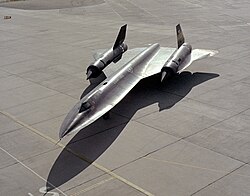
The most striking change was the modification of the aircraft's chines—the sharp edges running along the fuselage—to accommodate the massive Hughes AN/ASG-18 fire-control radar. This radar was essential for the "look-down/shoot-down" capability required to intercept targets against the clutter of the earth's surface. To maintain stability with these new aerodynamic profiles, engineers added ventral fins under the fuselage and modified the engine nacelles.
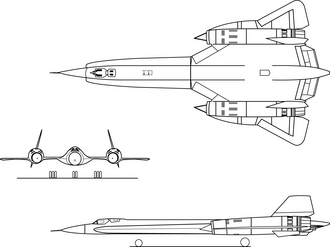
For weaponry, three of the four internal bays previously used for reconnaissance equipment were repurposed to carry AIM-47 Falcon (GAR-9) air-to-air missiles. This allowed the aircraft to engage targets while maintaining its streamlined, high-speed profile.
Operational History and Testing
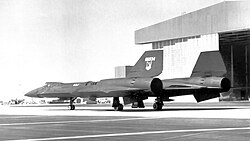
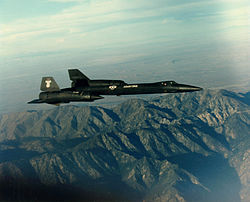
The YF-12A made its maiden flight on 7 August 1963. Its existence was kept relatively quiet until President Lyndon B. Johnson publicly revealed the aircraft on 24 February 1964. This public disclosure served a strategic purpose: it provided plausible deniability for the CIA's secret A-12 fleet, as any sightings of the A-12 could be attributed to the now-public YF-12.
During flight testing, the YF-12A proved its incredible performance. On 1 May 1965, it set a speed record of 2,070.101 mph and an altitude record of 80,257.86 feet. The aircraft also demonstrated successful missile combat capability; in one notable test, an AIM-47 missile launched at Mach 3.2 successfully struck a target drone, even without a warhead.
The End of the Interceptor Program
Despite its success, the YF-12B production program was canceled. The United States Air Force faced funding constraints due to the Vietnam War, and shifting military priorities meant the continental U.S. defense requirements had changed. By January 1968, the program was officially ended, but the aircraft's legacy was far from over.
NASA Research and Legacy
After its military testing phase, the YF-12 found a second life as a research tool for NASA. NASA utilized the aircraft to study the complexities of supersonic flight, including engine inlet performance, heat transfer, and boundary layer noise. These studies were critical for the development of future high-speed aircraft, including the SR-71 Blackbird.
NASA engineers developed advanced computer systems to solve severe control issues. The Cooperative Airframe-Propulsion Control System (CAPCS) was a breakthrough, reducing flight deviations by a factor of 10 and ultimately increasing the range of the SR-71 by 7 percent. Additionally, the Central Airborne Performance Analyzer (CAPA) was created to provide pilots with real-time engine data and fault diagnostics.
Summary of YF-12A Specifications
| Feature | Specification |
|---|---|
| Crew | 2 (Pilot and Fire Control Officer) |
| Maximum Speed | Mach 3.35 (2,275 mph) |
| Service Ceiling | 90,000 ft |
| Powerplant | 2 × Pratt & Whitney J58 turbojets |
| Armament | 3 × Hughes AIM-47A missiles |
Frequently Asked Questions
What was the difference between the A-12 and the YF-12?
The A-12 was a single-seat reconnaissance aircraft operated by the CIA. The YF-12 was a two-seat interceptor variant equipped with the AN/ASG-18 radar and armed with AIM-47 missiles.
Why was the YF-12 production program canceled?
The program was canceled primarily due to a lack of funding caused by the costs of the Vietnam War and a shift in military priorities regarding the defense of the continental United States.
How did the YF-12 influence the F-14 Tomcat?
The successful testing of the AIM-47 Falcon missile on the YF-12 led to the development of the larger and more powerful AIM-54 Phoenix missile, which became the primary armament for the F-14 Tomcat.
Where can I see a YF-12 today?
The only surviving YF-12A (AF Ser. No. 60-6935) is on display at the National Museum of the United States Air Force in Dayton, Ohio.