Yanghwa Bridge: A Vital Link Across Seoul's Han River
Spanning the majestic Han River, the Yanghwa Bridge serves as a critical artery for the city of Seoul. Connecting the Mapo District on the north side to the Yeongdeungpo District on the south, this eight-lane structure is more than just a transit route; it is a piece of engineering history that reflects South Korea's rapid development and technological advancement.
The bridge is uniquely positioned, with its eastern end buttressed by the island of Seonyudo, which is now home to the popular Seonyudo Park. Whether you are a commuter or a visitor, the bridge offers a significant perspective on the urban landscape of the Republic of Korea.
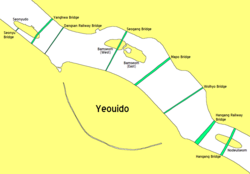
Key Facts
- Location: Connects Mapo-gu and Yeongdeungpo-gu, Seoul.
- Total Length: 1,053 meters.
- Structure: A combination of an "old bridge" (completed 1965) and a "new bridge" (completed 1982).
- Historical Significance: The original bridge was the first built using Korean technology following the country's independence in 1945.
- Cultural Note: The bridge is the namesake of a famous song by R&B/soul singer Zion.T.
A Tale of Two Bridges
The current Yanghwa Bridge is actually a combination of two distinct construction phases. The original structure, formerly known as the Second Han River Bridge, was completed in January 1965. As the first bridge constructed with domestic Korean technology after independence, it played a pivotal role as the primary gateway from Seoul to the west coast.
As traffic demands in Seoul grew, the need for expansion became inevitable. Construction on the expansion began in January 1979, resulting in the completion of the "new bridge" in February 1982. This modern addition transformed the crossing into a high-capacity, eight-lane thoroughfare.
Engineering and Materials
The bridge utilizes a sophisticated mix of materials and foundation techniques to ensure stability. The lower structure is supported by an open caisson well foundation, a method used to create deep, stable supports in riverbeds. The upper structures differ between the two phases:
- Old Bridge: Features a width of 18 meters and is composed of steel plate girders and concrete box girders.
- New Bridge: Features a width of 16.2 meters and is constructed as a steel plate girder bridge.
Maintenance and Modernization
To keep pace with the needs of a growing metropolis, the Yanghwa Bridge has undergone several significant renovations. In 1996, the bridge underwent repairs, and it reopened in April 2002 with the addition of new ramps to improve traffic flow.
Further modernization efforts were noted in February 2010, when renovations focused on widening the space between bridge posts. This specific upgrade was designed to allow larger vessels, specifically ships up to 5,000 tons, to pass safely underneath the structure.
Summary of Technical Specifications
| Feature | Old Bridge Details | New Bridge Details |
|---|---|---|
| Completion Year | 1965 | 1982 |
| Width | 18 m | 16.1 m |
| Total Length | 1,053 m | |
| Primary Material | Steel plate and concrete |
Frequently Asked Questions
What districts does the Yanghwa Bridge connect?
The bridge connects the Mapo District on the north side of the Han River to the Yeongdeungpo District on the south side.
Why is the bridge historically significant to South Korea?
The original bridge, completed in 1965, was the first bridge built using Korean technology following the nation's independence in 1945.
Is there a cultural connection to the bridge?
Yes, the R&B/soul singer Zion.T released a song titled "Yanghwa Bridge" (양화대교) in 2014.
What is Seonyudo Park?
Seonyudo Park is located on the island of Seonyudo, which provides the eastern buttress for the Yanghwa Bridge.
What was the purpose of the 2010 renovations?
The renovations aimed to widen the space between bridge posts to allow ships weighing up to 5,000 tons to pass through.