Wyandanch History: From Native Lands to a Diverse Community
The hamlet of Wyandanch, located in the Town of Babylon, possesses a rich and complex history shaped by the movement of people, the expansion of the railroad, and the evolving social landscape of Long Island. Named in honor of Chief Wyandanch, a 17th-century leader of the Montaukett Native American tribe, the area has transitioned from a wilderness of scrub oak and pine barrens into a diverse residential community.
Native American Roots and Early Land Transfers
While no archaeological evidence of permanent settlements has been found within the current boundaries of Wyandanch, the land was historically used by Native Americans for hunting and gathering fruits and berries. The region's early legal history is marked by two significant land transfers to Huntington: the Baiting Place Purchase of 1698 by the Massapequa Indians and the Squaw Pit Purchase of 1699 by the Secatogue Indians. The current site of Wyandanch falls within the Squaw Pit Purchase area.
Colonial Settlement and the Influence of the LIRR
The area, originally known as the Lower Half Way Hollow Hills, saw its first European settlement around 1706 when Captain Jacob Conklin was granted land in what is now Wheatley Heights. Over time, pioneers from Huntington purchased forest and farm lands from the Conklins. Notably, Jacob Conklin's "Pirate House," built in 1710, stands as the first house constructed in the town of Babylon.
The development of the hamlet accelerated with the arrival of the Long Island Rail Road (LIRR). In May 1875, at the request of General James J. Casey—brother-in-law to President Ulysses S. Grant—the LIRR established the West Deer Park station. This depot, which included a post office, provided Casey and other residents with closer access to transportation than the existing Deer Park station. To resolve traveler confusion between the West Deer Park and Deer Park stops, the LIRR officially renamed the area Wyandanch in 1903.
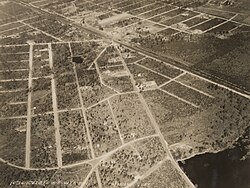
Early growth was further spurred by a land boom in 1872, with local realtors specifically targeting German and German-American buyers. In 1903, Bishop Charles Edward McDonnell of the Roman Catholic Diocese of Brooklyn purchased the 1,343-acre ex-Conklin estate, which later became a Catholic Youth Organization (CYO) summer camp. The historic Conklin family cemetery on this land was later restored in 2011 by descendant Michael Berdon.
Ethnic Evolution and Community Growth
From 1880 to 1955, Wyandanch was primarily populated by German and Austrian-Americans. Many worked at the Wyandance Brick and Terra Cotta works, while more affluent families settled in the sylvan Carintha Heights section. By the 1920s and 30s, working-class Irish immigrants from County Donegal began building bungalow-style homes in Home Acres and Wyandance Springs Park to escape the congestion of Manhattan and the Bronx while remaining within commuting distance via the LIRR.
African-American families began establishing roots in the 1920s in the "Little Farms" section. A landmark of early Black entrepreneurship was the C and D Cement Block Corp, opened in 1928 by Mortimer Cumberbach and Ignatius Davidson, which remained the only large African-American-owned business in Suffolk County until the mid-1950s.
During the 1950s and 60s, Wyandanch became one of the largest African-American communities in Suffolk County. This growth was partly driven by exclusionist real estate practices—such as red-lining and restrictive covenants—that barred Black families from other new developments like Levittown. The introduction of "interracial housing" projects, such as Carver Park (1951) and Lincoln Park (1956), further accelerated this demographic shift, leading to a majority African-American population by 1960 and subsequent "white flight." Additionally, Hispanic-American families began settling in the late 1940s, attracted by affordable land and jobs at nearby state psychiatric centers.
The 1967 Racial Disturbances and Recovery
In August 1967, Wyandanch experienced racial disturbances as part of a broader national trend of civil unrest. Small groups of young African-American adults targeted local stores, the VFW Hall, and the auditorium of the Martin Luther King, Jr. Elementary School. Suffolk County officials identified the root causes as joblessness, poor public transportation, a lack of youth recreation, and underrepresentation of African Americans in the police force.
In response, a coalition of government agencies, businesses, and community groups worked to improve the hamlet. The U.S. Office of Economic Opportunity established the Wyandanch Community Action Center to enhance job training and bus routes. Private investment also followed, including the construction of a modern A&P supermarket, which now serves as the Martin Luther King, Jr. Community Health Center.
Attempts at Incorporation
Wyandanch has twice attempted to change its governance status. In the 1950s, a proposal was made to merge Wyandanch, Dix Hills, Melville, and Sweet Hollow into the Incorporated Village of Half Hollow Hills, covering roughly 50 square miles. This plan failed. A second attempt in the 1980s to incorporate Wyandanch as its own village—citing racial neglect from the Town of Babylon—was also unsuccessful. Consequently, Wyandanch remains an unincorporated hamlet.
Key Facts
- Naming: Named in 1903 by the LIRR after Chief Wyandanch of the Montaukett tribe.
- First Home: Jacob Conklin's "Pirate House" (1710) was the first house in the town of Babylon.
- Railroad Influence: The West Deer Park station (est. 1875) was the catalyst for the hamlet's growth.
- Housing Milestones: Carver Park (1951) was one of the first advertised "interracial housing" developments in the area.
- Governance: Despite multiple attempts to incorporate, it remains an unincorporated hamlet under the Town of Babylon.
| Era/Period | Primary Influence/Group | Key Development |
|---|---|---|
| Pre-Colonial | Montaukett/Massapequa/Secatogue | Hunting and gathering; land purchases (1698-1699) |
| Early 1700s | Conklin Family | First colonial settlements and the "Pirate House" |
| Late 1800s | LIRR / German-Americans | Establishment of West Deer Park station (1875) |
| 1920s - 1940s | Irish / African-Americans | Bungalow construction and "Little Farms" settlement |
| 1950s - 1960s | African-American Community | Carver Park and Lincoln Park developments |
| 1967 - Present | Community Activists / Local Govt | Post-riot social services and health center establishment |
Frequently Asked Questions
Why was the hamlet renamed from West Deer Park to Wyandanch?
The Long Island Rail Road changed the name in 1903 to honor Chief Wyandanch and to eliminate confusion for passengers who were frequently mixing up the West Deer Park and Deer Park stations.
What was the significance of Carver Park?
Established in 1951, Carver Park was advertised as "interracial housing," offering affordable Cape Cod-style homes to families regardless of race, which helped trigger the demographic transformation of the community.
What caused the racial disturbances in 1967?
The disturbances were fueled by systemic issues including high unemployment, a lack of recreational facilities for youth, inadequate bus transportation to factories, and a lack of African-American representation within the police force.
Is Wyandanch an independent village?
No. Despite attempts to incorporate in the 1950s (as part of Half Hollow Hills) and again in the 1980s, Wyandanch remains an unincorporated hamlet governed by the Town of Babylon.
Who was the first European settler in the area?
Captain Jacob Conklin is credited as the first settler, having been given a tract of land by his father, Timothy Conklin, around 1706.