Wu Shuqing and the Women's Revolutionary Army of 1911
In the early 20th century, as China stood on the precipice of monumental political change, a young woman named Wu Shuqing emerged as a pioneer for gender equality and national liberation. Born in 1892 in Hanyang, Hubei, to Han Chinese parents, Wu was recognized by her peers for her intelligence, bravery, and exceptional physical strength. Driven by a conviction that every citizen—regardless of gender—bore the responsibility to defend their nation, she sought to overthrow the ruling Qing dynasty, which she viewed as an oppressive Manchu force suppressing the Han Chinese people.
The Fight for Female Military Recognition
The spark for Wu's military career came in October 1911 with the outbreak of the Wuchang Uprising, a pivotal revolt against the Qing government. At the time, the 19-year-old Wu was a student at Hanyang's Fengtian Normal College. Recognizing the need for broader support in the rebellion, she wrote to Li Yuanhong, the revolutionaries' commander-in-chief, proposing the creation of an armed female brigade.
Initially, Li rejected the proposal, citing the difficulty of integrating women into an exclusively male army. Undeterred, Wu launched a public campaign for her cause. On October 31, she sent a second letter to the general and published her arguments in the Minli Newspaper. She clarified that her motivation was not a quest for "momentary glory," but a sense of duty to the revolution. She argued that since men from all social classes were fighting, it was unjust to exclude women, many of whom had already prepared themselves physically in gymnasia.
Moved by Wu's persistence and the requests of other militant women, Li Yuanhong eventually granted her permission to raise an all-female unit.
![Due to her readiness to take up arms in order to fight for the Xinhai Revolution against the Manchu Qing dynasty, contemporaries likened Wu Shuqing to Hua Mulan, a legendary Chinese woman warrior.[4]](/images/d4/60/d460cb39ffb26cea09f430f4a2a5e66e1f8c19c6be4d63e424a231a3d2b4f909.jpg)
Formation of the Women's Revolutionary Army
Wu's recruitment drive was a resounding success. She posted notices throughout Hanyang, supported by propaganda that likened her to Hua Mulan, the legendary woman warrior of Chinese folklore. This comparison served as a powerful catalyst, inspiring hundreds of women to enlist. The recruits were primarily middle-class students, some of whom still had bound feet—a traditional practice of foot binding that restricted mobility—yet they were determined to serve.
Historical accounts vary regarding the exact size of the unit, known as the Women's Revolutionary Army. Historian Louise Edwards estimates the force at approximately 100 women, while researchers Ono Kazuko and Fan Hong suggest the number may have reached several hundred.
Combat Success and Strategic Impact
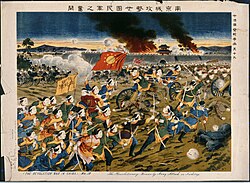
With remarkable efficiency, Wu organized and trained her troops in just ten days. She then led them into the Battle of Hankou. According to historian Su Xiao, Wu proved to be a highly capable commander; she utilized her motivated, though minimally trained, troops to bypass Qing forces and launch surprise attacks from the rear. This tactical success brought her unit quick renown.
The Women's Revolutionary Army later moved east to participate in the Battle for Nanjing, fighting alongside other female rebel militias. During this campaign, Wu was responsible for planning and executing the attack on the strategically vital Shizishen fort.
Key Facts
- Founder: Wu Shuqing, a 19-year-old student from Fengtian Normal College.
- Unit Name: The Women's Revolutionary Army.
- Primary Goal: Overthrowing the Manchu Qing dynasty to establish a "Great Han nation."
- Major Engagements: The Battle of Hankou and the Battle for Nanjing (specifically the Shizishen fort).
- Recruitment: Primarily middle-class female students, inspired by the legend of Hua Mulan.
- Disbandment: Ordered by the Provisional Government of the Republic of China on February 26, 1912.
| Category | Details |
|---|---|
| Role | Founder and Commander of the Women's Revolutionary Army |
| Key Tactics | Flanking maneuvers and surprise rear attacks |
| Estimated Force Size | 100 to several hundred women |
| Key Victory | Attack on Shizishen fort in Nanjing |
Frequently Asked Questions
Who was Wu Shuqing?
Wu Shuqing was a Chinese revolutionary and student who founded and led the Women's Revolutionary Army during the Xinhai Revolution of 1911.
Why did Wu Shuqing want to form a women's army?
She believed in gender equality and felt it was the duty of all citizens, regardless of gender, to defend their nation and fight against the ruling Qing dynasty.
How did Wu Shuqing convince General Li Yuanhong to allow a female unit?
After an initial rejection, she wrote a second persuasive letter and published her views in the Minli Newspaper, arguing that women's exclusion was unjust given their physical preparation and commitment to the revolution.
What were the major battles fought by the Women's Revolutionary Army?
The unit fought in the Battle of Hankou, where they used flanking maneuvers to attack Qing forces, and the Battle for Nanjing, where they captured the Shizishen fort.
What happened to the Women's Revolutionary Army after the revolution?
The unit was ordered to disband on February 26, 1912, by the Provisional Government of the Republic of China.