World Bank Group: Driving Global Economic Development and Poverty Reduction
The World Bank Group is a premier intergovernmental organization dedicated to the dual goals of economic development and the elimination of global poverty. Established as a treaty-based entity, it operates as a specialized agency of the United Nations, providing financial assistance and technical expertise to developing nations to foster sustainable growth.
Headquartered in Washington, D.C., the organization currently comprises 189 member states, including 188 UN countries and Kosovo. Under the leadership of President Ajay Banga and Managing Director and CFO Anshula Kant, the group leverages its vast resources to address systemic global challenges.
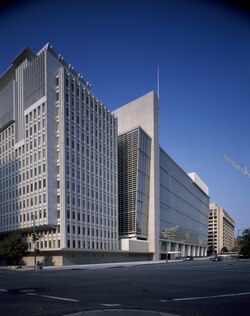
Key Facts
- Founded: July 4, 1944.
- Primary Goals: Economic development and poverty elimination.
- Membership: 189 states.
- Structure: A group of five distinct specialized organizations.
- Governance: Led by a Board of Directors and a President.
- Global Reach: Operated in 145 countries with 12,300 full-time staff as of 2020.
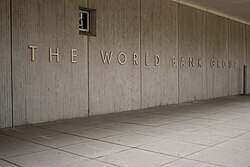
The Five Organizations of the World Bank Group
The World Bank Group is not a single entity but a collective of five organizations, each established at different times to address specific financial and developmental needs:
- International Bank for Reconstruction and Development (IBRD): Established in 1944, it is the original arm of the group.
- International Finance Corporation (IFC): Founded in 1956 to focus on the private sector.
- International Development Association (IDA): Created in 1960 to provide grants and low-interest loans to the poorest countries.
- International Centre for Settlement of Investment Disputes (ICSID): Established in 1965 to provide facilities for conciliation and arbitration of investment disputes.
- Multilateral Investment Guarantee Agency (MIGA): Founded in 1988 to promote foreign direct investment by offering political risk insurance.
History and Founding
The foundations of the World Bank were laid during the Bretton Woods Conference in 1944. The organization was shaped by the visions of Harry Dexter White and John Maynard Keynes, who are regarded as the founding fathers of both the World Bank and the International Monetary Fund (IMF).
![Harry Dexter White (left) and John Maynard Keynes, the "founding fathers" of both the World Bank and the International Monetary Fund (IMF)[13]](/images/3f/c6/3fc626ac08701693c095cb9e9427da74eee6ff15266143ec731998c52ef72a55.jpg)
The formal establishment took place in the Gold Room of the Mount Washington Hotel, marking a new era of international cooperation to rebuild war-torn economies and stabilize the global financial system.

Governance and Voting Power
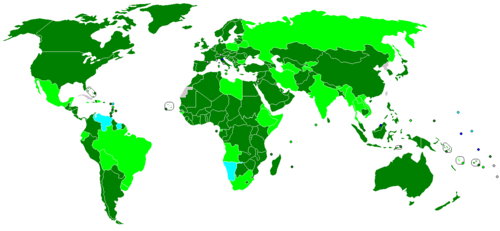
Voting power within the World Bank Group is distributed among member states, with the largest economies typically holding the most influence. The United States maintains the highest voting power across all five institutions, followed by nations such as Japan, China, Germany, and France.
While most of the 139 core members participate in all five WBG organizations, some maintain limited membership. For example, Nauru and San Marino participate in the IBRD and one other organization, while others are members of the IBRD only.
| Rank | IBRD | IFC | IDA | MIGA |
|---|---|---|---|---|
| 1 | United States | United States | United States | United States |
| 2 | Japan | Japan | Japan | Japan |
| 3 | China | Germany | United Kingdom | Germany |
| 4 | Germany | France | Germany | France |
| 5 | France | United Kingdom | France | United Kingdom |
Operational Focus and Funding
The World Bank Group employs various methods to achieve its goals, including poverty reduction strategies, efforts to reduce economic inequality, and the implementation of environmental and social safeguards. It also maintains an open data and open knowledge repository to share development insights globally.
Funding is directed toward critical sectors. Between 2007 and 2016, significant committed funding was allocated to road transport, social welfare services, and electrical transmission and distribution. The group has also pivoted to address modern crises, including the COVID-19 pandemic and the global response to climate change.
Criticisms and Controversies
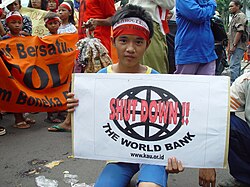
Despite its mission, the World Bank Group has faced significant criticism. Opponents have raised concerns regarding structural adjustment (policies requiring countries to make economic reforms in exchange for loans), the fairness of assistance conditions, and allegations of corruption.
The organization has also been scrutinized for its investments in fossil fuels and its handling of sovereign immunity. These tensions have occasionally manifested in public protests in cities like Jakarta and Washington, D.C.

Frequently Asked Questions
What is the primary purpose of the World Bank Group?
The primary purpose of the World Bank Group is to promote long-term economic development and eliminate extreme poverty worldwide.
How many organizations make up the World Bank Group?
The group consists of five organizations: the IBRD, IDA, IFC, ICSID, and MIGA.
Who is the current President of the World Bank?
The current President is Ajay Banga.
Which country holds the most voting power in the World Bank?
The United States holds the highest voting power across the World Bank Group's institutions.
How does the World Bank address climate change?
The World Bank integrates climate response into its funding and policy frameworks, though it has faced criticism regarding its continued historical ties to fossil fuel investments.