Workbench Design and Types for Every Craft
A workbench is more than just a sturdy table; it is the foundation of manual labor. Depending on the craft, a workbench can range from a simple flat surface to a complex piece of equipment that functions as a tool in its own right. While they vary in size—from the compact stations used by jewelers to the massive benches required by staircase makers—most share a rectangular shape, providing flat and square edges that serve as essential dimension standards for the worker.
Regardless of the specific trade, most effective workbenches incorporate three core attributes: a comfortable height tailored for either seated or standing work, a mechanism to fix the workpiece securely to the surface for two-handed operation, and integrated provisions for mounting and storing tools.
Key Facts
- Materials: Benches are constructed from wood, metal, stone, or composites based on the intended use.
- Versatility: Designs range from portable, collapsible units to heavy-duty industrial steel stations.
- Specialization: Different trades require specific features, such as ESD protection for electronics or chemical-resistant resins for laboratories.
- Surface Options: Common top materials include solid maple, steel, particleboard with melamine, and laminates.
Types of Workbenches
Workbenches are categorized by the specific tasks they are designed to accommodate. Choosing the right type ensures efficiency and safety in the workshop.
Woodworking and Art
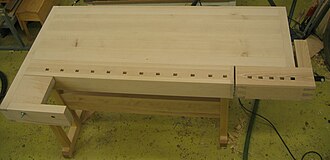
Woodworking benches are typically crafted from solid wood and feature integral clamping mechanisms. They are used for a variety of specialties, including joinery, cabinetmaking, carving, and trim work.
For those working in art and sculpture, benches are often designed to be used "in the round." This allows the artist to mount a workpiece firmly from underneath and access it from all sides, which is essential for stone and wood carvers.
Metalworking and Industrial
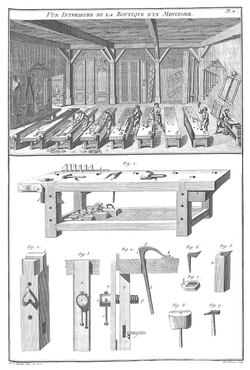
Metalworking benches, such as welding tables, are built to withstand grinding, forging, and light casting. These almost always feature a mounted metalworker's vise. On a larger scale, industrial workbenches utilize heavy-duty materials like steel to support massive projects and extreme weight.
Electronics and Precision Work
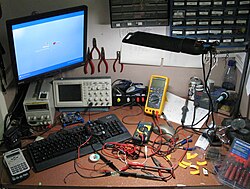
Electronics benches are designed for the assembly and repair of computers and communication equipment. Because these workers are typically seated, the benches are lower and equipped with electrostatic discharge (ESD) protection—electrically dissipative materials that prevent static electricity from damaging sensitive components.
Similarly, jewelers and watchmakers use purpose-built benches featuring a bench pin (a small protruding wooden surface for detailed work) and a leather apron or tray underneath to catch precious metal filings.
Specialized Utility Benches
- Laboratory: Built with chemical-resistant surfaces like epoxy resin, phenolic resin, stainless steel, or high-density polyethene. They often include integrated gas, water, and power services.
- Gardening: Moisture- and dirt-resistant benches used for potting and seeding, typically featuring built-in shelving.
- General Repair: Common in small engine shops and family farms, used for cleaning, lubricating, and light metal work.
- Fitting and Assembling: Used by machinists and electricians, these provide ample space for layout and integrated jigs or measuring devices.
- Multi-purpose/Portable: Small, collapsible benches with built-in clamps, such as the Black & Decker Workmate invented by Ron Hickman.
Software Workbenches
In computing, the term "workbench" is used as a metaphor. This refers to software interfaces that expose file management and application launching (such as the AmigaOS workbench) or tools used to design processes connecting data sources to models.
Workbench Surfaces
The surface is the most critical component of the bench, as it must withstand the specific stresses of the work being performed.
| Material | Characteristics | Common Use Case |
|---|---|---|
| Wood | Typically thick, solid maple | General woodworking and joinery |
| Steel | High durability and heat resistance | Metalworking and industrial use |
| Particleboard | Pressure-bonded particles; often melamine coated | General purpose; easy to wipe clean |
| Plastic/Laminate | Smooth, synthetic finish | Light assembly and general utility |
Frequently Asked Questions
What is a bench pin?
A bench pin is a small wooden work surface that protrudes toward the worker on a jeweler's or watchmaker's bench, providing a stable point to support small parts during precision work.
Why do electronics benches need ESD protection?
Electrostatic discharge (ESD) protection uses dissipative materials to prevent the buildup of static electricity, which could otherwise destroy sensitive electronic components during assembly or repair.
What materials are best for laboratory workbenches?
Laboratory benches require chemical-resistant materials to ensure safety and longevity. Common choices include stainless steel, epoxy resin, phenolic resin, and high-density polyethene.
How do art benches differ from woodworking benches?
While woodworking benches often focus on clamping a piece to a flat top, art and sculpture benches are designed for "in the round" access, allowing the artist to work on the piece from all sides.
What defines a multi-purpose portable workbench?
These benches are characterized by being lightweight, collapsible, and featuring built-in clamps, making them versatile for a wide range of manual tasks in different locations.