Wojciech Kossak: Master of Polish Historical and Battle Painting
Wojciech Horacy Kossak was a titan of Polish art, renowned for his ability to capture the drama, movement, and spirit of Poland's military history. As a member of the illustrious Kossak family—a dynasty of artists and writers—he dedicated his life to documenting the nation's struggle for independence through vivid, large-scale compositions and intimate portraits.
Born in Paris on December 31, 1856, Kossak was the son of the painter Juliusz Kossak. His early life was marked by a deep connection to the arts; he was named in honor of his godfather, the French painter Horace Vernet. After returning to Poland, he balanced a formal education at the Three Crosses Square Gymnasium in Warsaw and the Gimnazjum św. Anny in Kraków with private painting lessons under his father's tutelage.
Artistic Education and Development
Kossak's formal training was rigorous and international. Between 1871 and 1873, he studied at the Kraków School of Drawing and Painting (which later became the School of Fine Arts) under the guidance of Władysław Łuszczkiewicz. Seeking to refine his technique, he moved to Germany to attend the Munich Academy of Fine Arts until 1875, where he studied under professors Alexander Strähuber and Alexander Wagner.
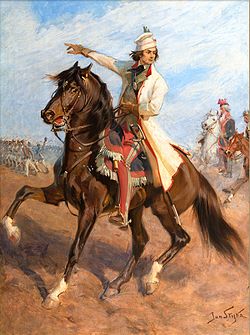
These experiences shaped his unique style. While he shared a passion for Polish history with the legendary Jan Matejko, Kossak diverged from Matejko's approach. He became a leading figure in a new generation of battle-scene artists—painters specializing in the depiction of military engagements—heavily influenced by the dynamic style of his father, Juliusz.
Notable Works and Legacy
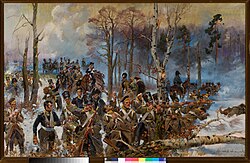
Kossak is most famous for his depictions of Polish armed struggles against foreign oppressors in Central and Eastern Europe. His most celebrated achievement is The Racławice Panorama, a monumental work that brings a pivotal moment of Polish history to life. Other significant works include Panorama Berezyna, Olszynka Grochowska, and Krwawa niedziela w Petersburgu 22 stycznia 1905 r.
![Kossak's Piłsudski on Horseback, 1928,[2] National Museum, Warsaw—one of the most popular artistic portrayals of Piłsudski](/images/ed/23/ed233dd4549f603fe1450db82ee5e0cc9121220f3429ebf61a2b9f0edaa4efe6.jpg)
His versatility extended beyond the battlefield. He produced numerous portraits, including those of Cardinal Hlond and General Kazimierz Sosnkowski, and genre scenes depicting hunting and weddings. His prestige was such that his work was featured in the art competition at the 1928 Summer Olympics.
Resilience During the Occupation
The German invasion of Poland in September 1939 was a profound shock to Kossak. Despite his heartbreak over the defeat, he maintained an unwavering belief in the Polish soldier. During the occupation, he continued to paint in secret, creating sketches for the panorama of Grochów and various portraits.
Kossak remained a man of principle during this dark period. He famously refused to collaborate with the German occupiers, rejecting a request to paint a portrait of Hans Frank. When questioned, he claimed old age as his excuse, even though his studio was filled with active works in progress.
Final Years and Recognition
Wojciech Kossak remained prolific until his final breath. His last works included the Portrait of Zofia Jachimecka and the Equestrian Portrait of Tadeusz Chutkowski. He passed away in Kraków on July 29, 1942, at the age of 85, surrounded by his family.
In 2018, on the 100th anniversary of Poland regaining its independence, President Andrzej Duda posthumously awarded Kossak the Order of the White Eagle, the highest distinction in Poland, recognizing his immense contribution to the nation's cultural heritage.
Key Facts
- Full Name: Wojciech Horacy Kossak.
- Lifespan: December 31, 1856 – July 29, 1942.
- Specialization: Historical and battle-scene painting.
- Masterpiece: The Racławice Panorama.
- Family Legacy: Son of Juliusz Kossak; father to Maria Pawlikowska-Jasnorzewska, Magdalena Samozwaniec, and Jerzy Kossak.
- Highest Honor: Posthumously awarded the Order of the White Eagle in 2018.
| Category | Details |
|---|---|
| Education | Kraków School of Drawing and Painting; Munich Academy of Fine Arts |
| Key Influences | Juliusz Kossak (father), Horace Vernet (godfather) |
| Major Themes | Polish military history, equestrian portraits, national struggle |
| Notable Works | The Racławice Panorama, Olszynka Grochowska, Panorama Berezyna |
| Death | July 29, 1942, in Kraków, Poland |
Frequently Asked Questions
How did Wojciech Kossak's style differ from Jan Matejko's?
While both focused on Polish history and struggle, Kossak belonged to a newer generation of battle-scene artists. His style was more influenced by his father, Juliusz, focusing on the dynamism and movement of military engagements rather than the static, theatrical compositions often associated with Matejko.
Who were the notable members of the Kossak family?
The family was a powerhouse of Polish art and literature. Wojciech's father was the painter Juliusz, and his son was the painter Jerzy. His daughters, Maria Pawlikowska-Jasnorzewska and Magdalena Samozwaniec, were highly talented writers.
Did Wojciech Kossak collaborate with the Germans during WWII?
No. Despite the pressure of the occupation, Kossak refused to work for the Germans, including a specific refusal to paint a portrait of Hans Frank.
What is the significance of the Order of the White Eagle award?
The Order of the White Eagle is Poland's highest distinction. It was conferred upon Kossak posthumously in 2018 by President Andrzej Duda to honor his role in preserving Polish national identity through art.
Where did Wojciech Kossak study painting?
He studied under his father, Juliusz, and formally attended the Kraków School of Drawing and Painting (under Władysław Łuszczkiewicz) and the Munich Academy of Fine Arts (under Alexander Strähuber and Alexander Wagner).