Wisconsin Special Purpose Units of Government
In the state of Wisconsin, special purpose units of government are specialized administrative entities designed to provide specific services to residents within a defined district. Unlike general-purpose local governments, these units focus on a single function or a narrow set of related services. To fund these operations, they are empowered to levy taxes on the residents living within their boundaries.
These districts are often regional in nature and frequently overlap or cross the boundaries of cities, villages, and towns. As of 2006, Wisconsin operated over 1,100 of these special districts. They are often established to address regional issues, bypass municipal debt limits, or allow the state to exert more control via governor-appointed boards. In some cases, appointed boards are used to insulate politicians from the public pressure associated with levying unpopular taxes.
Key Facts
- Wisconsin had over 1,100 special districts as of 2006.
- Special districts can cross municipal and county lines.
- Funding is primarily generated through district-specific taxes and user fees.
- Boards may be appointed by the governor rather than elected by residents.
- School districts are the most prevalent type of special purpose unit.
School Districts
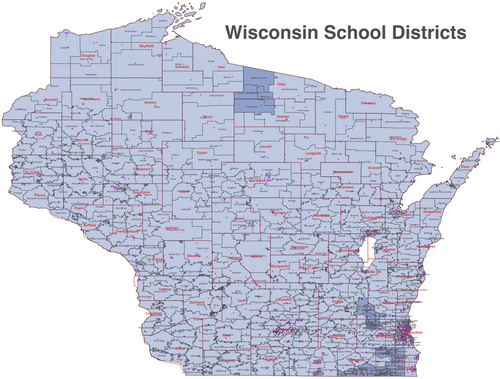
School districts serve as the most common form of special district in Wisconsin. They are responsible for providing, arranging, or contracting all public education services. This mandate includes special education and school transportation, the latter of which is provided for both public and non-public schools. In 2006, the state maintained more than 440 school districts.
A unique characteristic of these districts is that they are not always co-extensive—meaning they do not always share the exact same boundaries—as the municipalities that bear their names. Consequently, a student may live in one municipality but attend a school associated with a different municipality or county. Residents pay school taxes to the specific district in which they reside.
Technical College Districts
Wisconsin is divided into sixteen technical college districts. These units levy taxes to fund the Wisconsin Technical College System, which provides essential occupational training and vocational education to residents across the state.
Sports Districts
Wisconsin has utilized special districts to finance major athletic infrastructure. Two prominent examples include the Southeast Wisconsin Professional Baseball Park District and the Professional Football Stadium District.
Professional Baseball Park District
Created to fund Miller Park for the Milwaukee Brewers, this district financed its activities through bond sales. These bonds were repaid via a 0.1% sales and use tax on goods valued over $10.00. This tax was active from 1996 to 2020 across Milwaukee, Ozaukee, Racine, Washington, and Waukesha counties.
Professional Football Stadium District
This district was established to renovate the stadium used by the Green Bay Packers. It issued bonds repaid through a 0.5% sales tax within a district coextensive with Brown County. This tax was discontinued in 2015, and remaining revenue was distributed to cities within Brown County.
Other Specialized Government Units
Beyond education and sports, Wisconsin employs various other special-purpose units to manage infrastructure and culture.
Sewerage and Sanitary Districts
The Milwaukee Metropolitan Sewerage District manages the sewage system for a large portion of the Milwaukee metropolitan area, utilizing a combination of user fees and property taxes for funding.
Cultural Arts Districts
These districts manage major venues and arts centers. The Wisconsin Center District operates the U.S. Cellular Arena, the Milwaukee Theatre, the Wisconsin Center, and the Fiserv Forum (home of the Milwaukee Bucks). Similarly, the Madison Cultural Arts District manages the Overture Center for the Arts in Madison.
Additional Special Districts
Other specialized units include:
- Metropolitan planning organizations (MPOs)
- Regional planning commissions (RPCs)
- Drainage districts
- Sanitary districts
- Mosquito control districts
- Housing authorities
Summary of Wisconsin Special Districts
| District Type | Primary Purpose | Funding Mechanism |
|---|---|---|
| School Districts | Public education and transportation | Property taxes |
| Technical College Districts | Occupational training | District taxes |
| Sports Districts | Stadium construction and renovation | Sales taxes and bonds |
| Sewerage Districts | Waste management | Property taxes and user fees |
| Cultural Arts Districts | Venue and arts center management | Various |
Frequently Asked Questions
What is a special purpose unit of government?
It is a specialized government entity created to provide a specific service—such as education or sewage management—to a defined district, often crossing traditional municipal boundaries.
Why are some special district boards appointed rather than elected?
Appointed boards allow the state governor to exert more control over the district and can insulate elected politicians from the unpopularity of levying necessary taxes.
Do I always pay school taxes to the municipality where I live?
Not necessarily. Because school district boundaries are not always co-extensive with municipal boundaries, you pay taxes to the school district in which you reside, regardless of the municipality's name.
How were the professional sports stadiums in Wisconsin funded?
They were funded through the creation of special districts that issued bonds, which were then repaid using specific sales and use taxes levied within the district boundaries.
What is the difference between a school district and a technical college district?
School districts provide general public education (K-12) and transportation, while the sixteen technical college districts focus specifically on occupational training through the Wisconsin Technical College System.