The Wikimedia Foundation: Powering the World's Free Knowledge
In an era of fragmented information, the Wikimedia Foundation (WMF) stands as a cornerstone of global education. Founded by Jimmy Wales, the WMF is a 501(c)(3) charitable organization—a specific designation for tax-exempt non-profits in the United States—dedicated to the creation and maintenance of free, open-content, and multilingual internet projects. By leveraging the power of a wiki (a collaborative website that allows users to create and edit content), the foundation ensures that knowledge remains accessible to everyone, regardless of their location or financial status.
A Diverse Ecosystem of Knowledge Projects
While Wikipedia is the most famous project, the Wikimedia Foundation supports a vast array of specialized platforms designed to organize different types of human knowledge. These include:
- Wikipedia: The world's largest online encyclopedia.
- Wiktionary: A collaborative dictionary and thesaurus.
- Wikibooks: A library of open-content textbooks and manuals.
- Wikiquote: A curated collection of quotations.
- Wikivoyage: A community-driven travel guide.
- Wikisource: A digital library of source texts.
- Wikimedia Commons: A central repository for images, sounds, and videos used across all projects.
- Wikispecies: A taxonomic catalog of biological species.
- Wikiversity: A platform for tutorials, courses, and coordinated research.
- Wikidata: A structured knowledge base that provides data to other projects.
- Wikifunctions: A catalog of computer functions.
- Meta-Wiki: The central hub for coordinating the community and all projects.
- Wikimedia Incubator: A space for drafting new language editions of projects.
- MediaWiki: The software that powers the wikis, with its own coordination site.
- Wikitech: A repository for technical documentation regarding the foundation's infrastructure.
- Wikimedia Cloud Services: A hosting provider for various community tools.
It is worth noting that the ecosystem evolves over time; for instance, Wikinews was closed in 2026.

Wikimedia Enterprise
To further support its mission, the foundation introduced Wikimedia Enterprise. This is an opt-in product designed for companies and organizations, allowing them to reuse content from Wikipedia and other Wikimedia projects more efficiently through a dedicated API (Application Programming Interface), which allows different software programs to communicate with each other.

The Technology Behind the Knowledge
Maintaining a global knowledge base requires a sophisticated technical infrastructure. The foundation utilizes MediaWiki, the open-source software that enables the collaborative editing process. To ensure high availability and speed, the WMF manages a complex system architecture involving multiple data centers.
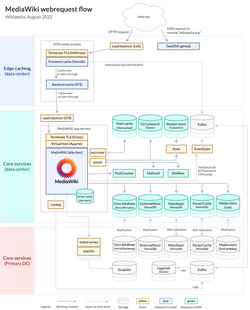
The foundation's hardware strategy involves a global distribution of servers to reduce latency for users worldwide. Key infrastructure has been established in Ashburn and Dallas, with recent expansions including the opening of the first data center in South America in 2024. The foundation also manages its own ASNs (Autonomous System Numbers), which are unique identifiers used in routing traffic across the internet.

Governance and the Human Element
The Wikimedia Foundation is led by CEO Bernadette Meehan and governed by a Board of Trustees. The board's composition is designed to be inclusive, featuring members selected by the project communities, representatives from Wikimedia chapters, and appointments made by the board itself.
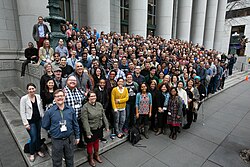
The organization operates through a hybrid of professional staff and a massive global volunteer force. As of 2025, the foundation employs 650 people, but its true strength lies in its community; in 2024, approximately 277,000 volunteers contributed to the projects.
Financial Sustainability and Growth
As a non-profit, the WMF relies on a combination of individual donations, corporate grants, and a long-term endowment. The Wikimedia Endowment is a fund designed to ensure the foundation's permanence, reaching a value of $169.4 million by June 2025.
The foundation has received significant support from major donors, including the Sloan Foundation ($9 million), the Stanton Foundation ($5.952 million), and Google ($3.1 million), among others.

The following table summarizes the foundation's financial trajectory over recent years:
| Year | Revenue | Expenses | Endowment (Net Assets) |
|---|---|---|---|
| 2026 | $207.5 million | $208.5 million | — |
| 2025 | $208.6 million | $190.9 million | $169.4 million |
| 2024 | $185.4 million | $178.6 million | $144.3 million |
| 2023 | $180.2 million | $168.3 million | — |
| 2022 | $167.9 million | $145.8 million | — |
![Wikimedia Foundation revenue, expenses and end-of-year net assets (in US$), 2003–2023Green: revenue (excluding direct donations to the endowment)Red: expenses (including WMF payments into the endowment)Black: net assets (excluding the endowment)[80]](/images/ee/07/ee07aaeefe93e50676d8ff46d01ba8010e45f5356c279495e30005fe2c0c4829.jpg)
Evolution and Infrastructure
The foundation's physical presence has shifted as it grew. For several years, the headquarters were located at the New Montgomery Street building, which served as the hub until 2017.

Following a period of transition, the Wikimedia Foundation established its current headquarters at One Sansome Street in October 2024.

Throughout its history, the foundation has navigated various challenges, from legal disputes regarding content liability to internal debates over projects like the "Knowledge Engine." It has also seen the rise of staff organization through Wiki Workers United, a global union for WMF employees. Despite these complexities, the foundation continues to celebrate milestones of free knowledge, such as the post-SOPA (Stop Online Piracy Act) events that highlighted the community's commitment to an open internet.