Wheeled Infant Transport: The Evolution of Prams and Strollers
From ornate, goat-drawn baskets to high-tech travel systems, the way parents move their children has undergone a massive transformation. While we often use the terms interchangeably, prams and strollers serve different developmental stages and offer distinct functional designs. Understanding their history reveals a journey of engineering focused on safety, maneuverability, and convenience.
Key Facts
- Prams (short for perambulators) are designed for newborns to lie flat, usually facing the parent.
- Strollers (or buggies/pushchairs) are for children up to age three, typically in a forward-facing seated position.
- The first early stroller was developed by William Kent in 1733.
- Owen Maclaren revolutionized the industry in 1965 by inventing the aluminum-framed umbrella stroller.
- Modern travel systems allow a single chassis to switch between a pram, a pushchair, and a car seat.
The History of Baby Carriages
The origins of wheeled infant transport were more about luxury than utility. In 1733, William Kent created a shell-shaped basket on wheels for the Duke of Devonshire, designed to be pulled by a small pony or a goat. By the 1830s, Benjamin Potter Crandall began selling the first manufactured baby carriages in the United States.
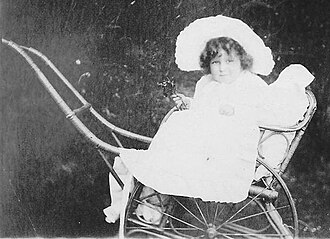
Innovation accelerated through the F.A. Whitney Carriage Company, where Jesse Armour Crandall introduced critical safety and convenience features, including brakes, folding models, and parasols. By 1840, these carriages became status symbols; Queen Victoria herself owned three from the Hitchings Baby Store. Early models were crafted from wood or wicker with expensive brass joints, often named after royalty, such as the "Princess," "Duchess," "Balmoral," and "Windsor."
Engineering Breakthroughs
A major leap in maneuverability occurred in June 1889, when William H. Richardson patented the first reversible stroller. His design allowed the bassinet to face either the parent or the world. More importantly, he redesigned the axle to allow wheels to move independently, significantly increasing the ease of steering. By the 1920s, prams became accessible to the general public, featuring sturdier frames, deeper bodies, and larger wheels for improved safety.
The Rise of the Modern Stroller
The modern era of lightweight transport began in 1965. Owen Maclaren, an aeronautical engineer, sought to solve the problem of heavy prams during international travel. Applying aviation principles, he developed a stroller with an aluminum frame, creating the first "umbrella stroller." This invention made transport significantly easier and led to the global popularity of the compact stroller.
Comparing Prams, Strollers, and Buggies
Terminology varies by region and design. In the UK, the term pushchair was dominant until the 1980s, when the more compact buggy became the trend. In the USA, stroller is the standard term, while "buggy" often refers to a quad bike.
Prams and Carrycots
Prams, or perambulators, are larger, heavier vehicles used primarily for infants. Over time, suspension was added to ensure a smoother ride. In the 1970s, the carrycot—a detachable baby carrier—became popular in the UK, allowing for a more modular approach to infant transport.
Strollers and Specialized Designs
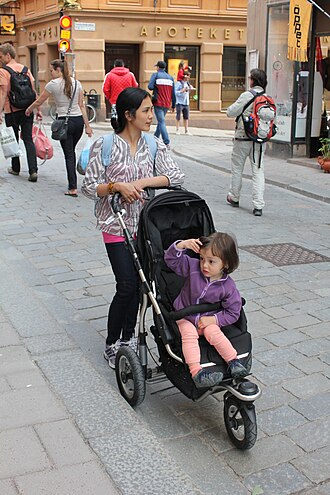
Strollers are designed for children up to approximately three years old. Modern versions are highly versatile, often allowing a child to transition from a lying position to a forward-facing seat. For larger families, twin and triple pushchairs are available; triple buggies typically support a weight limit of 50 kg and are recommended for children up to age four.
Innovation continues with hybrid designs. In 2005, Valentin Vodev developed the "Roller Buggy," which transforms into a kick scooter capable of reaching speeds of 15 km/h (10 mph). This concept was later explored by the manufacturer Quinny in 2012.
Modern Travel Systems and Safety
The contemporary travel system is a comprehensive set featuring a chassis with a detachable baby seat and/or carrycot. This allows parents to switch seamlessly between a pram and a pushchair. A key advantage is the integration with the infant car seat; the seat can snap into a base inside a vehicle, allowing parents to move a sleeping baby without waking them.
| Type | Primary User | Position | Key Characteristic |
|---|---|---|---|
| Pram | Newborns | Lying down | Large, heavy, parent-facing |
| Stroller / Buggy | Up to 3 years | Sitting up | Compact, forward-facing |
| Travel System | Newborn to Toddler | Variable | Modular chassis with car seat |
| Roller Buggy | Toddlers | Sitting up | Transforms into a kick scooter |
Frequently Asked Questions
What is the difference between a pram and a stroller?
A pram is designed for newborns to lie flat and usually faces the pusher, while a stroller is designed for older infants and toddlers (up to age three) to sit up and face forward.
Who invented the umbrella stroller?
The umbrella stroller was invented in 1965 by Owen Maclaren, an aeronautical engineer who used aluminum to create a lightweight, collapsible frame.
What is a travel system?
A travel system is a modular set consisting of a chassis that can accommodate a detachable carrycot, a pushchair seat, and a car seat, allowing for easy transitions between walking and driving.
What was the first reversible stroller?
The first reversible stroller was patented in June 1889 by William H. Richardson, which allowed the bassinet to face either the parent or the direction of travel.
Are there strollers for more than two children?
Yes, triple pushchairs are available to accommodate multiple births, typically supporting children up to age four with a total weight limit of around 50 kg.