Western Hunter-Gatherers: The Genetic Foundations of Ancient Europe
The genetic landscape of modern Europe is a complex mosaic, shaped by waves of migration, environmental shifts, and the gradual blending of distinct ancestral groups. Among the most critical of these is the Western Hunter-Gatherers (WHG), a population that represents a major demographic shift at the end of the last Ice Age. Together with Early European Farmers (EEF) and Western Steppe Herders (WSH), the WHG form the primary ancestral pillars of most contemporary Europeans.
Understanding the WHG is not merely a study of ancient remains, but a journey into how humans recolonized a frozen continent and interacted with the first agriculturalists to bring about the Neolithic Revolution.
![A map of Europe showing the Last Glacial Maximum refugia, c. 20,000 years ago Solutrean culture Epigravettian culture[3]](/images/77/a3/77a389d896e825dcc3ca96d3153b60c5f4ecce6ce77c824bc19523d16e9ada95.png)
Key Facts
- Ancestral Role: WHGs are one of the three primary ancestral components of modern Europeans.
- Timeline: They expanded into continental Europe following the Last Glacial Maximum, with significant presence from roughly 17,000 years ago.
- Genetic Markers: Primarily associated with Y-chromosome haplogroup I-M170 and mitochondrial haplogroup U5.
- Cultural Links: Closely associated with the Epigravettian archaeological culture.
- Interaction: They experienced prolonged interbreeding with Early European Farmers (EEF) during the Neolithic period.
Origins and the Expansion into Europe
The WHG represent a population expansion into continental Europe from refugia—survivable pockets of land—located in Southeastern Europe or West Asia. Genetic evidence suggests their ancestors diverged from eastern Eurasians approximately 40,000 years before present (BP) and from Ancient North Eurasians (ANE) by roughly 38,000 years ago.
A critical genetic grouping within this population is the Villabruna cluster. Research indicates this group may have diverged from hunter-gatherers in the Middle East and the Caucasus around 26,000 years ago during the Last Glacial Maximum. This connection is evidenced by a higher genetic affinity for Middle Eastern populations compared to earlier Paleolithic groups like the Gravettians.
![The transition from Magdalenian Goyet ancestry (green , Goyet Q2) to Western Hunter Gatherer (WHG) Villabruna ancestry (orange ) in European sites, according to timeline and climate evolution.[20]](/images/a9/4d/a94d85bb5c5085e8327d628d0cccb5d6c75a6e003f10857c632b480622ee77a4.jpg)
The Oberkassel Cluster and Regional Diversity
While the Villabruna cluster is prominent in Italy (dating to 17,000 BP), populations north of the Alps are often referred to as the Oberkassel cluster. These individuals are modeled as a mixture of Villabruna ancestry (roughly 75-90%) and ancestry from the Goyet-Q2 or Fournol clusters (10-25%), which are linked to earlier Solutrean and western Gravettian groups.
In the Iberian Peninsula, the transition was more gradual. Rather than a single replacement, there were repeated admixture events between incoming WHG lineages and local populations, resulting in higher genetic continuity in southwest Europe.
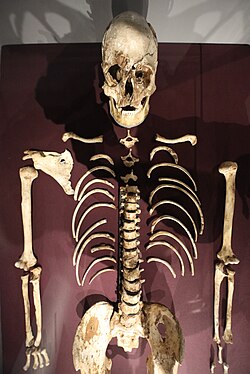
Genetic Markers and Lineages
The paternal and maternal lineages of the WHG provide a roadmap of their movements. The majority of WHG males belonged to Y-chromosome haplogroup I-M170. Some also carried haplogroup C-F3393 (specifically C-V20/C1a2), a lineage still found today in some men in Spain. Additionally, the Villabruna cluster carried haplogroup R1b-L754, suggesting an early link to the western edge of the Eurasian Steppe Belt.
Maternally, the WHG were dominated by mitochondrial haplogroup U5. In some regions, such as the Dnieper Rapids in Ukraine, maternal haplogroup U was found in nearly all samples, highlighting a strong genetic consistency over thousands of years.
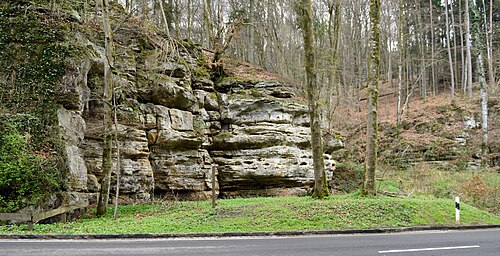
Interactions with Other Ancient Populations
The WHG did not exist in isolation. They interacted with several other prehistoric groups:
- Eastern Hunter-Gatherers (EHG): A distinct group that mixed with WHG to form Scandinavian Hunter-Gatherers (SHG).
- Scandinavian Hunter-Gatherers (SHG): A hybrid population where WHG migrated from the south (associated with the Ahrensburg culture) and EHG migrated from the northeast.
- Early Anatolian Farmers: WHG contributed ancestry to the first farmers in Anatolia and Ancient Northwestern Africans.
Interestingly, the WHG and EHG populations generally had lower frequencies of genes associated with depigmentation (SLC45A2 and SLC24A5) and light eye color (OCA/Herc2) compared to the later SHG populations.
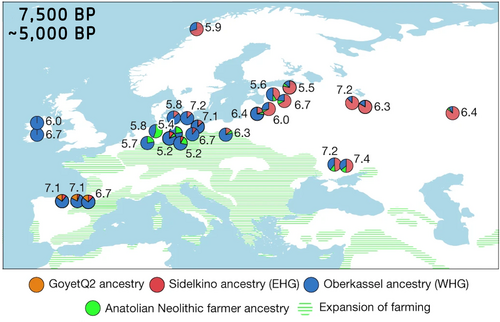
The Neolithic Transition and Replacement
The arrival of the Early European Farmers (EEF)—agriculturists primarily of Anatolian descent—around 8,000 BP triggered a massive demographic shift. In many parts of Europe, the EEF began to dominate the gene pool, replacing the hunter-gatherer lifestyle with agriculture.
However, this was not always an abrupt replacement. In Central Europe and Iberia, there was a prolonged period of interbreeding. By the late Neolithic, WHG ancestry in farming populations varied by region: roughly 10% in Hungary, 25% in Germany, and as high as 50% in Iberia.
![A simplified model for the demographic history of Europeans during the Neolithic period and the Neolithic Revolution which introduced agriculture.[31]](/images/5f/47/5f479884170943b530eb2f9780ada34882d6845204c4de33eb20343157794938.jpg)
In contrast, the transition in the British Isles and Denmark was more abrupt. In Denmark, the transition from the Maglemose, Kongemose, and Ertebølle cultures to the Funnelbeaker culture involved a population turnover with limited genetic contribution from the local hunter-gatherers.
| Group | Primary Origin | Key Genetic Markers | Primary Impact |
|---|---|---|---|
| WHG | Southeastern Europe / West Asia | Y-Haplogroup I, mtDNA U5 | Post-Ice Age recolonization of Europe |
| EEF | Anatolia (Near East) | G2a2 (common) | Introduction of agriculture (Neolithic) |
| EHG | Eastern Europe / Siberia | ANE-related ancestry | Contribution to Northern and Eastern Europeans |
| WSH | Pontic-Caspian Steppe | R1b / R1a | Late Neolithic/Bronze Age expansions |
Frequently Asked Questions
Who were the Western Hunter-Gatherers?
Western Hunter-Gatherers (WHG) were a population of prehistoric humans who expanded into continental Europe after the Last Glacial Maximum. They are one of the three main ancestral groups that contribute to the genetic makeup of modern Europeans.
How did WHG differ from Early European Farmers?
WHGs were nomadic hunter-gatherers indigenous to the post-glacial European landscape, while Early European Farmers (EEF) were migrants from Anatolia who introduced agriculture and sedentary living to Europe around 8,000 years ago.
What is the Villabruna cluster?
The Villabruna cluster is a specific genetic grouping within the WHG, first identified in Italy. They are thought to have diverged from Middle Eastern and Caucasus hunter-gatherers approximately 26,000 years ago.
Did the WHG disappear completely during the Neolithic?
No. While they were largely replaced by farmers in some areas, they interbred extensively with the EEF. This genetic legacy persists today, with higher proportions of WHG ancestry found in Northern Europeans and Basque populations.
Which Y-DNA haplogroups are most associated with WHG?
The most prominent paternal lineage among WHGs was haplogroup I-M170, though some groups also carried haplogroups C-F3393 and R1b-L754.