Western American Art: The Legacies of Charles M. Russell and Frederic Remington
The American Old West remains one of the most evocative eras in history, characterized by vast landscapes, rugged individualism, and the clash of cultures. While many remember this period through folklore, two artists—Charles Marion Russell and Frederic Remington—captured its essence through paint and bronze. Though they both focused on the frontier, their perspectives differed based on their unique relationships with the land and its people.
Charles Marion Russell: The Cowboy Artist
Known affectionately as "Kid Russell," Charles Marion Russell (1864–1926) was more than just an observer of the West; he lived it. Born in St. Louis, Missouri, Russell was the third of six children and displayed a natural artistic talent from a young age. Driven by the spirit of western expansion and the famous "Go West young man" slogan of Horace Greeley, Russell moved to Montana at age sixteen to work as a cowboy.
This firsthand experience provided Russell with an unparalleled advantage. While he was largely self-taught and unschooled in formal art, his intimate knowledge of ranch life allowed him to record the frontier with authentic detail. During his time as a cowboy, he was often viewed more as a storyteller and artist than a traditional ranch hand.
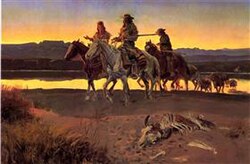
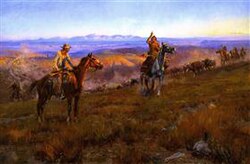
Russell produced over 2,000 paintings and various bronze sculptures. His work is particularly noted for its documentary precision and its empathetic portrayal of indigenous people, often representing the views of Native Americans rather than those of non-native settlers. He remained devoted to the traditions of the Old West, seeking to preserve its memory before it was fully absorbed by "white civilization."
One of his earliest significant works, "The Judith Roundup" (circa 1885), drew from his experiences in the Judith Basin. Another iconic piece, "The Toll Collectors" (1913), was inspired by a memory from decades earlier when cattle herds were stopped by Piegan and Crow warriors who demanded a traditional toll for crossing the Crow reservation.
Frederic Remington: The Master of Drama
While Russell lived the cowboy life, Frederic Sackrider Remington (1861–1909) approached the West with the eye of a dramatic illustrator. Born in Canton, New York, Remington received early training at a military school and later attended Yale University, though he left the university following the death of his father. At nineteen, he made his first trip to Montana, sparking a career that would produce over 3,000 paintings in less than 30 years.
Remington's work is characterized by narrativization—the use of painting to tell a specific story or report a scene. He focused on the tension, conflict, and high-impact action of the frontier, specifically the "hard riding and hard fighting" of cowboys and Indians at the end of the 19th century. Unlike Russell, who often emphasized the landscape and cultural nuance, Remington frequently prioritized the figures and animals to maximize the emotional impact of the scene.
Critics of the era praised Remington for his complex compositions and modern style, recognizing him as one of the most successful Western illustrators of his time. However, some noted that his relative lack of confidence with color occasionally limited the scope of his artistic development.
Key Facts
- Charles M. Russell was a self-taught artist and former cowboy who created over 2,000 works.
- Frederic Remington was a formally trained artist who produced over 3,000 works in under 30 years.
- Russell is distinguished by his focus on the indigenous perspective and documentary accuracy.
- Remington is known for his dramatic compositions and focus on action and conflict.
- Both artists spent significant time in Montana to capture the essence of the American West.
Comparison of Western Masters
| Feature | Charles M. Russell | Frederic Remington |
|---|---|---|
| Background | Self-taught; former cowboy | Military school; Yale University |
| Output | 2,000+ paintings & bronzes | 3,000+ paintings |
| Primary Focus | Daily life, indigenous views, authenticity | Drama, conflict, high-action narratives |
| Key Strength | Documentary precision | Complex composition |
| Lifespan | 1864–1926 | 1861–1909 |
Frequently Asked Questions
What made Charles M. Russell's art unique?
Russell's art was unique because he was a former cowboy. This lived experience allowed him to act as a documentary artist, capturing the authentic daily life of the West and providing a rare perspective that included the views of indigenous people.
How did Frederic Remington's style differ from Russell's?
Remington focused more on drama, tension, and the "maximum impact" of action. His work tended toward narrativization, focusing on the conflict and hard riding of the frontier rather than the quiet documentary details Russell favored.
What was the inspiration behind "The Toll Collectors"?
The painting was inspired by an event where beef cattle herds were stopped by Piegan and Crow warriors on the Crow reservation, who required the white settlers to pay a traditional toll for passage.
Did Frederic Remington have formal art training?
Yes, Remington took his first painting lessons at a military school and later attended art school at Yale University before leaving to pursue his career in the West.
How many works did these artists produce?
Charles M. Russell created more than 2,000 paintings, while Frederic Remington produced over 3,000 paintings during his artistic life.