WDSU Channel 6: A Legacy of Broadcasting in New Orleans
WDSU Channel 6 stands as a cornerstone of media in the Gulf South. As the first television station to sign on in Louisiana, New Orleans, and the entire Deep South, it has spent over seven decades documenting the triumphs and tragedies of the Crescent City. From its early days as a multi-network pioneer to its current role as a primary NBC affiliate, WDSU has remained a vital source of news and information for the region.
Key Facts
- First Air Date: December 18, 1948.
- Affiliation: Primary NBC affiliate.
- Ownership: Hearst Television.
- Historical Milestone: First TV station in Louisiana and the Deep South.
- Current Facility: Howard Avenue, New Orleans.
- Digital Channel: 19 (Virtual Channel 6).
The Early Years and Founding
WDSU was founded by businessman Edgar B. Stern Jr., who acquired the construction permit after purchasing WDSU radio for $750,000. The station's call sign is rooted in its radio origins: the "D" stood for the DeSoto Hotel, the "S" for the New Orleans States newspaper, and the "U" for Joseph Uhalt, the radio station's founder.
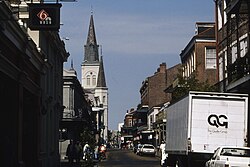
Initially, WDSU operated out of the Hibernia Bank Building, which was the tallest structure in New Orleans at the time. In April 1950, the station moved to the historic Brulatour Mansion on Royal Street in the French Quarter, where Stern established production studios as part of the Royal Street Corporation.
In its infancy, WDSU was a versatile broadcaster. While it maintained a primary relationship with NBC, it also carried programming from CBS, ABC, and the DuMont Television Network. By September 1957, following the launch of other local stations, WDSU became exclusively affiliated with NBC.
Evolution of Ownership and Technology
The station underwent several ownership changes that shaped its identity. In 1972, the Royal Street Corporation merged with Cosmos Broadcasting in a $17 million deal. Cosmos shifted the station's focus toward its news operation, which had already been recognized as a pioneer in the field. In 1989, Pulitzer, Inc. purchased the station for $47 million, eventually dropping the "-TV" suffix from the call sign in 1993.
Technological milestones have defined WDSU's growth. In 1955, it originated the first international broadcast by relaying a Today show segment from Bimini. In 1986, it became the first NBC affiliate in Louisiana to broadcast in stereo. By the 1990s, it introduced the "Super Doppler 6000," the first Doppler weather radar system operated by a New Orleans station.
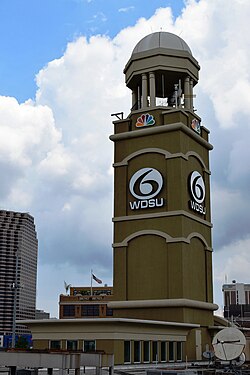
In 1999, Pulitzer sold its television division to Hearst-Argyle Television (now Hearst Television) for $1.8 billion. The station later moved to its current Howard Avenue facility in March 1996.
Resilience Through Natural Disasters
WDSU's commitment to public service was most evident during the region's greatest crises. During Hurricane Katrina in 2005, the station's studios survived with minimal damage, but its transmitters were destroyed. To keep the public informed, WDSU partnered with WPXL-TV and KPXB-TV in Houston to maintain its signal and simulcast morning news.
The station rebuilt its transmitter facility to be hurricane-resistant, completing the project in February 2008. Similarly, during Hurricane Gustav in 2008, WDSU provided five consecutive days of continuous coverage. This effort was so critical that DirecTV simulcast the coverage nationally on channel 361, and the audio was carried across several local radio stations.
News Operations and Programming
WDSU currently produces 38 hours of local news weekly. The news department has a storied history, featuring pioneers like meteorologist Nash Roberts and news director Bill Monroe. The station also gained fame for its editorial cartoons by John Churchill Chase during the 1950s and 60s.
While the station has faced stiff competition from rivals like WWL-TV and WVUE, it has seen significant demographic wins in the 5 p.m. and 6 p.m. time slots. In terms of production, WDSU transitioned to 16:9 widescreen standard definition in 2010.
Station Technical Summary
| Feature | Detail |
|---|---|
| Digital Channel | 19 (UHF) |
| Virtual Channel | 6 |
| Effective Radiated Power (ERP) | 925 kW |
| HAAT | 288.4 m (946 ft) |
| Primary Affiliation | NBC (6.1) |
| Subchannels | MeTV (6.2), 365BLK (6.3), Story Television (6.4), QVC (6.6) |
Frequently Asked Questions
What is the meaning behind the WDSU call sign?
The call sign is derived from the station's radio roots: "D" for the DeSoto Hotel, "S" for the New Orleans States newspaper, and "U" for Joseph Uhalt, the founder of the original radio station.
How did WDSU handle the loss of its transmitters during Hurricane Katrina?
WDSU arranged to transmit its signal via WPXL-TV and partnered with KPXB-TV in Houston to simulcast news. They eventually built a new, elevated, hurricane-resistant transmitter building completed in 2008.
Who owns WDSU today?
WDSU is owned by Hearst Television (specifically New Orleans Hearst Television Inc.).
Was WDSU the first television station in the region?
Yes, WDSU was the first television station to sign on in the state of Louisiana, the city of New Orleans, the Gulf Coast, and the Deep South.
What other programming is available on WDSU's digital subchannels?
In addition to NBC on 6.1, WDSU broadcasts MeTV on 6.2, 365BLK on 6.3, Story Television on 6.4, and QVC on 6.6.