Warsaw University of Technology: A History of Engineering Excellence
The evolution of technical universities in Poland followed a distinct path compared to the traditional Humboldtian model of higher education. While the Humboldtian approach emphasized institutional autonomy to shield universities from corporate and external interference, technical institutions were intentionally designed to be closer to industry. This alignment was a direct response to rapid economic growth and the surging demand for highly trained engineering specialists.
Key Facts
- Founded: The first multidisciplinary technical school opened on January 4, 1826.
- Key Figure: Stanisław Staszic was instrumental in creating the school and writing its charter.
- Resilience: The university continued to operate underground during World War II.
- Growth: Student enrollment grew from 2,148 in 1945 to 22,000 by 1999.
- Global Standing: Ranked 14th in the QS Emerging Europe and Central Asia rankings (2022).
The Early Foundations (1826–1831)
Polish technical education has roots stretching back to the 18th century, primarily focused on mining and military technology. The need for complex technological processes, such as exploiting deeper coal seams, drove this early development. The broader European trend was influenced by the French Ecole polytechnique, founded in Paris in 1794, which served as a model for similar institutions in Prague (1806), Vienna (1815), and Karlsruhe (1824).
In Poland, this movement culminated in the opening of the Preparatory School for the Institute of Technology on January 4, 1826. This institution, the precursor to the modern Warsaw University of Technology, was shaped largely by Stanisław Staszic and led by mathematician Kajetan Garbiński. However, this early chapter ended abruptly when the school was closed in 1831 following the November Insurrection.
Re-establishment and Imperial Influence (1898–1914)
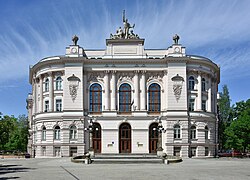
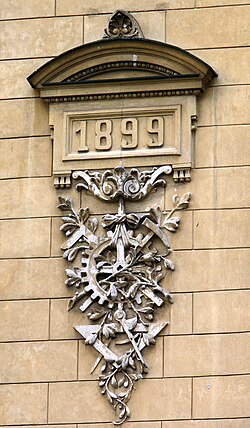
Technical education returned to Warsaw in 1898 through the efforts of the Technological Section of the Warsaw Society for Russian Commerce and Industry. Under the direction of engineer Kazimierz Obrębowicz, funds were raised to establish the Emperor Nicolas II University of Technology. Initially, the university operated with Russian as the primary language of instruction, starting at 81 Marszałkowska Street before moving to purpose-built facilities designed by Stefan Szyller and Bronisław Rogóyski.
At its inception, the university featured three faculties: Chemistry, Mathematics, and Engineering and Construction. The Faculty of Mining was added in June 1902. Despite the imperial administration, Polish students formed the majority of the student body, reaching 1,100 by 1905.
Independence and Interwar Growth (1915–1939)
A pivotal shift occurred on August 5, 1915, when German troops entering Warsaw allowed the university to reopen with Polish as the language of instruction to gain local sympathy. The official grand opening took place on November 15, 1915, with Zygmunt Straszewicz serving as the first rector. While the Polish-Bolshevik war and the restoration of the Polish State hindered early progress, regular lectures finally stabilized in November 1920.
The university expanded its academic scope to include Mechanics, Electrical Engineering, Chemistry, Architecture, Civil Engineering, Aquatic Engineering, and Geodesy (the latter added in 1925). By 1933, several faculties were merged to form the Faculty of Engineering under a new Academic Schools Law.
The interwar period saw a dramatic increase in prestige and scale. Student numbers rose from 2,540 in the 1918/1919 academic year to 4,673 by the start of World War II. During this time, the university granted over 6,200 diplomas, including 320 to women. It became a global hub for scientific research, hosting luminaries such as Jan Czochralski, Stefan Bryła, and Karol Adamiecki.
Resistance and Underground Education (1939–1945)
World War II brought severe repression and material loss, but the university refused to cease operations. It transitioned to a clandestine system, offering secret courses in vocational schools and, from 1942, through a two-year State Higher Technical School. Approximately 3,000 students participated in these underground studies, resulting in 198 engineering diplomas and 20 PhDs.
Beyond teaching, the university engaged in critical intelligence work. Professors Józef Zawadzki, Marceli Struszyński, and Janusz Groszkowski conducted secret analyses of German V-2 rocket steering and radio devices for the Polish Home Army Intelligence, while other faculty members focused on post-war reconstruction plans.
Modern Era and Global Standing (1945–Present)
Classes resumed in improvised conditions on January 22, 1945, shortly after the liberation of Warsaw. The university quickly rebuilt its damaged infrastructure and reopened all pre-war faculties. In 1951, it incorporated the Wawelberg and Rotwand School of Engineering, and later established the Academic and Research Centre in Płock in 1967.
The growth in the post-war era was exponential. By 1999, the university had expanded to 16 faculties with 22,000 students. Between 1945 and 1998, it awarded over 104,000 Bachelor and Master of Science degrees and saw 5,500 PhD theses completed.
Today, the Warsaw University of Technology is recognized globally for its research and academic rigor, as reflected in various international rankings.
| Ranking Body | Category/Year | Position |
|---|---|---|
| QS World | Overall (2026) | =487 |
| CWTS World | Overall (2022) | 598 |
| ARWU World | Overall (2020) | 801–900 |
| THE World | Overall (2020) | 1001+ |
| QS Emerging Europe & Central Asia | Regional (2022) | 14 |
Frequently Asked Questions
Who was the key figure in the founding of the university?
Stanisław Staszic played the most significant role in creating the school and drafting its original charter.
How did the university operate during World War II?
The university operated underground through clandestine courses and vocational schools, where approximately 3,000 students continued their education in secret.
What was the significance of the 1915 reopening?
In 1915, German forces allowed the university to reopen with Polish as the language of instruction, marking a shift away from the previous Russian-language mandate.
How has the student population changed over time?
The university has seen massive growth, moving from 2,148 students in 1945 to 22,000 students across 16 faculties by 1999.
What role did the university play in military intelligence?
During WWII, professors Janusz Groszkowski, Marceli Struszyński, and Józef Zawadzki analyzed German V-2 rocket radio and steering devices for the Polish Home Army Intelligence.