Warehouse Management Systems: Optimizing Modern Distribution and Inventory Control
In the fast-paced world of logistics, a Warehouse Management System (WMS) serves as the operational backbone of a distribution center. At its core, a WMS is a set of policies and processes designed to organize warehouse work, ensuring facilities operate efficiently to meet their strategic objectives. The primary function of this software is to record the arrival and departure of inventory, providing a digital paper trail for every item that enters or leaves the building.
Modern WMS solutions go far beyond simple record-keeping. They offer advanced capabilities such as tracking the precise location of stock, optimizing available storage space, and coordinating complex tasks to maximize labor and equipment efficiency. While smaller facilities might still rely on spreadsheets or manual pen-and-paper methods, contemporary industry standards overwhelmingly favor sophisticated computer systems.
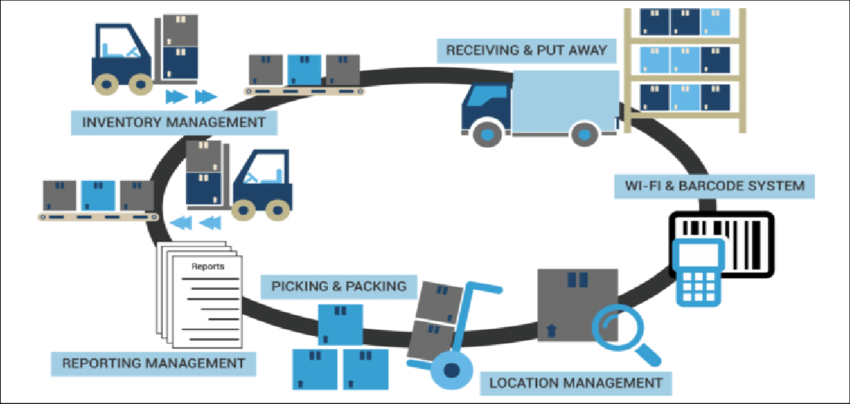
Key Facts
- Core Function: Recording the arrival and departure of inventory and managing precise stock locations.
- Market Growth: The global WMS market is projected to grow from US$2.8 billion in 2021 to $6.1 billion by 2026.
- Deployment Trends: There is a significant industry shift from local, perpetual license installations to cloud-based subscription models (SaaS).
- Complexity Levels: Systems range from basic inventory tracking to fully autonomous AI-driven operations.
- Integration: Advanced systems can connect with IoT devices, GPS tracking, and ERP platforms.
Levels of WMS Complexity
Not all warehouse management software is created equal. Academic research classifies these systems into four distinct levels of complexity, ranging from simple tracking to independent decision-making.
Basic WMS
A basic system focuses on inventory management and location control. Its primary performance metric is "throughput"—the volume of stock moving through the warehouse during a specific period. At this level, the software is often nearly identical to a standard Inventory Management System.
Advanced WMS
An advanced WMS moves beyond tracking to analysis. It can evaluate capacity, monitor stock levels, and track the time and labor spent on specific activities. This allows managers to measure efficiency and identify areas for improvement. Most WMS solutions currently in use outside of East Asia fall into this category.
Controlled WMS
A controlled system is characterized by its ability to exchange data with external entities. By using API integrations (Application Programming Interfaces), it can ingest real-time data from manufacturing schedules, customer orders, or transportation providers. For example, it can receive live updates from truck GPS units to plan inbound arrivals. These systems may also integrate with Internet of Things (IoT) devices and use machine learning to simulate operational strategies.
Autonomous WMS
The pinnacle of warehouse technology is the autonomous WMS. These systems utilize artificial intelligence (AI) and predictive analytics to optimize operations with minimal human intervention. They can independently adjust labor allocation, equipment usage, and delivery schedules. An autonomous system might integrate with robotic picking systems, autonomous mobile robots (AMRs), and digital twins (virtual models of the physical warehouse) to ensure maximum resilience and efficiency.
Installation and Licensing Models
Historically, companies purchased WMS software through perpetual licenses, installing the software on their own on-premises servers. While these local installations offer permanent rights to the software, they often require additional costs for updates and technical support.
Today, the industry is moving toward cloud-based deployment. This shift has been driven by the rise of cross-border e-commerce, which requires the ability to manage inventory across multiple international locations. Cloud-based models, often delivered as Software-as-a-Service (SaaS), require much lower initial capital investment, making advanced inventory capabilities accessible to small and medium enterprises (SMEs).
By 2025, marketplace platforms are expected to control 65% of B2B e-commerce transaction value, with many offering cloud-based WMS as standard infrastructure. Platforms like Alibaba demonstrate this by providing millions of SMEs with real-time inventory monitoring and automated task coordination, helping them navigate the complexities of international customs and multi-country distribution.
| Software Type | Primary Focus | Key Characteristic |
|---|---|---|
| WMS | Warehouse operations | Optimizes movement and storage within the facility. |
| Inventory Management | Stock levels | Focuses on material costs and reorder points. |
| ERP Module | Financial/Transactional | Connects warehouse data to accounting and commercial logic. |
| SCMS | Supply Chain integration | Combines warehouse and transportation management. |
| WCS/WES | Equipment control | Manages automated hardware like conveyors and robotics. |
| YMS | Yard management | Tracks vehicles, trailers, and dock appointments. |
Challenges and Limitations
Despite their benefits, WMS implementations face several hurdles. Many systems are built upon legacy code—older programming languages used in previous decades—which can make the software inflexible and difficult to maintain. Customizing these systems to fit specific business needs can be prohibitively expensive, sometimes requiring a full re-implementation.
Furthermore, there is often a tension between the system's capabilities and the warehouse's desired operational flow. If a system is too rigid, it may force compromises that negatively impact performance. Additionally, while WMS excels at internal movement, many systems still struggle with receiving operations, which can account for roughly 17% of total warehouse operating costs due to bottlenecks in communication with external carriers and suppliers.
Frequently Asked Questions
What is the difference between a WMS and Inventory Management Software?
Inventory Management Software primarily focuses on tracking stock levels and analyzing costs or reorder points. A WMS is more specialized, focusing on the efficient physical movement, storage, and task coordination of that stock within a warehouse environment.
How does a cloud-based WMS help with international e-commerce?
Cloud-based systems provide a centralized view of inventory across multiple countries. They use algorithms to automate customs documentation and optimize routing, allowing smaller businesses to manage complex, geographically dispersed supply chains that were previously only accessible to large corporations.
What is a Warehouse Execution System (WES)?
A WES is an evolving category of software that sits between a WMS and a Warehouse Control System (WCS). It integrates advanced control of automated equipment with the high-level management capabilities of a WMS, blurring the lines between operational planning and machine execution.
Can a WMS be part of another software package?
Yes. A WMS can be a standalone product, or it can exist as a specific module within a larger Enterprise Resource Planning (ERP) system or a Supply Chain Management System (SCMS).
What is Warehouse Optimization Software (WOS)?
WOS acts as a decision-support layer that works alongside a WMS. It is used to provide specialized intelligence to improve specific decisions regarding storage, picking, and packing processes.