Waltham Abbey: A Journey Through Ancient History and Industrial Innovation
From the echoes of prehistoric settlements to the thunder of industrial explosives, Waltham Abbey stands as a testament to the layered history of Essex. This town has evolved from a sacred site of early Christian worship into a powerhouse of military innovation, all while maintaining a deep connection to the English monarchy and the natural landscape of the River Lea.
Ancient Roots and Early Settlements
The area surrounding Waltham Abbey has been inhabited since prehistoric times. Evidence of Roman settlement is prominent, with Ermine Street located just 5 km to the west. Historians believe the causeway crossing the River Lea from Waltham Cross in Hertfordshire may also be a Roman construction. Local folklore adds a dramatic layer to this era, claiming that the rebellion of Boudica against Roman rule ended here, where she is said to have taken her own life using hemlock gathered from the banks of Cobbins Brook.
Christianity established a foothold here early on. Archaeological excavations beneath the choir of the current building have revealed flint rubble foundations of a wooden church dating back to the 7th century. Radiocarbon dating of an associated burial places it between 590 and 690 AD. This timeline suggests the church may have been built during the reign of Sæberht of Essex, a king known for his church-building efforts. Other significant finds from this period include a Kentish jewellery book-clasp featuring eagles grasping a fish.
The Rise of the Abbey and Royal Patronage
The town's recorded history gained momentum in the early 11th century during the reign of King Canute. His standard-bearer, Tovi (or Tofig) the Proud, founded or rebuilt a church to house a miraculous cross discovered at Montacute in Somerset—the relic that gave Waltham its name. Following Tovi's death around 1045, the site reverted to King Edward the Confessor, who then granted it to Earl Harold Godwinson.
Around 1060, Harold rebuilt the church in stone, reportedly as an act of gratitude for being cured of paralysis after praying before the miraculous cross.
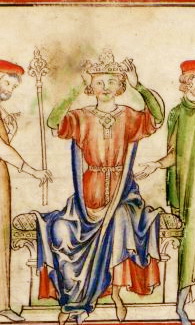
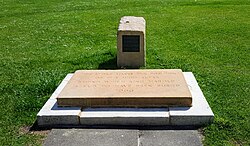
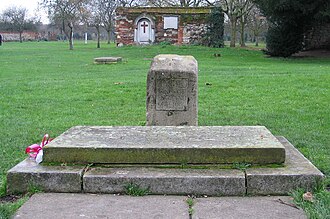
The Abbey served as the parish church for the local population, who paid their tithes and worked the glebe (land assigned to the support of a parish priest) and other manorial lands. Following the Battle of Hastings in 1066, legend states that the body of King Harold was brought back to Waltham for burial near the High Altar.
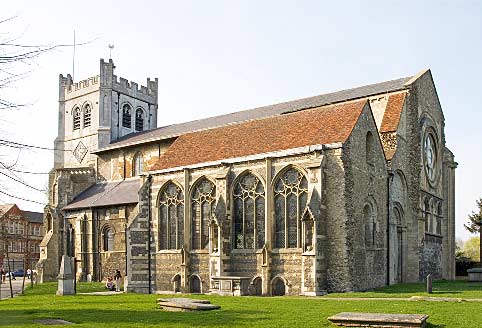
In 1177, King Henry II refounded the church as a priory of Augustinian Canons Regular—a group of priests living in a community—as penance for his role in the murder of Thomas Becket. By 1184, it was expanded into a full abbey with an abbot and twenty-four canons, eventually becoming the wealthiest monastery in Essex.
The town's commercial growth followed the Abbey's success. In 1189, Richard the Lionheart granted a charter for regular markets and fairs. This tradition survives today, with the market still operating every Tuesday and Saturday in the town square.
Medieval Guilds and Tudor Influence
During the medieval and early Tudor eras, the parish was supported by two guilds: the Brotherhood of Our Lady (established by at least 1375) and the Charnel Guild (referred to as 'the Sepulchre' in 1366). These organizations provided endowments for priests and utilized different parts of the church, including the Lady Chapel and the crypt.
The Abbey also attracted royalty. King Henry VIII was a frequent visitor and is believed to have kept a lodge at Romeland. In 1532, Henry and Queen Anne Boleyn spent five days at the Abbey during their summer progress.
The Reformation and Industrial Transition
The dissolution of the monasteries in 1540 marked a turning point for the town. Waltham Abbey was the last working monastery to be dissolved, and its partial demolition led to a period of local decline. However, the 17th century brought new opportunities. A gunpowder factory was established, leveraging the marshlands of the River Lea and efficient river transport.
By the 18th and 19th centuries, the town diversified. A fulling mill (used for cleaning and thickening cloth) operated at Sewardstone around 1777, and a pin factory appeared by 1805. Silk and calico printing also became vital industries, supported by the 1769 opening of a new canal across the marshes to improve the River Lee Navigation.
The Royal Gunpowder Mills and Modern Era
In 1787, the government purchased the gunpowder factory, expanding it into the Waltham Abbey Royal Gunpowder Mills. This site became a hub for chemical innovation. In 1863, Frederick Abel developed guncotton, a more powerful propellant, followed by the production of cordite in 1891.
The facility's strategic importance made it a target during World War II. On March 7, 1945, a German V-2 rocket struck Highbridge Street, causing significant loss of life and property damage. The factory closed in 1943, transitioning into an explosives research establishment.
In the 20th century, the landscape shifted toward agriculture and recreation. The area was once dominated by market gardens and glass-houses. Additionally, gravel extraction in the Lea Valley created numerous pits that now serve as wildlife habitats and recreational spaces. The town saw significant population growth in the 1960s and 1970s through center redevelopment and the creation of housing estates like Roundhills and Ninefields.
Key Facts
- Royal Connection: Rebuilt in stone by Harold Godwinson around 1060 and visited by Henry VIII.
- Religious Significance: Home to a 7th-century church and later the richest monastery in Essex.
- Industrial Legacy: Site of the Royal Gunpowder Mills, where guncotton and cordite were developed.
- Ancient History: Evidence of Roman settlement and legends of Boudica's final moments.
- Modern Trade: A market chartered by Richard the Lionheart in 1189 still operates today.
| Period | Key Development | Significant Figure/Event |
|---|---|---|
| Prehistoric/Roman | Early settlement and causeways | Boudica's rebellion legend |
| 7th Century | First wooden church | Sæberht of Essex |
| 11th Century | Stone church and miraculous cross | Harold Godwinson |
| 12th Century | Refounded as Augustinian Abbey | Henry II |
| 16th Century | Dissolution of the Abbey | Henry VIII (1540) |
| 18th-19th Century | Industrialization | Royal Gunpowder Mills |
| 20th Century | Research and Urban Growth | V-2 rocket strike (1945) |
Frequently Asked Questions
Who was buried at Waltham Abbey?
According to legend, King Harold Godwinson was brought to Waltham for burial near the High Altar after his death at the Battle of Hastings in 1066. This site is currently marked by a stone slab in the churchyard.
What was the significance of the Royal Gunpowder Mills?
The mills were a center for propellant explosives research. Notable achievements include the development of guncotton by Frederick Abel in 1863 and the production of cordite starting in 1891.
Why was the Abbey refounded by Henry II?
Henry II refounded the church as a priory of Augustinian Canons Regular in 1177 as an act of penance for his involvement in the murder of Thomas Becket, the Archbishop of Canterbury.
How did the town's economy change after the Abbey's dissolution?
After the Abbey was dissolved in 1540, the town experienced a decline. It eventually recovered by pivoting toward industry, specifically gunpowder production, silk, calico printing, and agriculture.
What is the origin of the name Waltham?
The town's name is associated with a miraculous cross discovered at Montacute in Somerset, which was housed in the church founded or rebuilt by Tovi the Proud in the early 11th century.