Voussoirs: The Engineering and Artistry of Arch Construction
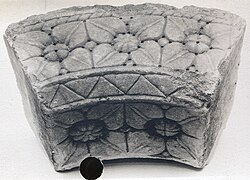
At the heart of some of the world's most enduring structures lies a simple yet brilliant geometric solution: the voussoir. A voussoir is a wedge-shaped element, typically carved from stone, used to construct an arch or a vault. By utilizing a series of these tapered blocks, architects can span wide openings and support immense weight, relying on the physics of compression rather than the tensile strength of a single beam.
The magic of the voussoir lies in its shape. Because each block is wider at the top than at the bottom, they cannot fall through the opening they create. Instead, they lean against one another, distributing the downward force of gravity into a lateral thrust that is transferred across the curve of the arch.
Key Facts
- Definition: A wedge-shaped masonry unit used to build arches and vaults.
- Structural Role: Transfers the weight of the structure from the top center down to the vertical supports.
- Critical Components: Includes the springer (the lowest block) and the keystone (the central apex block).
- Terminology: The outer curve of the voussoir is the extrados, while the inner curve is the intrados (or soffit).
- Specialized Types: Joggled voussoirs act like puzzle pieces to increase stability and earthquake resistance.
The Anatomy of an Arch
While every wedge in an arch is technically a voussoir, two specific positions hold unique functional importance: the springer and the keystone.
The Springer
The springer is the lowest voussoir on each side of the arch. It is located exactly where the curve "springs" from the vertical support, such as a wall, pier, or abutment. Because the springer must handle the transition from vertical support to curved arch, it requires precise shaping to control the direction of thrust and ensure the weight is transferred successfully to the foundations.
The Keystone
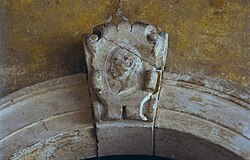
The keystone is the central masonry unit at the apex of the arch. It is the final piece placed during construction and serves to lock all other voussoirs into place. Without the keystone, the arch would collapse inward.
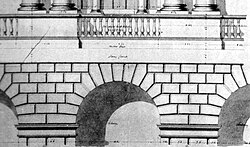
Beyond its structural necessity, the keystone is often a focal point for artistry. In 16th-century Mannerism—a late Renaissance style—architects like Giulio Romano began using enlarged or slightly dropped keystones to create a sense of stability and visual drama. Romano also pioneered the use of voussoirs above rectangular openings, replacing the traditional flat lintel.
Specialized Techniques and Cultural Variations
Depending on the architectural goal, voussoirs can be cut and arranged in various ways to create round, pointed, horseshoe, or multifoil arches.
Joggled Voussoirs
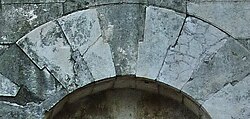
Originally developed in Roman architecture to strengthen structures, joggled voussoirs are carved with interlocking shapes, similar to puzzle pieces. This technique was later adopted and refined by Islamic architects. By allowing the blocks to lock together while maintaining a slight ability to sway, joggled arches could better withstand the movements of earthquakes and return to their original positions.
Ablaq and Decorative Masonry
In Moorish, Visigothic, and Damascene traditions, architects often employed ablaq—the use of alternating colored stones. This technique, also seen in some Romanesque architecture, began during the Umayyad period. While initially driven by the available materials (such as alternating red brick and white stone), ablaq became a signature of Islamic art and a symbol associated with 'Abd al-Rahman I and his followers.
Structural Summary
| Term | Location | Primary Function |
|---|---|---|
| Springer | Base of the curve | Transfers thrust to the abutment/pier |
| Keystone | Apex (Center) | Locks the structure in place |
| Extrados | Outer boundary | Forms the exterior curve of the arch |
| Intrados | Inner boundary | Forms the interior curve (soffit) |
| Joggled | Throughout the arch | Interlocking for seismic stability |
Frequently Asked Questions
What is the difference between a voussoir and a keystone?
A voussoir is any of the wedge-shaped stones that make up an arch. The keystone is a specific voussoir located at the very top center that locks all the other stones into place.
How do voussoirs support weight?
They turn the downward thrust of the mass above them aside, transferring the weight from stone to stone until it reaches the springer and is passed into the buttresses, piers, or abutments.
What are joggled voussoirs?
Joggled voussoirs are stones cut into interlocking, puzzle-like shapes. This design increases the strength of the arch and allows it to better absorb the shocks of earthquakes.
What is ablaq architecture?
Ablaq is an architectural style characterized by alternating rows of light and dark colored stone, frequently seen in Islamic and Umayyad traditions for both decorative and material reasons.
What is the purpose of the springer in an arch?
The springer is the lowest stone of the arch; its primary purpose is to control the direction of the structural thrust and ensure it is transferred correctly to the vertical supports below.