Volleyball Skills: Mastering the Six Core Techniques of the Game
Competitive volleyball is a game of precision, power, and timing. To succeed at a high level, teams must master six fundamental skills: serving, passing, setting, attacking, blocking, and digging. While the basics are straightforward, each skill encompasses a variety of specialized techniques that allow professional athletes to manipulate the ball's trajectory and outmaneuver their opponents.
Key Facts
- Six Core Skills: Serve, pass, set, attack, block, and dig.
- The Ace: A serve that lands directly in the opponent's court or cannot be volleyed.
- The Kill: An attack that is not returned, resulting in an immediate point.
- The Roof: A powerful offensive block that sends the ball straight down to the attacker's floor.
- The Pancake: A defensive move where a player slides their hand flat on the floor to save a ball.
The Serve: Starting the Play
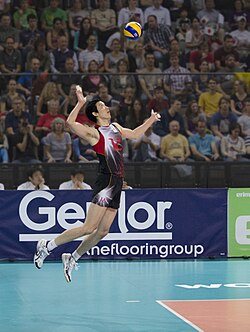
The serve is the only time a player has total control over the ball. Standing behind the end line, the server aims to drive the ball into the opponent's court. Beyond simply getting the ball over the net, players manipulate speed, direction, and acceleration to make the reception difficult for the opposing team.
Modern volleyball utilizes several serving styles:
- Underhand: The ball is struck below the waist. While common for beginners, it is rarely used in high-level play.
- Sky Ball: A high-arcing underhand serve used primarily in beach volleyball. Though considered outdated, it saw a resurgence during the 2016 Rio Olympics via player Adrian Carambula. In Brazil, it is known as Jornada nas Estrelas (Star Trek).
- Topspin: An overhand serve where a wrist snap creates forward rotation, causing the ball to drop faster and fly straighter.
- Float: An overhand serve hit without spin, creating an unpredictable, "knuckleball" flight path.
- Jump Serve: The gold standard for professional teams, involving a high toss, a timed approach, and a jump to hit the ball with maximum pace and topspin.
- Jump Float: A hybrid serve where the player jumps before hitting a float serve, combining unpredictability with increased power.
Passing: The First Line of Defense
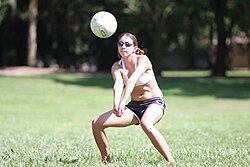
Passing, or reception, is the act of handling an opponent's serve or attack. The goal is to prevent the ball from hitting the floor and deliver it precisely to the setter.
There are two primary passing techniques:
- Underarm Pass (Bump): The ball is contacted using the "platform" created by the inside of the joined forearms at waist level.
- Overhand Pass: The ball is handled with the fingertips above the head. While legal in most formats, beach volleyball has stricter regulations regarding this technique.
Setting: Orchestrating the Offense
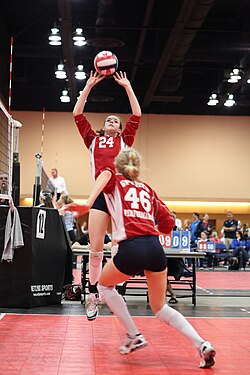
The set is typically the second contact. The setter acts as the team's playmaker, positioning the ball in the air so an attacker can drive it into the opponent's court. Setters may use an overhand set for maximum control or a bump set if the ball is too low.
Advanced setting variations include:
- Front and Back Sets: Depending on whether the ball is pushed in the direction the setter is facing or behind them.
- Jump Set: Used when the ball is close to the net; the setter jumps (usually off the right foot) to avoid net contact.
- The Dump: A strategic move where the setter, if in the front row, plays the ball directly into the opponent's court instead of setting a teammate.
Precision is critical; if a setter touches the ball with one hand noticeably later than the other, the referee may call a double hit, awarding the point to the opponent.
Attacking: Scoring the Point
The attack, or spike, is usually the third contact. The hitter uses a specific approach, jumps, and swings their arm at the apex of the jump to drive the ball downward. A bounce refers to a spike so hard it follows a steep trajectory and bounces high off the floor, while a kill is any attack that results in a point.
Common attacking techniques include:
- Backcourt Attack: Performed by a back-row player jumping from behind the 3-meter line. A Pipe Attack specifically involves the center back-row player.
- Line and Cross-court Shots: The ball is hit either parallel to the sidelines or at an angle. A cut shot is a cross-court hit with a sharp angle.
- Soft Hits: These include the tip, dink, or cheat (lightly touching the ball into an open space) and the off-speed hit (reducing pace to confuse defenders).
- Tooling: Also known as a wipe or block-abuse, where the hitter intentionally hits the ball off the blocker's hands and out of bounds.
- Quick Hits: A fast attack (often by the middle blocker) where the jump begins before the setter even contacts the ball. Variations include the Slide (using a low backset) and the Double Quick/Stack (two hitters jumping simultaneously to deceive blockers).
Blocking: Stopping the Attack
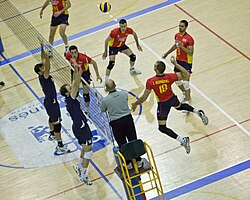
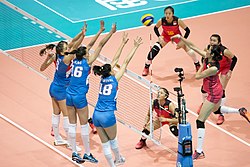
Blocking occurs at the net to stop or redirect an opponent's spike. An offensive block aims to send the ball directly back into the opponent's court, often resulting in a roof. A defensive (soft) block aims to deflect the ball upward to slow it down for the team's defenders.
Blocks are categorized by the number of players involved: single (solo), double, or triple blocks. Even if the ball isn't touched, a successful block can force an attacker to hit a less powerful shot, making it easier for the defense to manage.
Digging: The Art of the Save
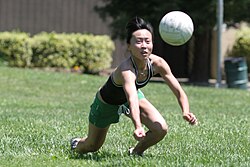
Digging is a reflex-based skill used to prevent a spiked ball from touching the ground. While similar to passing, digging often requires more extreme movements. Players often use a split step to remain agile and ready to move in any direction.
Specialized digging techniques include:
- Dive: Throwing the body forward to save a ball and landing on the chest.
- Pancake: Sliding a hand flat on the floor so the ball bounces off the back of the hand. This is common in indoor volleyball but rare in beach volleyball due to the sand.
- Roll: A technique used when dropping quickly to the floor to minimize injury while saving the ball.
| Skill | Primary Goal | Key Technique/Term | Typical Contact Order |
|---|---|---|---|
| Serve | Start play / Score ace | Jump Serve, Float Serve | 1st (Opponent) |
| Pass | Control serve/attack | Bump, Overhand Pass | 1st |
| Set | Position ball for attack | Jump Set, Dump | 2nd |
| Attack | Score a kill | Spike, Quick Hit, Tool | 3rd |
| Block | Stop opponent's attack | Roof, Soft Block | Defensive |
| Dig | Prevent ball from landing | Pancake, Dive | Defensive |
Frequently Asked Questions
What is the difference between a pass and a dig?
While both involve preventing the ball from hitting the floor, passing (reception) is generally the first contact used to handle a serve and deliver it to the setter. Digging is a more reflex-driven defensive action used to save a hard-driven spike or attack.
What constitutes a "double hit" in setting?
A double hit occurs when a player, particularly the setter, does not touch the ball with both hands simultaneously. If one hand is noticeably late, the referee may call a foul and award the point to the opposing team.
What is a "pancake" and why is it rare in beach volleyball?
A pancake is a defensive move where a player slides their hand flat on the court surface to save a ball just before it touches the ground. It is rare in beach volleyball because the uneven, yielding nature of the sand prevents the ball from making the clean contact required for the move to work.
How does a "roof" differ from a "soft block"?
A roof is an offensive block that redirects the ball's power straight down into the attacker's court for an immediate point. A soft block is a defensive maneuver where the player deflects the ball upward to slow it down, allowing their teammates to dig and continue the play.
What is a "pipe attack"?
A pipe attack is a specific type of back-row attack where the center player in the back row jumps from behind the 3-meter line to spike the ball.