Vladimir Zworykin: The Engineering Pioneer of Electronic Television
Vladimir Kosma Zworykin was a Russian-American inventor and engineer whose work fundamentally transformed how the world consumes visual information. As a pioneer of electronic television, Zworykin developed the critical components necessary to move the medium from mechanical experiments to a practical, electronic reality. His innovations in cathode-ray tubes (vacuum tubes that emit a beam of electrons to produce an image) laid the groundwork for decades of broadcasting technology.
Key Facts
- Primary Inventions: Developed the Iconoscope (transmitter) and the Kinescope (receiver).
- Core Technology: Pioneered the use of cathode-ray tubes for both transmitting and receiving television signals.
- Major Affiliations: Worked with Westinghouse and later the RCA (Radio Corporation of America) laboratories.
- Scientific Range: Beyond television, he contributed to the development of the electron microscope and infrared image tubes.
- Legacy: Recipient of the National Medal of Science and the IEEE Edison Medal.
Early Life and Academic Foundations
Born in Murom, Russia, around 1888 or 1889, Zworykin grew up in a prosperous merchant family. His journey into electrical engineering began at the St. Petersburg Institute of Technology, where he studied under Boris Rosing. In Rosing's private laboratory, Zworykin was introduced to "electrical telescopy," a conceptual precursor to television.
Rosing had already made secret strides in the field, filing a patent in 1907 for a system using a mechanical transmitter and a cathode-ray tube receiver. This collaboration sparked Zworykin's lifelong fascination with the transmission of images via electricity.
After graduating in 1912, Zworykin expanded his expertise by studying X-rays under Professor Paul Langevin in Paris. His early career was interrupted by World War I, during which he served in the Russian Signal Corps testing radio equipment. Amidst the turmoil of the Russian Civil War, Zworykin emigrated to the United States in 1918, eventually settling there permanently.
The Path to Electronic Television
Upon arriving in the U.S., Zworykin joined the Westinghouse laboratories in Pittsburgh. It was here that he began his formal pursuit of a fully electronic television system. In 1923, he filed his first U.S. patent applications for "Television Systems," proposing the use of cathode-ray tubes for both the transmitter and receiver.
![Drawing from Zworykin's 1923 patent application Television System.[11][12]](/images/d6/55/d655f7384777106aa9188eab12690ed19c911965f5fbb30aa0a05c786b22beb3.jpg)
Despite his vision, early demonstrations did not immediately impress Westinghouse management, who urged him to focus on more "practical" projects. Undeterred, Zworykin continued his research, earning a PhD from the University of Pittsburgh in 1926 through his work on photoelectric cells.
The Kinescope and the Move to RCA
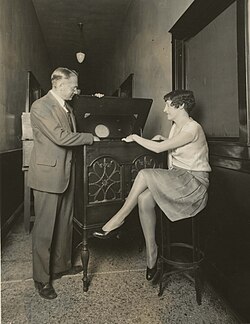
In 1929, Zworykin achieved a significant milestone by introducing the kinescope, an improved cathode-ray receiving tube. This breakthrough led to his move to the RCA Camden laboratories in 1930, where he had the resources to tackle the more difficult challenge of the transmitter.
The Iconoscope Breakthrough
The real "breakthrough" occurred in 1931. Drawing on the principle of charge storage—where charges accumulate between scans of the electron beam—Zworykin developed a new camera tube. On October 23, 1931, this device was named the iconoscope.
![Vladimir Zworykin's patent diagram of an iconoscope, 1931,[27] with an apparatus similar to the camera part.[11][12]](/images/4d/ba/4dba2398181ac510d0035c25d9e438cdb01652e48e8ce40dde3d89d82dc8a98b.png)
The iconoscope allowed for far greater sensitivity and image quality than previous mechanical systems. By 1934, a collaboration with Telefunken resulted in the "image iconoscope," which was utilized by the Reichspost in Germany for public broadcasts using a 180-line system.
Legal Battles and Global Impact
Zworykin's success was shadowed by a protracted legal battle with another inventor, Philo Farnsworth. RCA filed suit claiming Zworykin's 1923 patents gave him priority. However, the U.S. Patent Office ruled in 1934 that Farnsworth held priority for the invention of the image dissector. While litigation continued for years, RCA eventually paid royalties to Farnsworth.
Beyond the courtroom, Zworykin's work had profound implications for national security. His research into cathode-ray tubes and wideband circuits contributed to the development of radio-location, later known as radar. This technology is credited by some historians as a decisive factor in the Allied victory during the Battle of Britain.
Summary of Contributions and Honors
| Category | Details |
|---|---|
| Key Inventions | Iconoscope, Kinescope, Photomultiplier |
| Scientific Fields | Television, Electron Microscopy, Medical Electronics |
| Major Awards | National Medal of Science (1966), IEEE Edison Medal (1952), IRE Medal of Honor (1951) |
| Education | St. Petersburg Institute of Technology, University of Pittsburgh (PhD) |
Later Life and Legacy
Zworykin retired from RCA in 1954, having served as the company's honorary vice president. In his later years, he shifted his focus toward the application of engineering to medicine, founding the International Federation for Medical Electronics and Biological Engineering.
He passed away on July 29, 1982, in Princeton, New Jersey, at the age of 92 to 94. His legacy persists not only in the history of broadcasting but in the very foundation of modern electronic imaging.
Frequently Asked Questions
What is the difference between the Iconoscope and the Kinescope?
The Iconoscope was the transmitter (the camera tube that captured the image), while the Kinescope was the receiver (the tube that displayed the image on a screen).
Did Vladimir Zworykin invent television alone?
No. Television was the result of cumulative efforts. Zworykin built upon the work of Boris Rosing and Kálmán Tihanyi, and he famously engaged in a priority dispute with Philo Farnsworth over the invention of the electronic camera tube.
How did Zworykin's work contribute to World War II?
The development of cathode-ray tubes, VHF transmission, and wideband circuits for television provided the technical foundation for the creation of radar, which was critical for air defense during the war.
What was the "charge storage" principle?
Charge storage is the process where the camera tube accumulates and stores electrical charges during the interval between the scans of the electron beam, significantly increasing the sensitivity and brightness of the captured image.
What other scientific contributions did he make besides TV?
Zworykin contributed to the development of the electron microscope and infrared image tubes, and he was a pioneer in applying electronic engineering to the field of medicine.