Vireos: The Green Songbirds of the New World and Asia
Vireos are a diverse family of small to medium-sized passerine (perching) birds known for their greenish plumage and persistent songs. Belonging to the family Vireonidae, these birds are primarily found across the New World—ranging from Canada to Argentina, including the West Indies and Bermuda—though some related species also inhabit Southeast Asia. The name "vireo" is derived from Latin, referring to a green migratory bird.
Physically, vireos are often characterized by dull, greenish tones. While smaller species may resemble wood warblers, they are distinguished by their heavier bills. Their size varies significantly across the family: the Chocó vireo, dwarf vireo, and lesser greenlet are among the smallest at approximately 10 cm and 8g, while peppershrikes and shrike-vireos can reach up to 17 cm and 40g.
Key Facts
- Family: Vireonidae, containing 62 species across eight genera.
- Distribution: Primarily Middle and Northern South America, with 13 species in North America and some in Southeast Asia.
- Diet: Omnivorous, consuming insects, arthropods, and fruit.
- Habitat: Forest environments, including canopies, undergrowth, and mangrove swamps.
- Behavior: Most are territorial; many North American species are migratory.
Distribution and Habitat
The highest concentration of vireo species is found in Middle America and northern South America. In the north, thirteen species of "true vireos" inhabit the United States, Canada, and Bermuda. With the exception of Hutton's vireo, all of these northern species are migratory. Outside of these migration patterns, members of the family rarely fly long distances.
Vireos are forest specialists. Depending on the species, they may occupy the high forest canopy, the dense undergrowth, or specialized environments like mangrove swamps. Occasionally, a few species from the genus Vireo have been spotted as vagrants on the eastern side of the Atlantic in the Western Palearctic region.
Behavior and Vocalization
Resident vireos typically live in pairs or family groups and maintain their territories year-round. Migratory species also defend winter territories, though some—such as the red-eyed, yellow-green, black-whiskered, and Yucatan vireos—winter in small, wandering flocks.
Vocalizations are a hallmark of the family. Males are often persistent singers. While some species in the Caribbean islands have simple or monotonous songs, others, such as the peppershrikes and the Chocó vireo, produce more elaborate and melodic phrases.
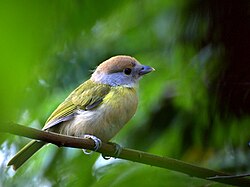
Breeding and Diet
While the breeding habits of many tropical species remain unknown, known species build cup-shaped nests that hang from tree branches. In most cases, the female handles the majority of the incubation, with the male providing support, except in the red-eyed vireo complex.
Vireos have a varied diet consisting mostly of insects and other arthropods, which they glean from leaves and branches. All species incorporate some fruit into their diet. True vireos are also known to flycatch, and the gray vireo occasionally hunts on the ground, which accounts for about 5 percent of its prey.
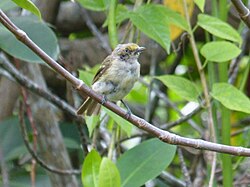
Systematics and Classification
The family Vireonidae is part of the superfamily Corvoidea, making them relatives of shrikes (Laniidae) and crow-like birds (Corvidae). The family is currently divided into eight genera. Historically, the family was thought to consist only of four New World genera: Vireo (true vireos), Hylophilus (greenlets), Vireolanius (shrike-vireos), and Cyclarhis (peppershrikes).
Modern phylogenetic and biochemical studies have refined this classification. The genus Hylophilus was found to be polyphyletic (not sharing a single common ancestor), leading to the creation or resurrection of the genera Pachysylvia and Tunchiornis. Furthermore, two Asian genera, Pteruthius and Erpornis, have been identified as members of the family, though some taxonomists still place them in their own separate families (Pteruthidae and Erpornidae).
| Genus | Common Name/Group | Region |
|---|---|---|
| Vireo | True Vireos | Americas |
| Cyclarhis | Peppershrikes | Americas |
| Vireolanius | Shrike-vireos | Americas |
| Hylophilus, Pachysylvia, Tunchiornis | Greenlets | Americas |
| Pteruthius, Erpornis | Shrike-babblers / Erpornis | Southeast Asia |
Frequently Asked Questions
What is the difference between a vireo and a wood warbler?
While smaller vireos look similar to wood warblers, vireos generally have heavier, stronger bills and different singing patterns.
Where are vireos found geographically?
They are primarily found in the New World, from Canada through the West Indies and Bermuda down to Argentina, with some related species located in Southeast Asia.
Do all vireos migrate?
No. While many species in North America are migratory, resident species in other regions maintain territories year-round. Even among North American species, Hutton's vireo is a notable non-migrant.
What do vireos eat?
Vireos are primarily insectivores, eating insects and arthropods found on branches and leaves, though all species also eat some fruit.
How are vireos related to other birds?
They belong to the superfamily Corvoidea, which means they are distantly related to crows (Corvidae) and shrikes (Laniidae).